How to Analyze YouTube Content Performance
A practical method for finding comparable competitor outliers, designing original packaging tests, and reading owned click-through and retention results.

Founder, Task Machine
YouTube content intelligence combines two different evidence sets. Public competitor data can show which videos performed unusually well within a comparable channel cohort and what packaging those videos used. Owned-channel analytics can show whether an original title, thumbnail, hook, and video held the channel's own audience after publication.
The first set is research. The second is decision evidence. Keeping them separate prevents a competitor's public view count from being treated as proof that a package will work for another audience.
Simple outlier math hides mismatched comparisons
A simple "views divided by channel average" calculation hides several mismatches. Shorts and long-form videos behave differently. A two-day-old upload and an eighteen-month-old catalog hit have had different opportunities to accumulate views. Live streams, collaborations, trend spikes, paid distribution, embeds, languages, topics, and channel eras can all change the comparison.
The average itself is fragile. One viral upload can raise a channel mean enough to hide other meaningful outliers. A median within a comparable channel, format, age, topic, language, and duration cohort is usually a more stable research baseline, provided the sample is large enough.
Public statistics also stop at the surface. Views do not reveal impressions, click-through, retention, watch time, subscriber gain, or revenue. A public outlier can suggest a title or thumbnail question worth testing, but it cannot answer whether packaging caused the result.
What the manual process looks like
A careful monthly research and readback loop has twelve steps:
- Define competitor channels, lookback, minimum video age, formats, languages, topics, duration bands, exclusions, and the outlier threshold.
- Snapshot stable channel and video ids, publication and retrieval times, titles, visible thumbnails, durations, public views, and available channel context.
- Separate Shorts from long-form, live from edited uploads, and materially different topic, language, length, and maturity cohorts.
- Calculate each candidate against the predeclared comparable median or other approved baseline.
- Preserve raw views, baseline, sample size, video age, ratio, ordinary comparison videos, and data limitations.
- Review outliers beside non-outliers for recurring title, thumbnail, topic, promise, specificity, proof, and opening-hook patterns.
- Record counterexamples and alternative explanations such as distribution, collaborations, embeds, paid support, trend timing, topic demand, and external events.
- Translate supported observations into original hypotheses for the owned audience rather than copying a creator's title, thumbnail, script, likeness, or distinctive expression.
- Before publication, record the exact title, thumbnail asset version, hook, retention devices, proof, CTA, owned baseline, traffic assumptions, fixed windows, primary retention outcome, business signals, and guardrails.
- Have another person reproduce the public cohort, outlier math, pattern evidence, originality boundaries, and test plan.
- After a human publishes, wait for each complete window and reconcile the immutable video id and package versions with YouTube Studio evidence.
- Separate packaging, retention, downstream, and guardrail results before approving a bounded learning.
The research narrows what to test. Only the owned result supports a decision for the channel.
What an agent can automate
An analyst and reviewer can handle the recurring evidence work:
- Build comparable public cohorts. The analyst resolves stable ids, snapshots public evidence with retrieval times, applies exclusions, and separates format, language, topic, duration, age, and maturity groups.
- Calculate reproducible outliers. Each ratio retains its raw numerator, named baseline, sample size, age, threshold, and caveats. Below-threshold videos remain available for comparison.
- Extract packaging observations. Outliers and ordinary videos are reviewed together for title structure, thumbnail composition, topic framing, visible proof, specificity, promise, and the opening when publicly inspected.
- Preserve counterevidence. Patterns that also appear in ordinary videos, channels that do not fit, and alternative distribution or topic explanations remain beside the finding.
- Prepare original tests. A competitor observation becomes a new owned-audience hypothesis with brand, proof, claims, and copying boundaries.
- Freeze the measurement plan. Exact package versions, comparable owned baseline, traffic assumptions, windows, primary retention measure, business signals, guardrails, sources, and owner feedback are recorded before publication.
- Read back owned analytics. The second workflow waits for complete due windows and retrieves packaging, retention, downstream, guardrail, and traffic-source evidence.
- Reproduce material math. The reviewer independently checks public cohorts, medians, outlier ratios, patterns, originality, package plans, analytics filters, and result comparisons.
The agents do not publish, schedule, edit, remove, republish, or reproduce a video, and they do not change channel guidance automatically.
The guardrails that make it safe
Competitor analysis uses public pages and stable citations. Every snapshot has a retrieval time because view counts, titles, thumbnails, and availability can change. Historical reviews are not silently refreshed.
Originality is a hard boundary. The workflow can identify an abstract pattern such as a concrete time promise, a before-and-after contrast, or one visible proof element. It cannot copy exact titles, thumbnail composition as distinctive expression, scripts, creator likeness, trademarks, or branding.
The test approval records a plan only. A human publishes and later records the immutable video id, final publication time, and any title, thumbnail, hook, edit, distribution, or amplification change. The readback approval records a bounded reuse, keep testing, retire, or unproven decision. It does not edit a live package.
Set it up in Task Machine
The YouTube content research playbook provides a starting point for the method above. You need an active Task Machine workspace with Chat, workspace-management and Playbook-installation access (workspace owners have it). Public channel research uses supplied URLs or handles. Owned readbacks use attached YouTube Studio exports or screenshots.
1. Find the playbook
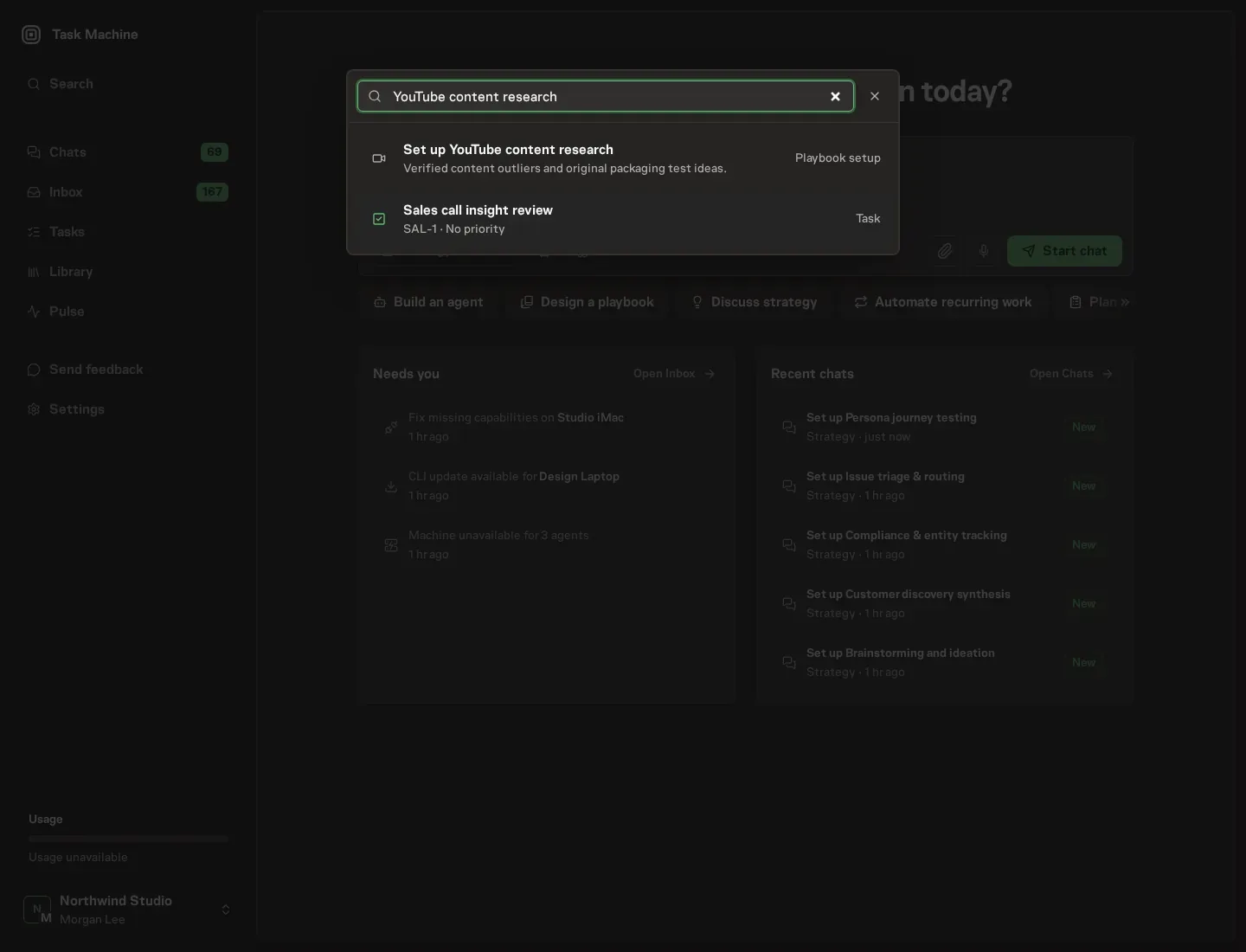
Open Search in your workspace and enter "YouTube content research". The command center lists Set up YouTube content research under Playbook setup.
2. Start the conversation
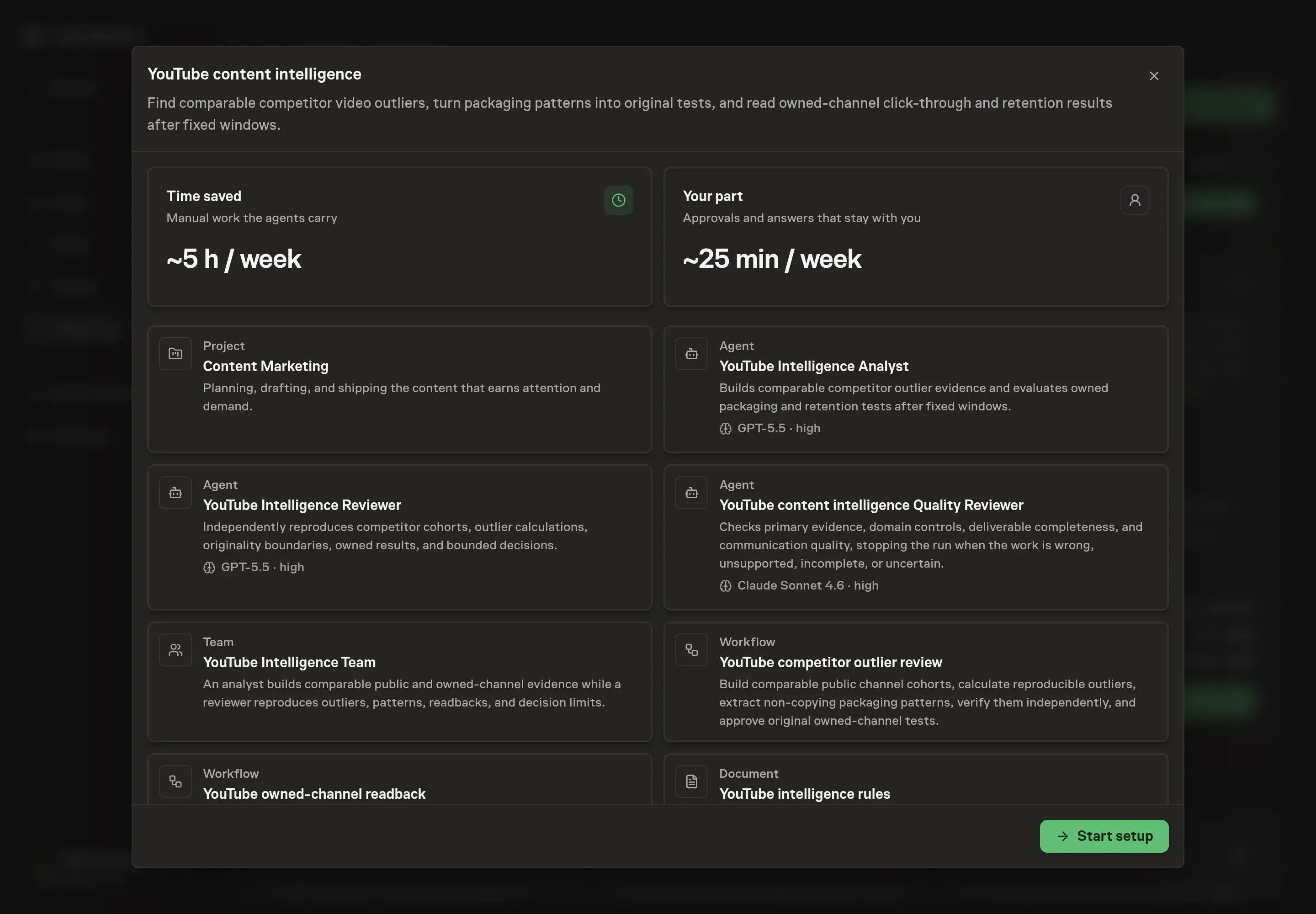
Choose Set up YouTube content research. Task Machine opens a dedicated Chat with the Playbook card and an editable, unsent request. Read the intended job and outcome. Add your situation and send it when ready. Opening the draft does not install anything or start work. This walkthrough uses settings that require approval of the proposed Playbook.
3. Agree the working brief
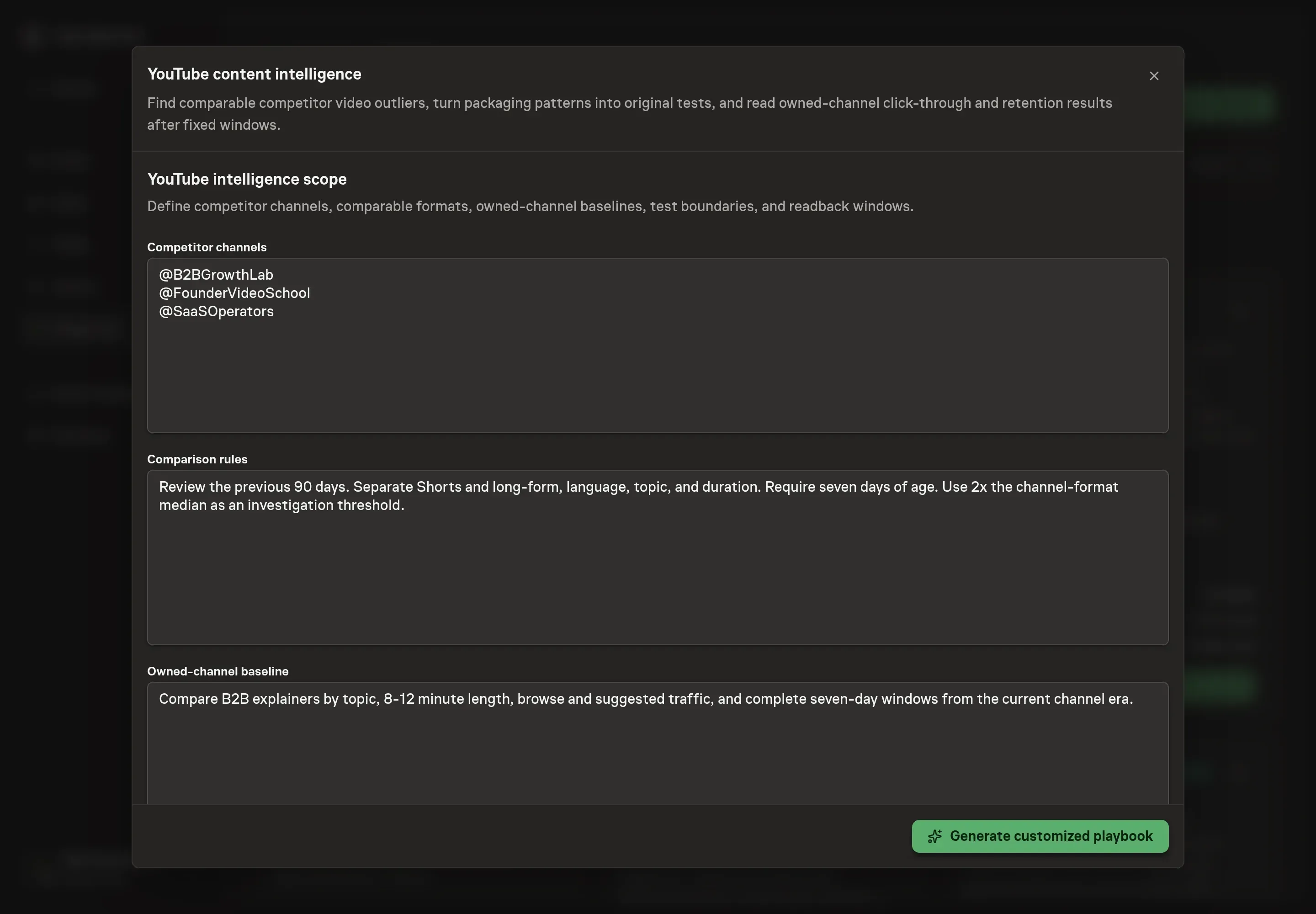
Use Chat to agree the inputs, expected output and limits before asking for a proposal. Discuss the competitor channels, comparison rules, owned-channel baseline, packaging and originality boundaries, and result windows. A useful starting contract separates Shorts and long-form, uses mature videos from a fixed lookback, compares within topic and duration bands, and treats 2x the channel-format median as an investigation threshold rather than a universal quality score.
4. Review the proposed Playbook
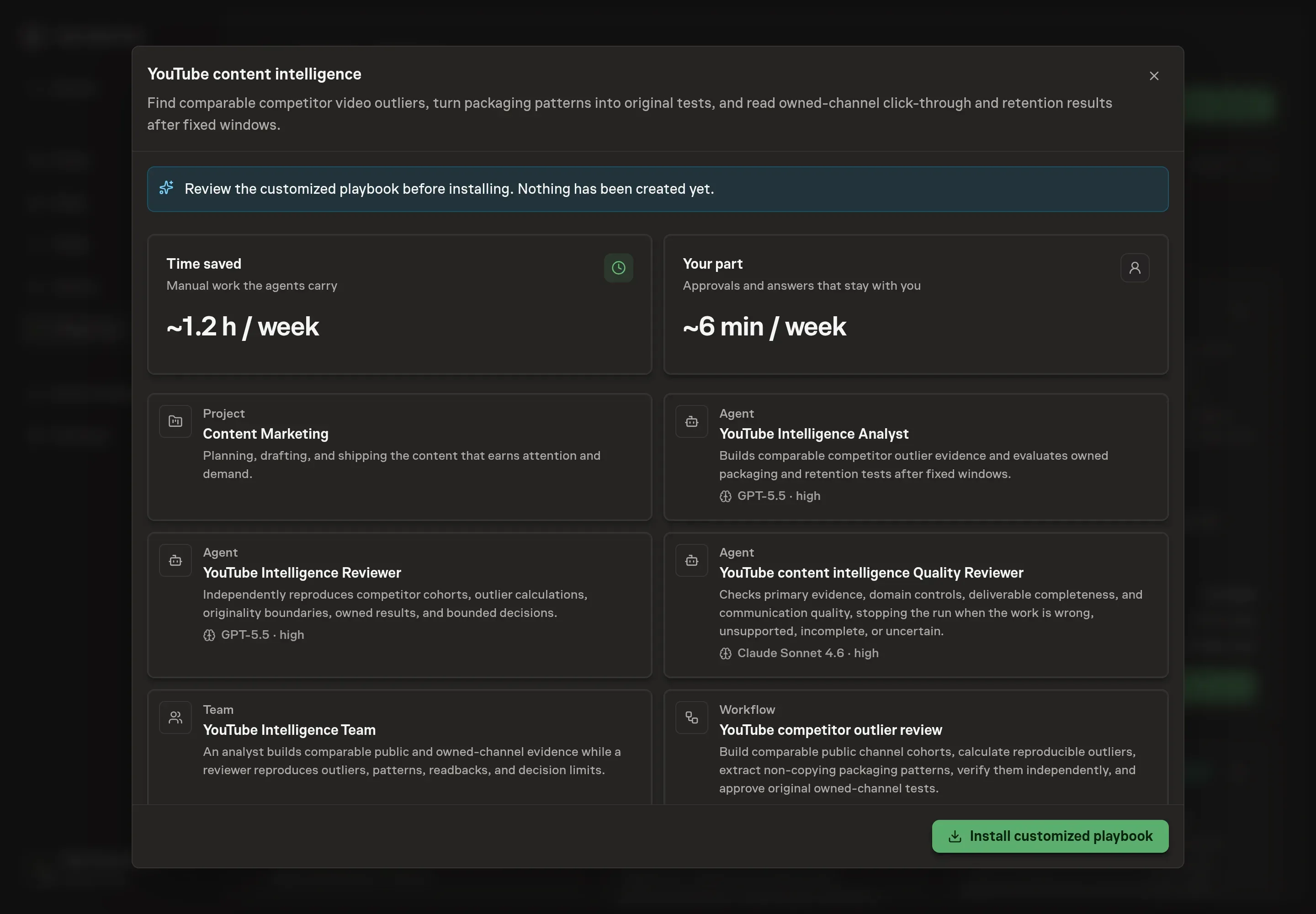
Ask the Agent to generate the Playbook from the agreed brief. Open its proposal in Chat and check the instructions and resources it will install, which carry more detail than the conversational summary. Confirm public snapshots retain video age, baseline sample, ratio, and retrieval time. Patterns preserve ordinary comparisons and alternative explanations. Package tests are original. Owned readbacks separate click-through from retention. Ask for a revised proposal if anything is missing or changes the job.
5. Approve and prepare the first work
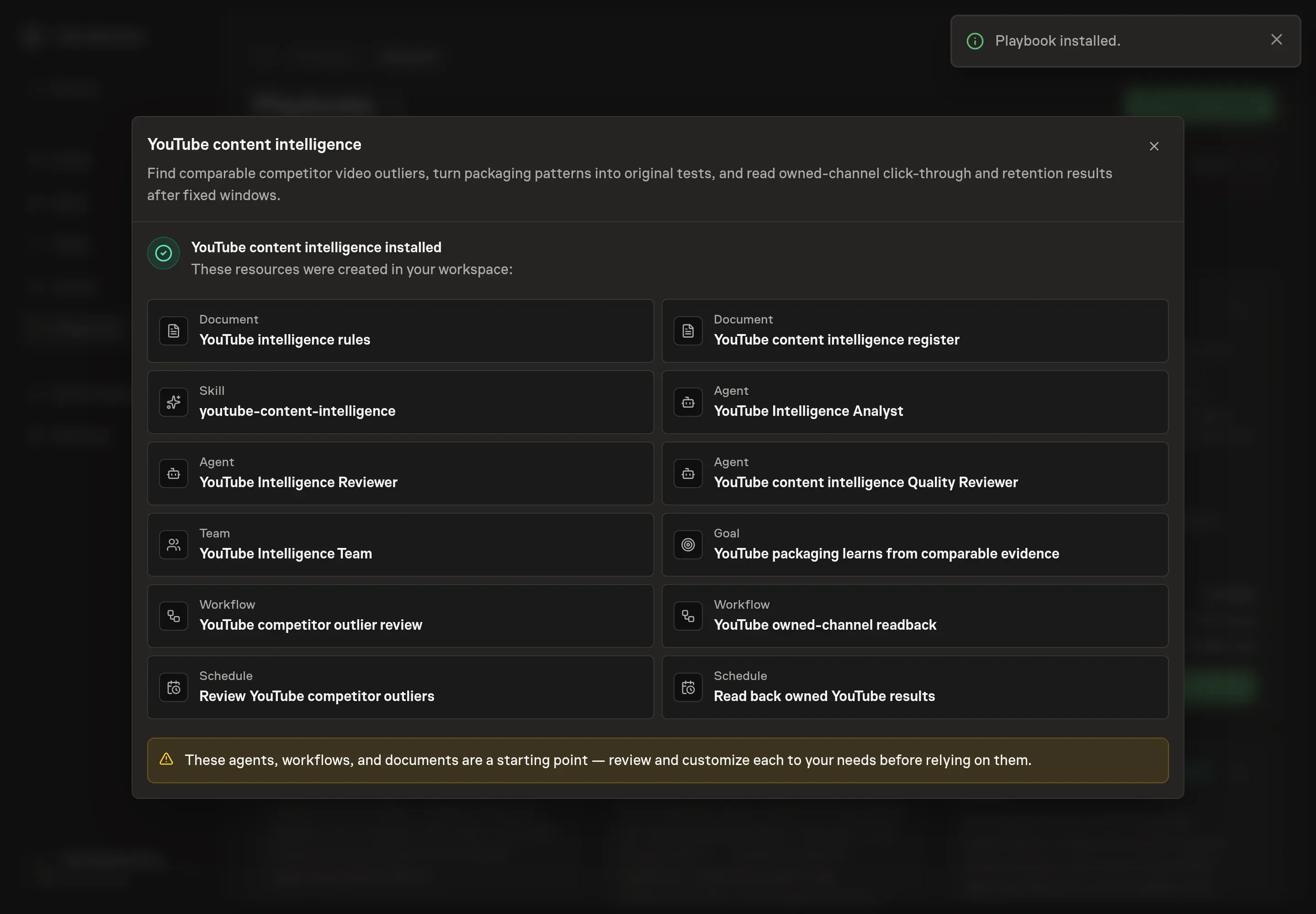
Choose Approve on the proposal in Chat when the configuration matches your brief. Task Machine installs that reviewed configuration. The approved item retains its review details. If your autonomy settings allow direct installation, this approval may not be required. Check the resulting configuration in that case too.
Complete any remaining secure service setup from the installation details in Chat. Inbox keeps those setup items available if you return later. Prepare the source documents and inputs before starting the first Task or Workflow. Installation does not authorize sending, publishing or changing an external service beyond the boundaries you agreed. Confirm each schedule's cadence and timezone, and resolve any pending schedule setup before it starts. A readback must wait for its agreed observation window and source data. Check the reviewed tracker or results document before the first cycle so evidence and human decisions have a durable home.
What good looks like
A useful YouTube intelligence loop passes five checks:
- The public cohort is comparable. Format, age, maturity, topic, language, duration, exclusions, and retrieval time remain visible.
- Outlier math is reproducible. Each flag shows raw views, baseline statistic, sample size, age, ratio, and ordinary videos used for comparison.
- Patterns do not become copies. The proposal translates an observation into an original audience and proof hypothesis with explicit brand and claim limits.
- Owned measures stay distinct. Impressions and click-through diagnose packaging. One preselected retention outcome is primary. Watch time, subscribers, CTA actions, conversations, and revenue are downstream. Negative feedback, corrections, unsubscribes, audience mismatch, copyright, brand, and claim issues are guardrails.
- The window is complete. Early data can diagnose, but the decision waits for the complete predeclared window.
A public 2x outlier is worth studying. It is not proof that the package caused performance or will transfer.
How the loop learns
The approved test records exact title and thumbnail versions, the opening hook and retention devices, topic, audience, format, length, proof, CTA, owner keep/change/avoid/reason feedback, comparable owned baseline, expected traffic sources, planned publication, and result dates.
A 24-48 hour review diagnoses impressions, click-through, and early retention. Seven complete days is the default decision window for the preselected retention outcome. An optional complete 28-day review examines durability and subscriber contribution.
The analysis checks traffic-source mix, notifications, external embeds, paid or partner amplification, channel growth, seasonality, trend half-life, topic demand, publication timing, post-approval edits, production changes, low impressions, and analytics gaps. Packaging can win while retention loses. Strong retention with weak distribution may leave packaging unproven. The approved learning stays bounded to the tested topic, audience, format, title structure, thumbnail concept, hook, retention device, traffic mix, and window.
Common questions
Is 2x average views a good outlier threshold? It is a useful initial research convention, not a universal truth. Prefer a comparable median, show the sample and video age, and adjust the threshold only before reviewing results.
Can public views reveal click-through or retention? No. Public views cannot establish impressions, click-through, retention, watch time, subscriber gain, or revenue. Use owned YouTube Studio evidence for those measures.
Should Shorts and long-form videos share a baseline? No. Separate them, along with live formats and materially different language, topic, duration, and maturity cohorts.
Can the agent change a title or thumbnail after the readback? No. It can prepare an exact bounded learning. Any live package change remains separate human-owned work.
What if click-through improves but retention falls? Treat it as a packaging-content mismatch, not an overall win. Preserve both results and decide whether the package overpromised, the opening failed to deliver, or the comparison is confounded.