How to Mine Insights from Sales Calls
A practical method for extracting attributed call evidence, counting cross-call patterns correctly, and approving sales and content learning.

Founder, Task Machine
Sales call insight mining is the recurring process of extracting source-attributed evidence from individual call transcripts, then synthesizing patterns across a defined cohort. It can reveal recurring objections, buying signals, competitor comparisons, pricing questions, commitments, follow-up opportunities, and content gaps without flattening every conversation into generic sales advice.
This is different from summarizing a meeting. A call summary helps one team act after one conversation. Cross-call analysis asks a separate question: what repeats across independent calls, what contradicts it, how broad is the sample, and what decision can the evidence support?
Why sales call analysis produces false patterns
Transcripts contain enough detail to make almost any interpretation sound plausible. Three counting and context errors are especially common.
The first is counting mentions instead of calls. One buyer may repeat a pricing concern five times. That is one call with a pricing concern, not five independent customers. Repeated calls with the same account create the same distortion at the cohort level.
The second is stripping context from a quote. "That could work" can be a buying signal, a hypothetical response, or polite disagreement depending on who said it and what came before. Negation, hedging, speaker role, call stage, and transcript quality change the meaning.
The third is reading outcomes backward. If an objection appears more often in won calls, the objection did not necessarily cause a win. Qualification, seller behavior, stage mix, account concentration, call type, and missing outcome data can explain the association. Sales-call evidence describes what happened in the observed cohort and does not make a causal claim by itself.
What the manual process looks like
A defensible weekly or monthly review has eleven steps:
- Define the cohort by date, segment, stage, call type, owner, and outcome maturity, including explicit exclusions.
- Confirm recording, analysis, access, quotation, redaction, and retention rules for the transcript batch.
- Build a stable source manifest with call ids, transcript versions, dates, accounts, owners, and known data gaps.
- Read each included transcript completely before selecting excerpts.
- Extract objections, buying signals, competitor mentions, pricing discussions, commitments, follow-up cues, content questions, and contradictions.
- Preserve the timestamp, speaker label and role, verbatim excerpt, faithful paraphrase, required context, classification, strength, qualifiers, privacy status, and transcript quality for every record.
- Deduplicate repeated discussion inside one call and group only semantically equivalent evidence across calls.
- Count unique calls and accounts, name the denominator and inclusion rule, and preserve contradicting calls and low-frequency severe cases.
- Compare segments, stages, and outcomes only when those fields are complete and sufficiently comparable.
- Have a second person reproduce material quotations, classifications, counts, privacy handling, and proposed follow-up or content boundaries.
- Approve the exact evidence and learning, then read back any separately executed change after its predeclared window.
The source trail is what separates an insight from a confident summary.
What an agent can automate
An analyst and reviewer can handle the recurring evidence work:
- Build the batch manifest. The analyst records stable call ids, source versions, cohort fields, permissions, included and excluded counts, and transcript limitations.
- Extract call-level evidence. Every objection, signal, mention, commitment, and question keeps its source location, speaker context, exact wording, paraphrase, qualifiers, and privacy status.
- Apply one taxonomy consistently. Categories are defined before synthesis. Unknown speakers, roles, strengths, and outcomes stay unknown instead of being completed by inference.
- Count independent evidence. Repetition inside a call is deduplicated. Cross-call frequency uses unique calls, and account breadth remains visible beside it.
- Preserve contradiction. Supporting and contradicting calls appear in the same pattern record, with alternative explanations and confidence that reflects the sample.
- Draft call-specific follow-up. A proposed note uses only the approved context and commitments from that call. Cross-account details never leak into it.
- Draft content briefs. Recurring audience questions can become source-backed briefs with evidence breadth, claim limits, quotation restrictions, and a clear reader job.
- Review prior decisions. If the team separately tested a follow-up, sales-language, enablement, or content change with a fixed window, a later run can reconcile the approved outcome measures.
- Reproduce material findings. The reviewer checks source transcripts, timestamps, quotations, classifications, denominators, permissions, and draft limits before approval.
The agents do not send follow-up, publish content, edit CRM data, change sales guidance, make product commitments, or expose confidential call material.
The guardrails that make it safe
Transcript analysis begins with permission and minimum necessary use. The cohort must comply with the team's recording, analysis, access, confidentiality, quotation, redaction, and retention rules. The evidence library stores the smallest excerpt needed for an internal finding rather than copying full transcripts into another system.
Attribution remains internal and stable: call id, source version, timestamp, speaker label and role, and deal context. Personal or confidential details are redacted according to policy. Material can support internal learning while still being restricted from a customer follow-up, public quote, case study, or content asset.
The approval is decision-complete. It includes the cohort and taxonomy versions, sample and exclusions, transcript limitations, evidence records, call and account denominators, contradictions, outcome gaps, reviewer finding, exact follow-up drafts, content briefs, structured owner feedback, and exact document patches. Approval records those artifacts only. Sending, publication, CRM updates, sales-guidance changes, and product work remain separate human actions.
Set it up in Task Machine
The Sales call insight analysis playbook provides a starting point for the method above. You need an active Task Machine workspace with Chat, workspace-management and Playbook-installation access (workspace owners have it). Attach timestamped transcript exports and their deal context to each review.
1. Find the playbook
Open Search in your workspace and enter "Sales call insight analysis". The command center lists Set up Sales call insight analysis under Playbook setup.
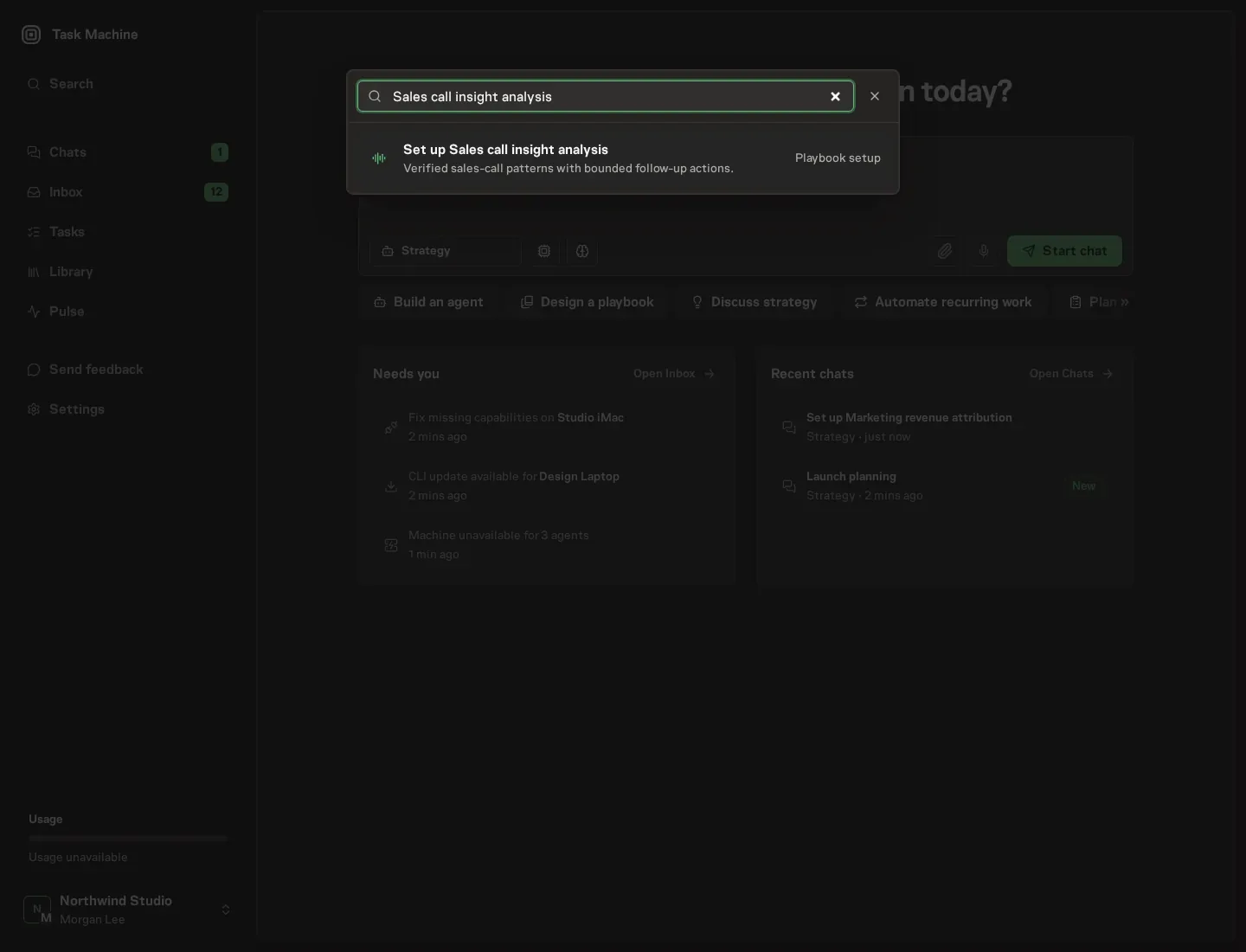
2. Start the conversation
Choose Set up Sales call insight analysis. Task Machine opens a dedicated Chat with the Playbook card and an editable, unsent request. Read the intended job and outcome. Add your situation and send it when ready. Opening the draft does not install anything or start work. This walkthrough uses settings that require approval of the proposed Playbook.
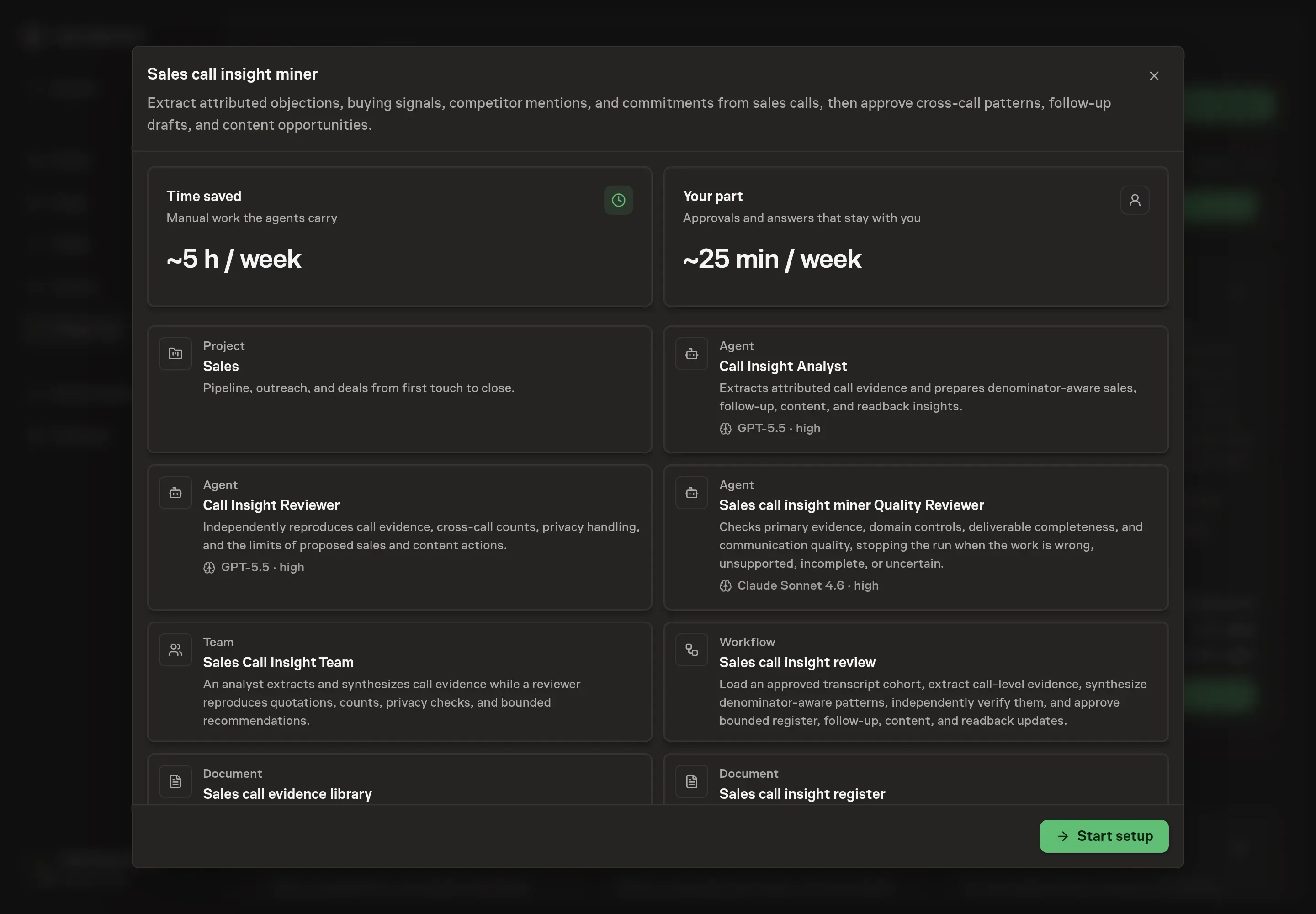
3. Agree the working brief
Use Chat to agree the inputs, expected output and limits before asking for a proposal. Describe the transcript sources and stable identifiers, the call cohort, the insight taxonomy, privacy and retention rules, and the follow-up and content decisions this review may propose. A useful cohort might cover discovery and evaluation calls from one segment during a closed month, with mature won, lost, and open outcomes kept separate.
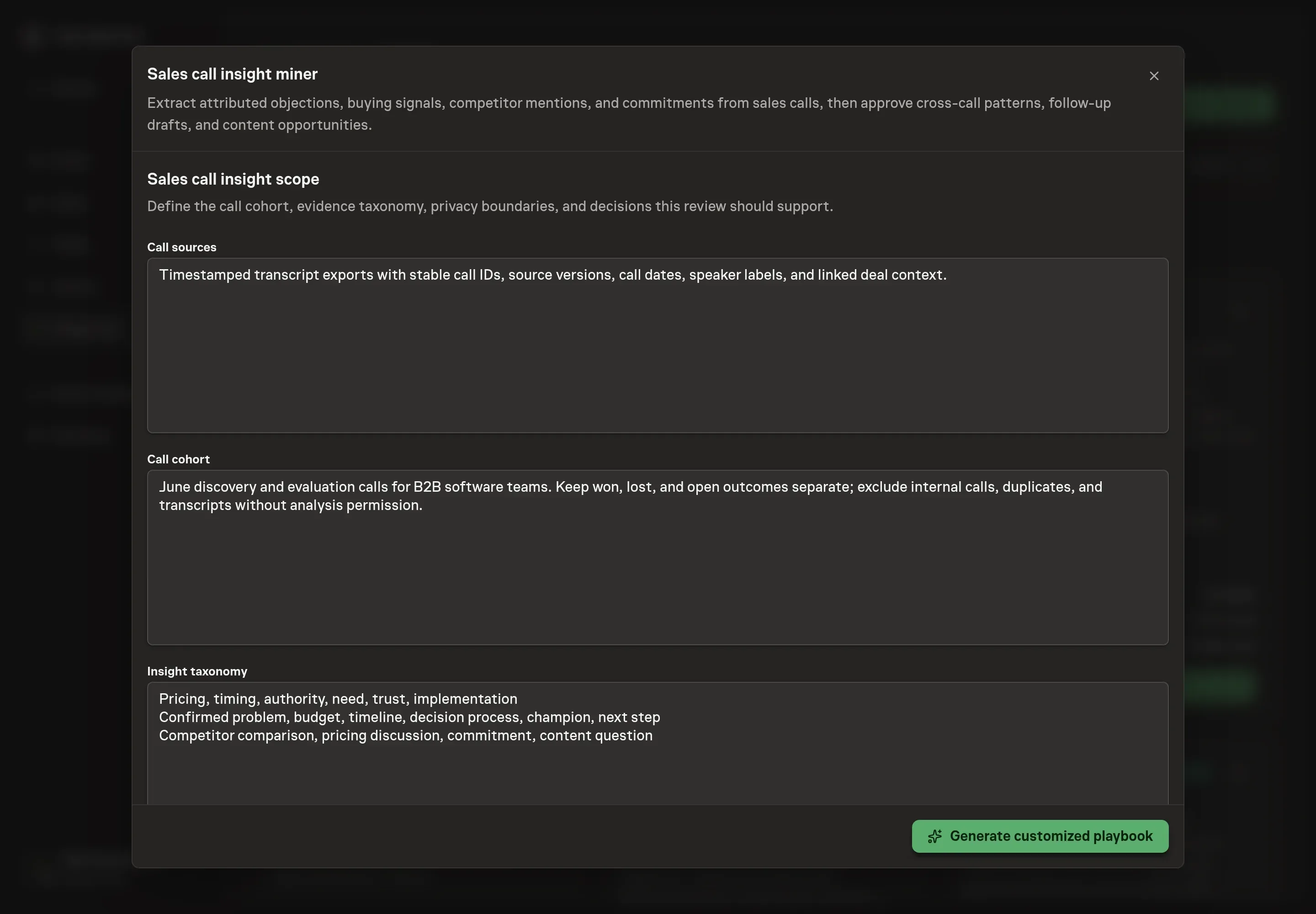
4. Review the proposed Playbook
Ask the Agent to generate the Playbook from the agreed brief. Open its proposal in Chat and check the instructions and resources it will install, which carry more detail than the conversational summary. Confirm each evidence record requires a call id, timestamp, speaker context, quotation and paraphrase, privacy status, and transcript-quality note. Check that patterns use unique-call and account counts, preserve contradictions, and pass independent review before approval. Ask for a revised proposal if anything is missing or changes the job.
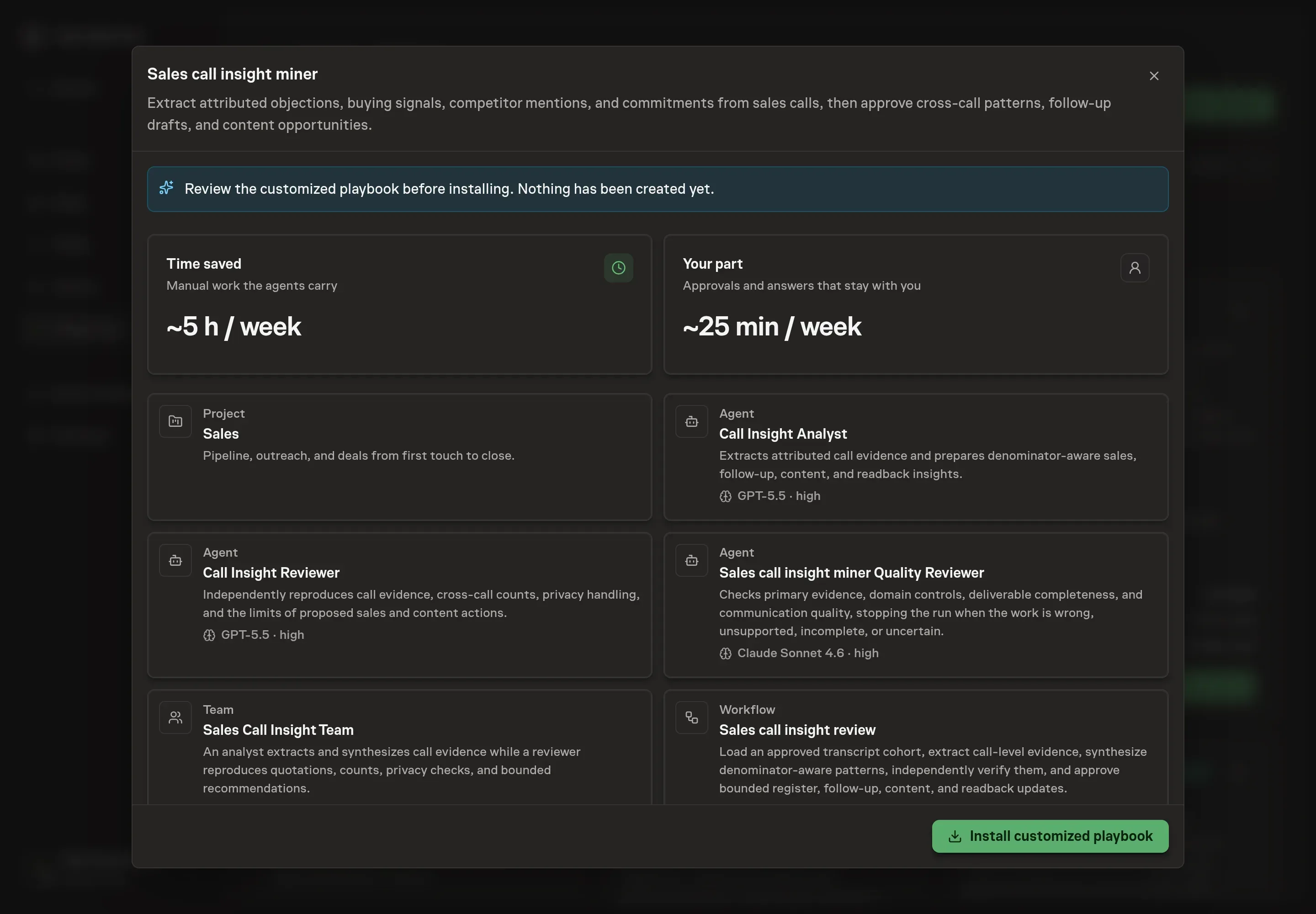
5. Approve and prepare the first work
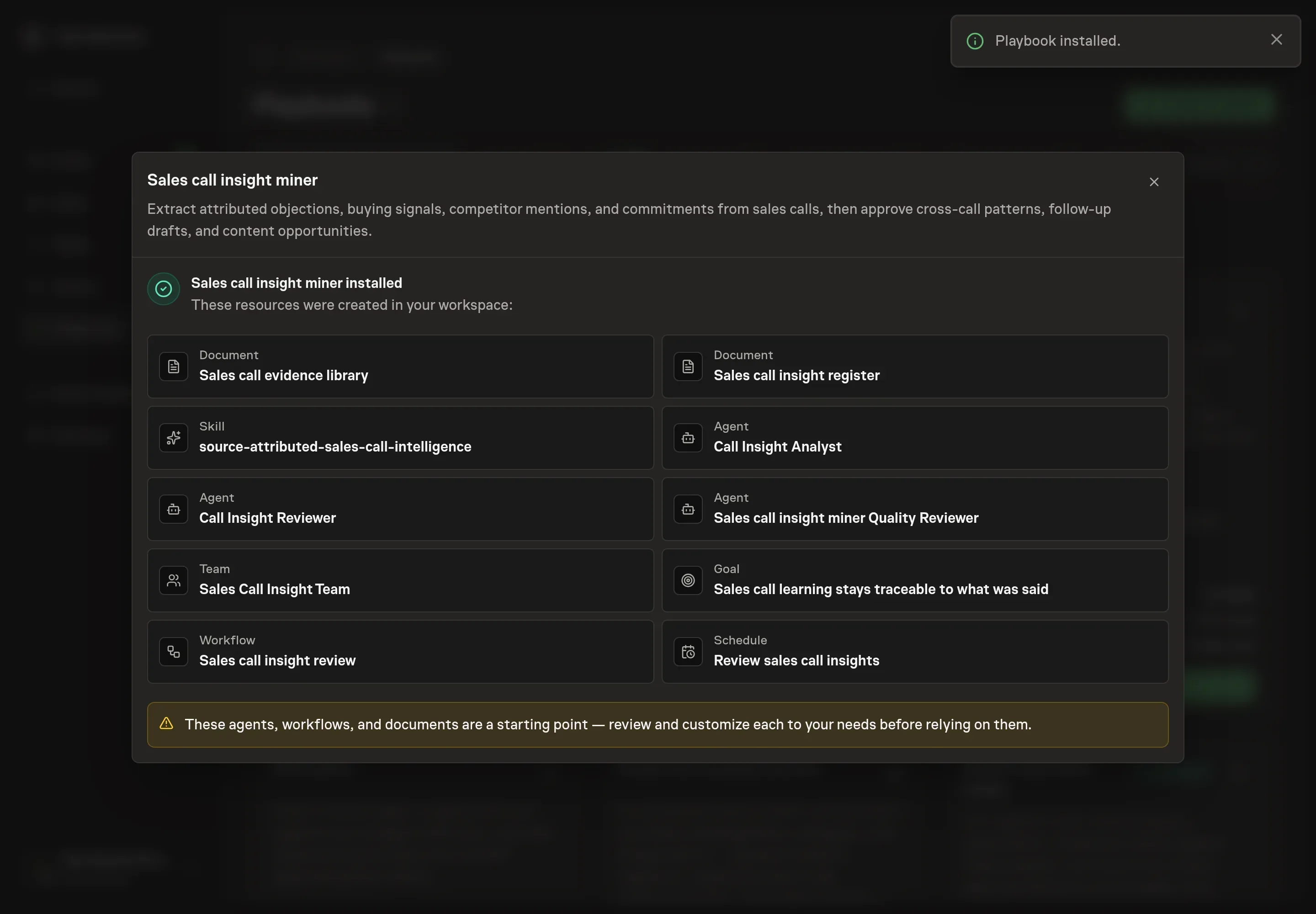
Choose Approve on the proposal in Chat when the configuration matches your brief. Task Machine installs that reviewed configuration. The approved item retains its review details. If your autonomy settings allow direct installation, this approval may not be required. Check the resulting configuration in that case too.
Complete any remaining secure service setup from the installation details in Chat. Inbox keeps those setup items available if you return later. Prepare the source documents and inputs before starting the first Task or Workflow. Installation does not authorize sending, publishing or changing an external service beyond the boundaries you agreed. Confirm each schedule's cadence and timezone, and resolve any pending schedule setup before it starts. A readback must wait for its agreed observation window and source data. Check the reviewed tracker or results document before the first cycle so evidence and human decisions have a durable home.
What good looks like
A useful sales-call insight review passes five checks:
- Every finding is traceable. A stable call id, source version, timestamp, speaker context, exact excerpt, paraphrase, and required context support each evidence record.
- Counts use the right unit. Cross-call frequency counts unique calls, account breadth is separate, and every rate names its denominator and inclusion rule.
- Contradictions remain visible. The register shows calls that do not fit the pattern and alternative explanations for segment or outcome differences.
- Privacy limits travel with the evidence. Internal-use material is not silently turned into a customer quote, case study, follow-up claim, or public content.
- Recommendations stay bounded. A follow-up draft belongs to one call. A content brief states the audience, evidence breadth, claims, restrictions, and decision it supports.
A low-frequency severe objection can still matter, but it should remain a case for review rather than being mislabeled as a recurring pattern.
How the loop learns
Each recurring review records a stable batch and taxonomy version. The analyst extracts call-level evidence and synthesizes patterns by unique calls and accounts. The reviewer reproduces material source facts, classifications, counts, and permissions. A person then approves, revises, or rejects the exact evidence-library and insight-register patches, per-call drafts, content briefs, and any due readback.
When the team separately executes an approved change, the register can predeclare its audience, owner, baseline, candidate window, primary measure, diagnostics, guardrails, and rollback condition. Later reviews may read back positive replies, next-step completion, qualified opportunity movement, objection recurrence, content engagement, and policy issues from named sources.
The analysis inspects account concentration, repeated calls from one opportunity, seller behavior, qualification changes, segment, stage and call-type mix, outcome maturity, transcript quality, seasonality, concurrent changes, and missing attribution. A human can approve reuse, keep testing, retire, or unproven for the tested condition. Negative and inconclusive evidence remains in the register.
Common questions
How many calls make a pattern? More than one independent call is the minimum for recurrence, not a guarantee of confidence. Show unique calls, unique accounts, the denominator, contradictions, segment mix, and transcript quality so the reader can judge the evidence.
Can a single call still matter? Yes. A severe objection, policy issue, commitment, or product gap may deserve immediate review. Keep it as a case rather than inflating it into a cross-call trend.
Can the workflow compare won and lost calls? Yes, when outcome definitions are mature and comparable. The result is an association with caveats, not proof that one phrase, objection, or seller behavior caused the outcome.
Does it send the follow-up drafts? No. A person approves the exact draft, and any sending happens separately. The workflow records what was approved and can later read back a predeclared result.
Can transcript quotes be used in public content? Only when the quotation and customer permissions allow it. Internal evidence may support a theme while the underlying wording remains restricted.