How to Revive Closed-Lost Deals
A practical method for finding closed-lost deals whose original loss condition changed, approving selective outreach, and learning from outcomes.

Founder, Task Machine
Closed-lost deal resurrection is the selective process of revisiting an opportunity after evidence shows that the reason it was lost may have changed. The work starts with the old decision, not a list of accounts that have been quiet for a while. A credible candidate connects a recorded loss reason to a current, sourced changed condition and still passes every contact and suppression rule.
This is different from nudging an open stalled deal. A stalled deal remains active but has stopped moving. A closed-lost deal records a completed decision. Re-engaging one requires a stronger reason, a cooling-off period, and respect for the old no. Time passing or a high deal value does not turn a closed record into permission to contact someone.
Why closed-lost reactivation often goes wrong
A CRM makes old pipeline look like a convenient prospect list. It contains known accounts, prior contacts, discovery notes, and estimated value. That familiarity can hide three problems.
First, loss reasons are often incomplete. "Timing" may mean a real budget date, a polite refusal, or an initiative that disappeared. Rewriting an unknown reason as a promising one makes ranking easier and evidence worse.
Second, company news is easy to overinterpret. Funding, hiring, or a website visit can justify research, but it does not automatically resolve a product gap, an explicit bad fit, a trust failure, or an incumbent contract. A useful trigger must bear directly on the constraint recorded in the deal.
Third, the people and boundaries may have changed. The old champion may have moved, the account may now be a customer in another motion, the contact may have unsubscribed, or a relationship owner may already be active. Historical contact is context, not continuing consent.
What the manual process looks like
A careful monthly review has ten steps:
- Define the approved pipelines, lookback, eligible loss reasons, cooling-off periods, exclusions, contact boundaries, and fixed result window.
- Pull the complete closed-lost population with deal ids, stage history, close date, verbatim loss reason, value, owner, contacts, activity, consent, and suppression state.
- Separate closed-lost records from open stalled deals, wins, duplicates, current customers, and accounts with active opportunities.
- Apply hard exclusions before ranking: bad fit, do-not-contact, unsubscribe, legal or trust disputes, unresolved security concerns, regional restrictions, and unapproved relationship ownership.
- For each remaining loss reason, define the evidence that would show the old constraint changed.
- Research current CRM and public business sources, preserving source ids or URLs, publication dates, retrieval dates, quoted facts, and bounded inferences.
- Verify the current recipient's role and public business channel. Treat a replacement contact carefully and a former champion at a new company as a separate prospect.
- Have a second person reproduce material CRM state, source evidence, suppression checks, and the loss-to-trigger logic.
- Draft only for passing candidates, then approve each exact recipient, claim, offer, CTA, and message with the fixed outcome plan.
- After a human-operated send and the complete window, reconcile positive replies and downstream pipeline, inspect confounders, and approve a narrow learning.
Most of the time goes into proving why an account belongs in the cohort and why another one does not.
What an agent can automate
An analyst and reviewer can run the repetitive evidence work without automating the decision or the send:
- Reconstruct the true population. The analyst loads complete CRM history, preserves verbatim loss reasons, deduplicates related records, and separates closed-lost opportunities from stalled or active work.
- Apply hard exclusions first. Cooling-off, suppression, consent, legal, account ownership, customer, recent-contact, and active-opportunity checks happen before any score or draft.
- Research changed conditions. Each candidate begins with the original constraint. The analyst gathers dated CRM and public evidence that directly bears on it and labels fact, inference, and confidence separately.
- Verify contacts safely. Current role relevance and a public business channel are required. Private contact details are not inferred, and a former champion does not carry the old deal into a new employer.
- Run independent review. The reviewer reproduces material CRM and source facts and returns PASS, correction-ready FAIL, or UNCERTAIN when access or identity blocks a defensible decision.
- Draft selective outreach. Passing candidates get a concise note that respects the old decision, states only a supported change, offers one relevant proof point, and asks for one low-friction next step.
- Freeze the result plan. The cohort, baseline, exact copy, final-touch date, fixed readback date, primary outcome, downstream signals, diagnostics, guardrails, and source evidence are recorded before approval.
- Read back real outcomes. The second workflow waits for the full window, reconciles recipients with delivery and CRM evidence, and proposes a bounded decision.
The agents do not send or enroll outreach, change suppression, edit a live deal, create an opportunity, or reopen a closed record.
The guardrails that make it safe
Eligibility is rule-based. Deal value and age may prioritize research, but they cannot override a failed exclusion or supply a missing trigger. Unknown loss reasons stay unknown. Generic growth, elapsed time, and email opens are weak context, not proof that the old condition changed.
Research uses public business sources and authorized CRM evidence. The workflow does not bypass access controls, scrape restricted pages, infer private addresses, or imply surveillance in a draft. A job move is never inherited permission.
There are two human boundaries. The first approves each exact recipient, evidence packet, draft, and fixed result plan. A human then handles any sending separately and provides immutable message identifiers. The second approves the measured result and a narrow reuse, keep testing, retire, or unproven decision. Neither approval repeats outreach or changes CRM state.
Set it up in Task Machine
The Lost deal outreach playbook provides a starting point for the method above. You need an active Task Machine workspace with Chat, workspace-management and Playbook-installation access (workspace owners have it). Until you authorize a CRM, the workflows use attached exports.
1. Find the playbook
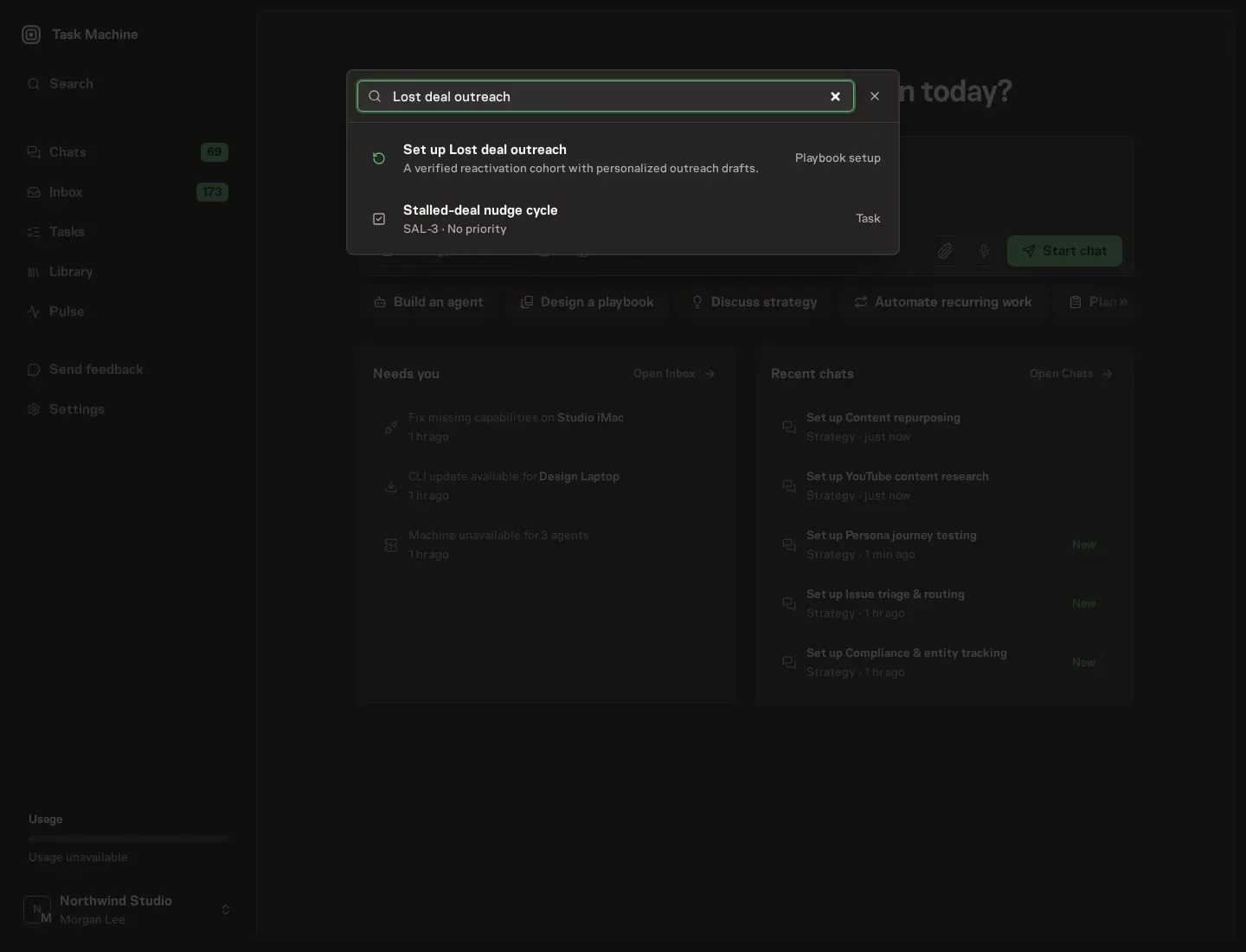
Open Search in your workspace and enter "Lost deal outreach". The command center lists Set up Lost deal outreach under Playbook setup.
2. Start the conversation
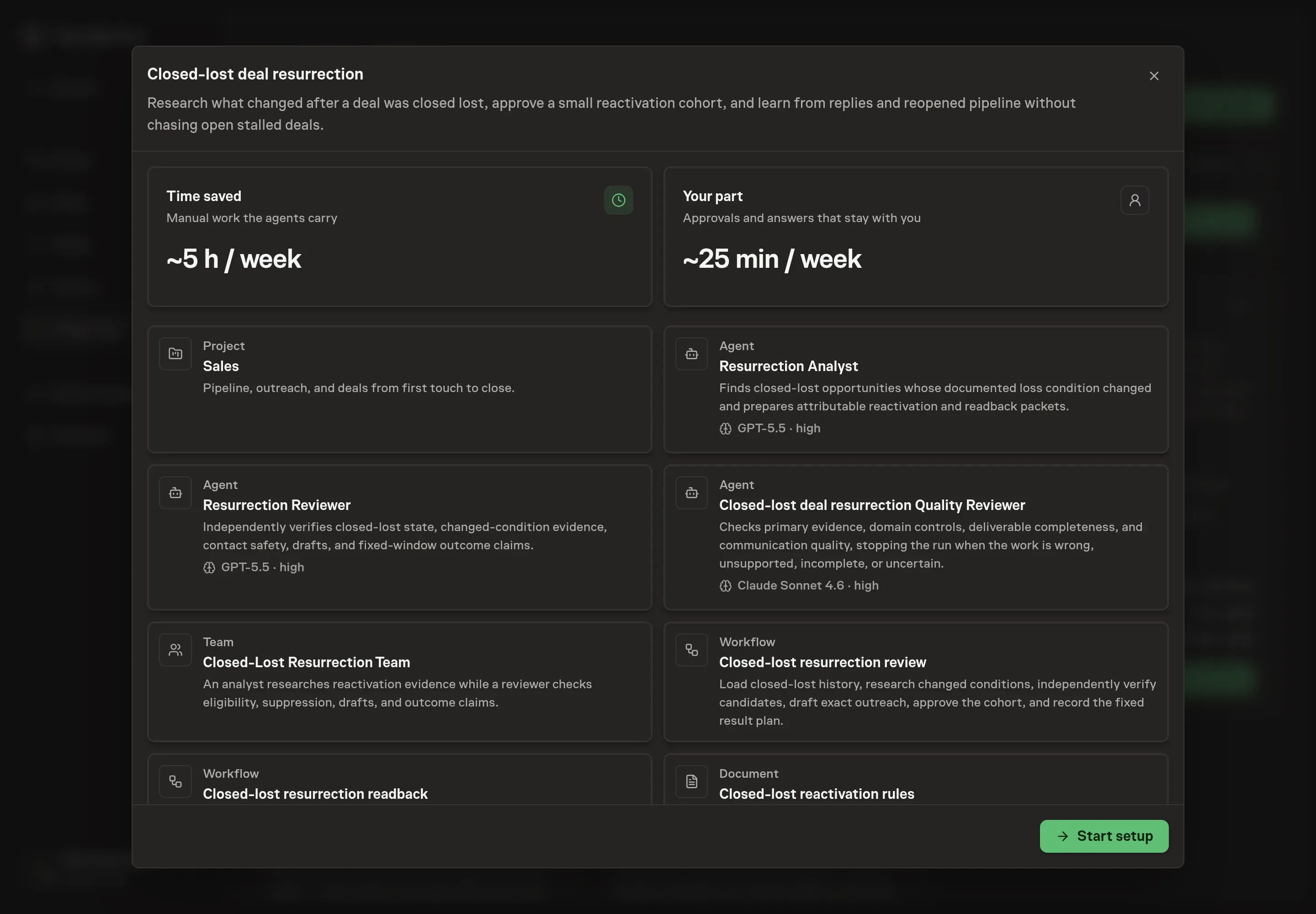
Choose Set up Lost deal outreach. Task Machine opens a dedicated Chat with the Playbook card and an editable, unsent request. Read the intended job and outcome. Add your situation and send it when ready. Opening the draft does not install anything or start work. This walkthrough uses settings that require approval of the proposed Playbook.
3. Agree the services
Tell the Agent which services you use. The catalog offers these starting choices:
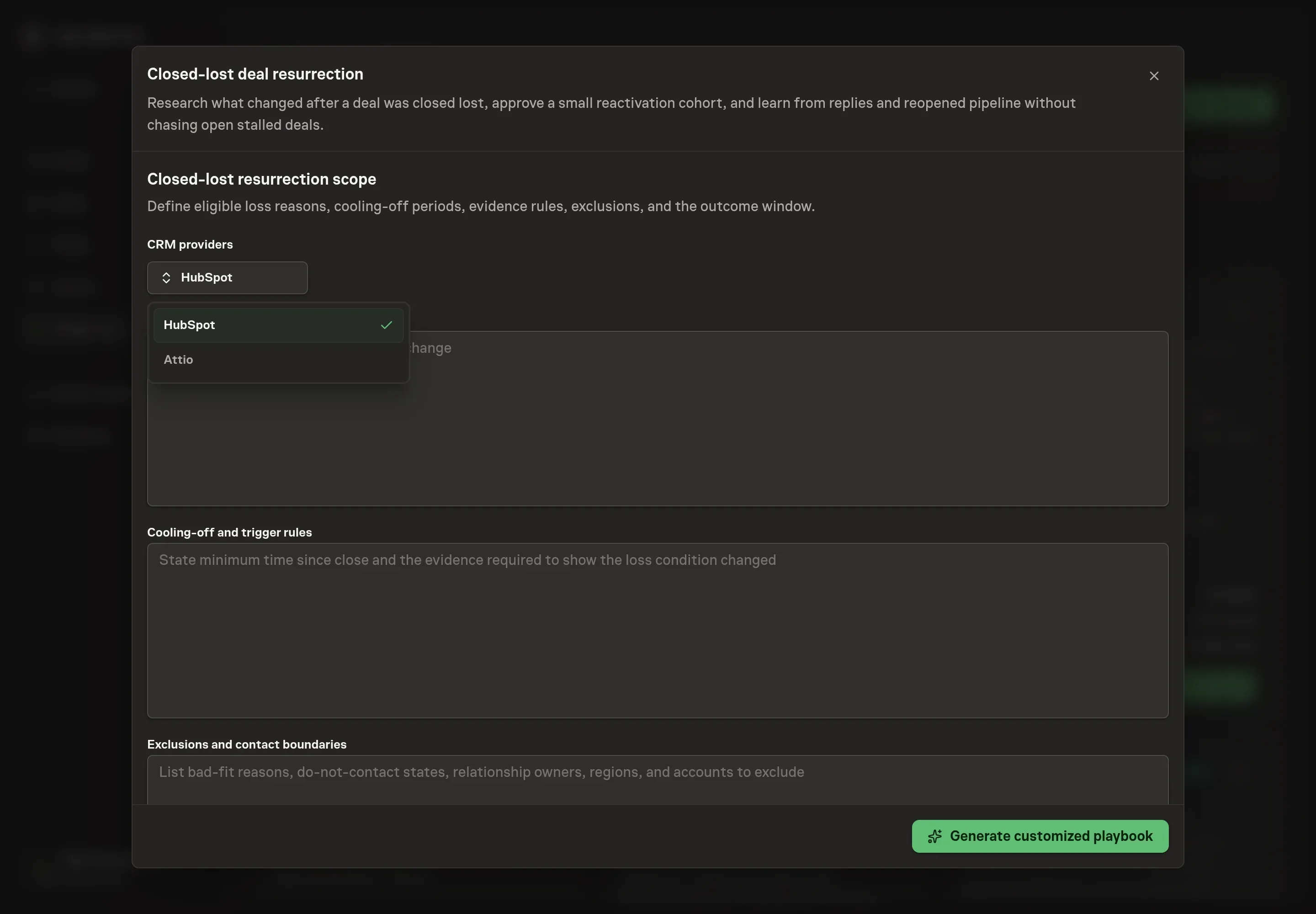
- CRM providers: HubSpot, Attio. Optional.
Discuss any missing access or export-based alternative before generation. Check the exact proposal includes only the services you agreed. Enter credentials only through secure setup, never in Chat.
4. Agree the working brief
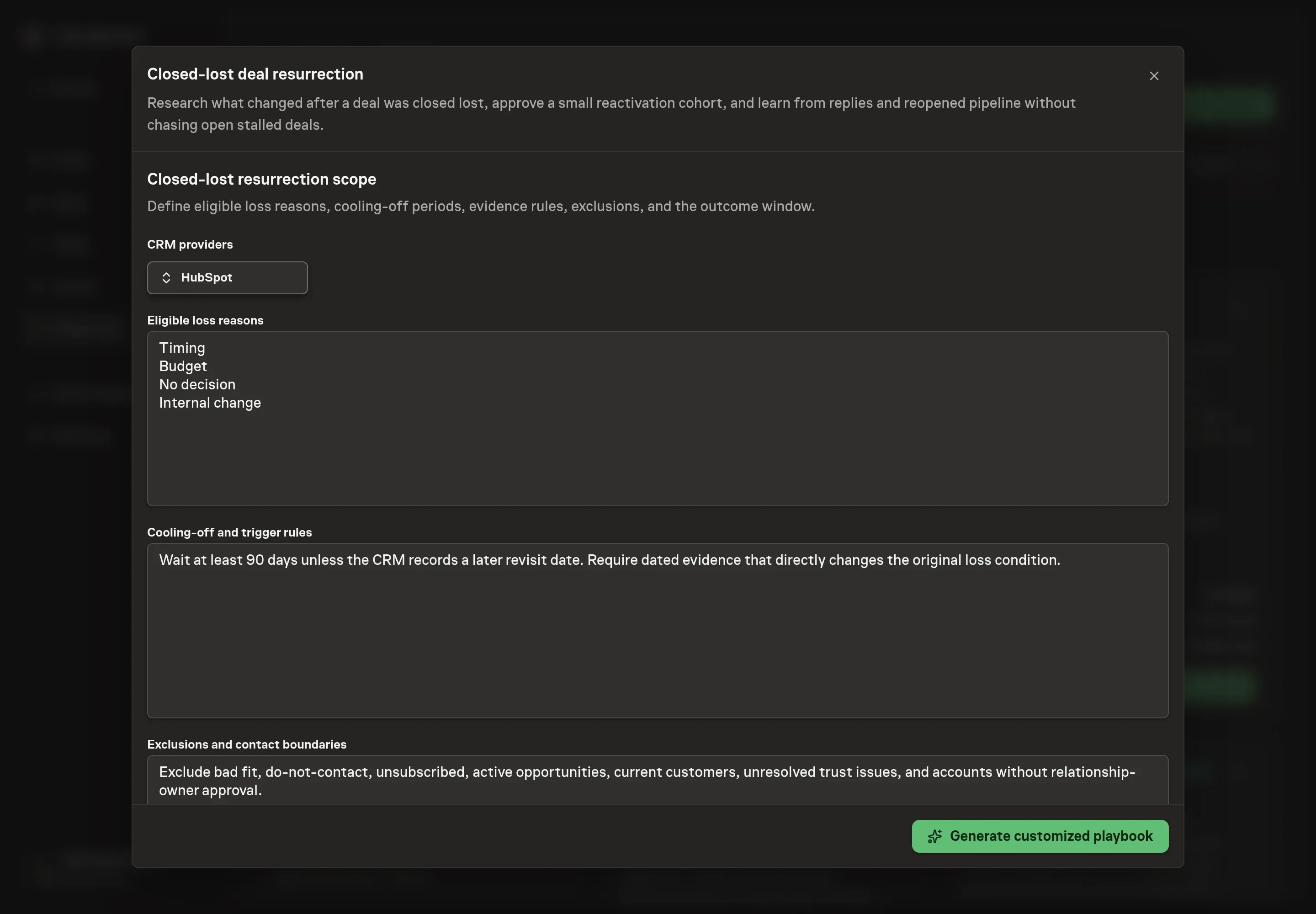
Use Chat to agree the inputs, expected output and limits before asking for a proposal. Discuss eligible loss reasons, cooling-off and trigger rules, hard exclusions, contact boundaries, the reactivation offer and voice, and the fixed outcome window. A useful starting scope might allow timing, budget, no-decision, and internal-change losses only when dated evidence directly changes the old constraint. Keep bad fit and explicit no-contact states excluded.
5. Review the proposed Playbook
Ask the Agent to generate the Playbook from the agreed brief. Open its proposal in Chat and check the instructions and resources it will install, which carry more detail than the conversational summary. Confirm open stalled deals are out of scope, loss reasons remain verbatim, hard exclusions precede ranking, every trigger carries a source and date, the reviewer is independent, and the first approval records rather than sends the cohort. Ask for a revised proposal if anything is missing or changes the job.
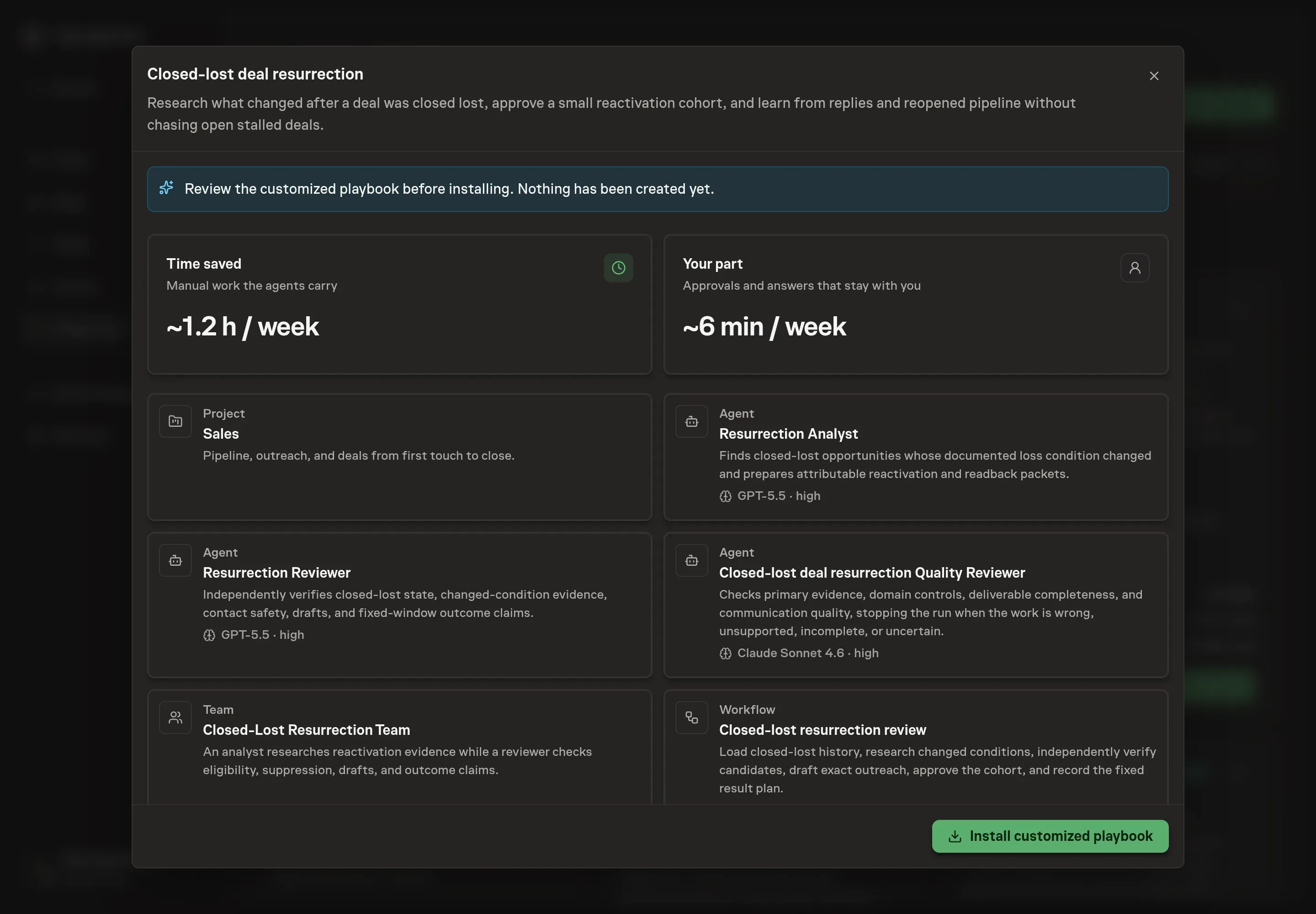
6. Approve and prepare the first work
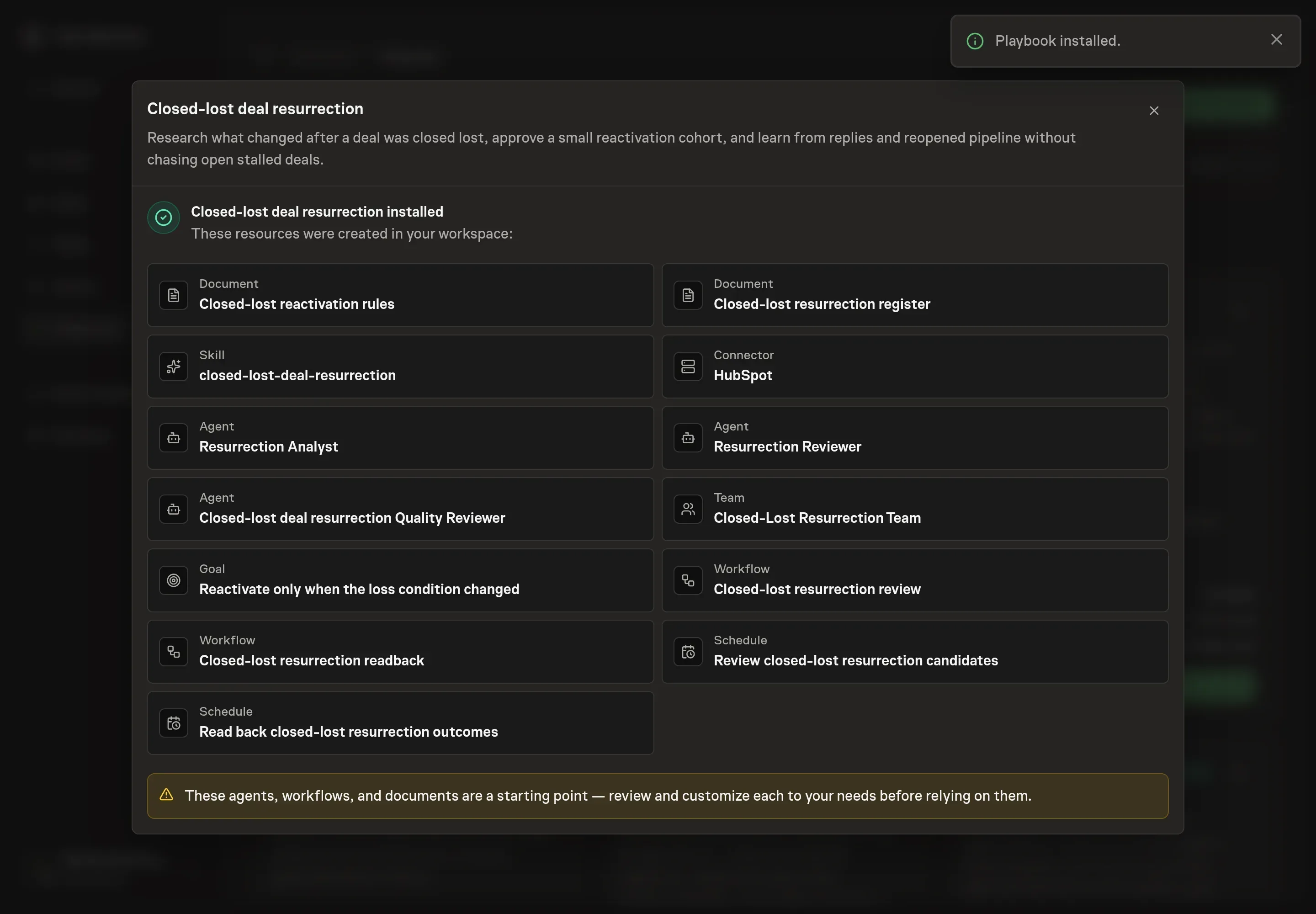
Choose Approve on the proposal in Chat when the configuration matches your brief. Task Machine installs that reviewed configuration. The approved item retains its review details. If your autonomy settings allow direct installation, this approval may not be required. Check the resulting configuration in that case too.
Complete any remaining secure service setup from the installation details in Chat. Inbox keeps those setup items available if you return later. Prepare the source documents and inputs before starting the first Task or Workflow. Installation does not authorize sending, publishing or changing an external service beyond the boundaries you agreed. Confirm each schedule's cadence and timezone, and resolve any pending schedule setup before it starts. A readback must wait for its agreed observation window and source data. Check the reviewed tracker or results document before the first cycle so evidence and human decisions have a durable home.
What good looks like
A useful resurrection cycle passes four checks:
- Every candidate is truly closed lost. Stalled, active, won, customer, duplicate, and current-opportunity records are reported separately rather than mixed into the cohort.
- The trigger resolves the recorded constraint. The evidence is current, attributable, and relevant to the verbatim loss reason. Age and value do not substitute for it.
- Contact boundaries are current. Suppression, ownership, role, channel, consent, and regional checks are rerun before approval.
- The result survives a complete window. Positive replies use delivered recipients as the denominator, and downstream pipeline remains distinct from diagnostics and guardrails.
A small passing cohort is better than a large list held together by generic company news.
How the loop learns
Before outreach, the register records the eligibility-rules version, exact candidates, original loss reasons, changed-condition evidence, contact and suppression checks, reviewer findings, exact copy, structured owner feedback, a comparable baseline when one exists, planned period, final-touch date, fixed readback date, positive-reply outcome, downstream measures, diagnostics, guardrails, and sources.
After the full window, positive reply rate among delivered recipients is primary. Meetings, qualified reopened opportunities, pipeline, wins, and attributable revenue are downstream. Delivery is diagnostic. Opens are not success. Bounces, spam complaints, opt-outs, negative replies, and policy violations are guardrails.
The analysis checks deal age and value, loss-reason and trigger mix, contact changes, sender and domain health, offer, cadence, seasonality, concurrent outreach, list size, CRM gaps, tracking gaps, and owner effects. A person approves learning only for the tested audience, loss reason, trigger type, offer, and operating conditions. Losing and inconclusive cohorts remain in the register.
Common questions
How long should a closed-lost deal cool off? There is no universal number. Use the recorded reason and any promised revisit date. A timing loss may have a specific date, while bad fit should usually remain excluded rather than age into eligibility.
Does funding make an old deal eligible? Not by itself. Funding can support research, but the candidate needs evidence that directly changes the old constraint, such as an approved initiative or budget cycle relevant to the recorded need.
Can the agent contact a champion who changed companies? Not as a continuation of the old deal. The new employer is a separate prospect with separate relevance, contact, consent, ownership, and approval checks.
Does the workflow send the reactivation email? No. It records the approved cohort and exact drafts. A human-operated system handles sending and supplies the identifiers used for readback.
When should a deal be reopened? Only after a real response and the team's normal qualification and CRM process. The workflow never reopens a deal automatically.