How to Attribute Marketing Revenue
A practical method for reconciling analytics, CRM, and billing data before comparing marketing attribution models.

Founder, Task Machine
Marketing revenue attribution is the process of reconciling customer-journey evidence with pipeline and collected revenue, then assigning descriptive credit under a stated model. A defensible report keeps source totals, identity rules, lookback windows, unknown traffic, unattributed revenue, and model definitions visible.
It is worth doing because channel reports influence budget and strategy. If analytics conversions, CRM opportunities, and billing transactions do not reconcile before credit is assigned, a precise-looking dashboard can hide missing identities, duplicate records, refunds, and incompatible revenue definitions.
Attribution tools assign credit before the data agrees
Attribution tools often begin where the difficult work should end. They assign credit before anyone confirms whether the analytics, CRM, and billing populations describe the same people, periods, currencies, and outcomes.
Unknown traffic is especially easy to hide. Cookie loss, cross-device journeys, missing campaign parameters, offline touches, and blocked analytics create real gaps. Redistributing those gaps across known channels makes the report add up, but it replaces missing evidence with confidence the sources did not provide.
Model choice creates another trap. First touch rewards discovery. Lead-creation credit rewards the transition into a known lead. Last touch rewards the final eligible interaction. A position-based model spreads credit. Their disagreement describes different journey positions and does not prove which channel caused revenue.
What the manual process looks like
A reliable monthly review has eight steps:
- Lock the reporting period, maturity window, event definitions, revenue basis, currencies, channel mappings, identity rules, lookbacks, and exclusions.
- Pull complete analytics events with raw campaign parameters, referrers, session identities, and timestamps.
- Pull CRM contacts, qualified leads, opportunities, stages, won values, account identities, and timestamps.
- Pull billing transactions, refunds, currencies, statuses, customer identities, and collection dates.
- Normalize and reconcile analytics to CRM, then CRM wins to billing using approved deterministic identifiers.
- Preserve duplicates, orphans, late events, unknown traffic, unattributed revenue, exclusions, and unexplained differences.
- Apply first-touch, lead-creation, last-touch, and the approved multi-touch rule over the same eligible revenue population.
- Have another analyst reproduce source and model totals before a person approves the report and any bounded follow-up.
The reconciliation is the work. The model calculation is useful only after the sources and exceptions are visible.
What an agent can automate
An analyst and reviewer can handle the recurring mechanics:
- Load complete source populations. The analyst retrieves closed-period analytics, CRM, and billing records with raw identifiers, filters, extraction times, and definitions version.
- Normalize the sources. Time zones, currencies, refunds, test records, duplicate contacts, opportunity stages, and transaction status follow approved rules.
- Reconcile identities and value. Deterministic joins produce matched, unmatched, duplicate, orphaned, late, unknown, and unattributed tables.
- Compare explicit models. First touch, lead creation, last touch, and position based use one eligible population and each foot to the same joined revenue plus stated exceptions.
- Keep missing evidence visible. Unknown and unattributed value remain columns and channels instead of being distributed across known sources.
- Reproduce the report. The reviewer recalculates material source totals, joins, and model rows and returns PASS, FAIL, or UNCERTAIN.
- Prepare bounded decisions. Tracking investigations, channel observations, and experiment proposals include caveats and counterevidence before approval.
The agents do not change budgets, campaigns, targeting, attribution definitions, source records, or closed historical periods.
The guardrails that make it safe
The definitions document is versioned by effective date. It states event meaning, revenue basis, identity fields, source precedence, channel mapping, lookback, direct-traffic treatment, and every model rule before a reporting period is calculated.
Only approved deterministic identifiers may connect records. Names, company similarity, and model guesses do not establish identity. Unknown and unattributed records remain explicit. Closed periods are restated with a reason rather than overwritten.
Human approval follows independent reproduction. The person reviews source totals, reconciliation exceptions, model disagreement, unknown share, caveats, counterevidence, and the exact ledger patch. Approval records the report and decision. Any operational change remains separate reviewed work.
Set it up in Task Machine
The Marketing revenue attribution playbook provides a starting point for the method above. You need an active Task Machine workspace with Chat, workspace-management and Playbook-installation access (workspace owners have it). The workflow works from attached exports until services are authorized.
1. Find the playbook
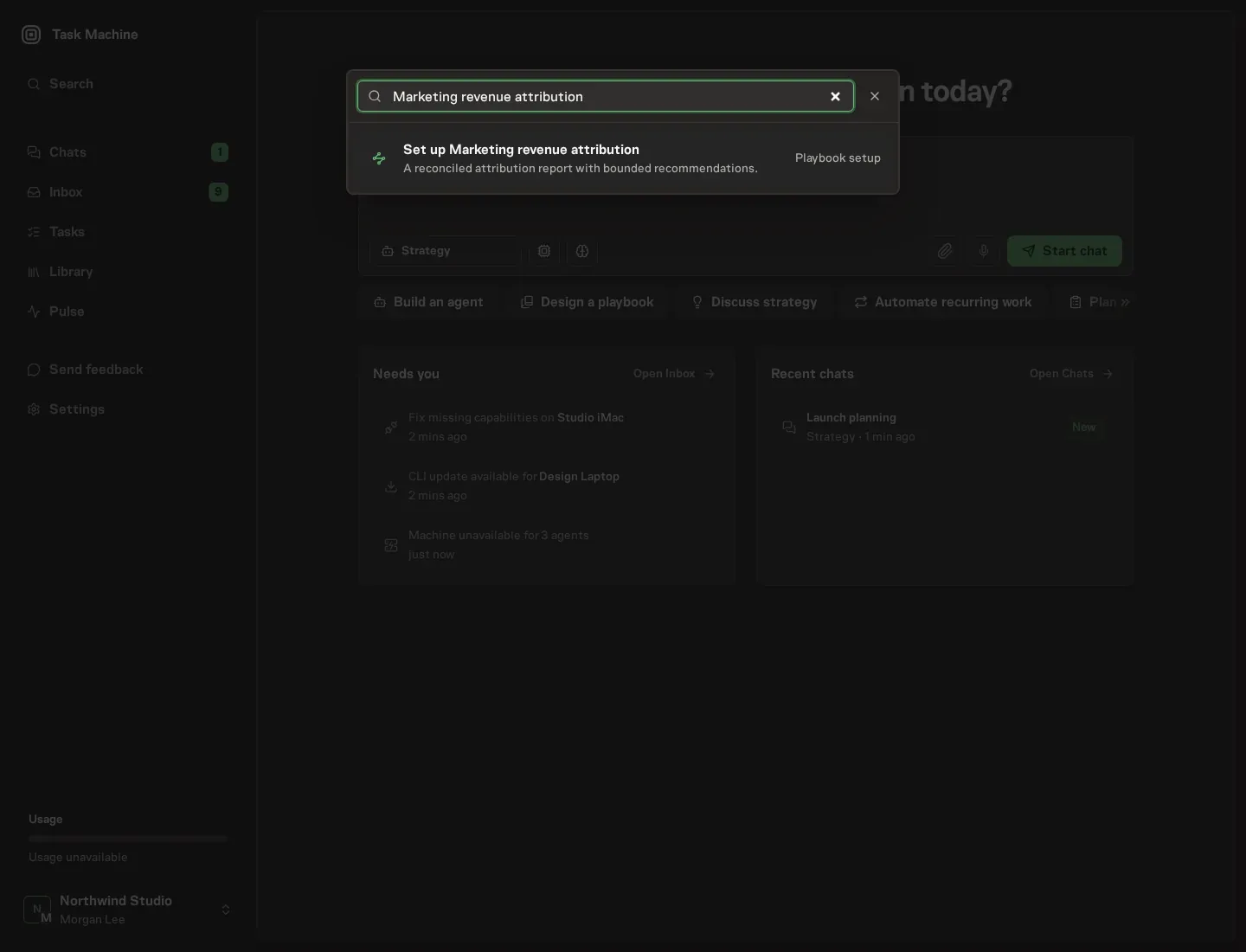
Open Search in your workspace and enter "Marketing revenue attribution". The command center lists Set up Marketing revenue attribution under Playbook setup.
2. Start the conversation
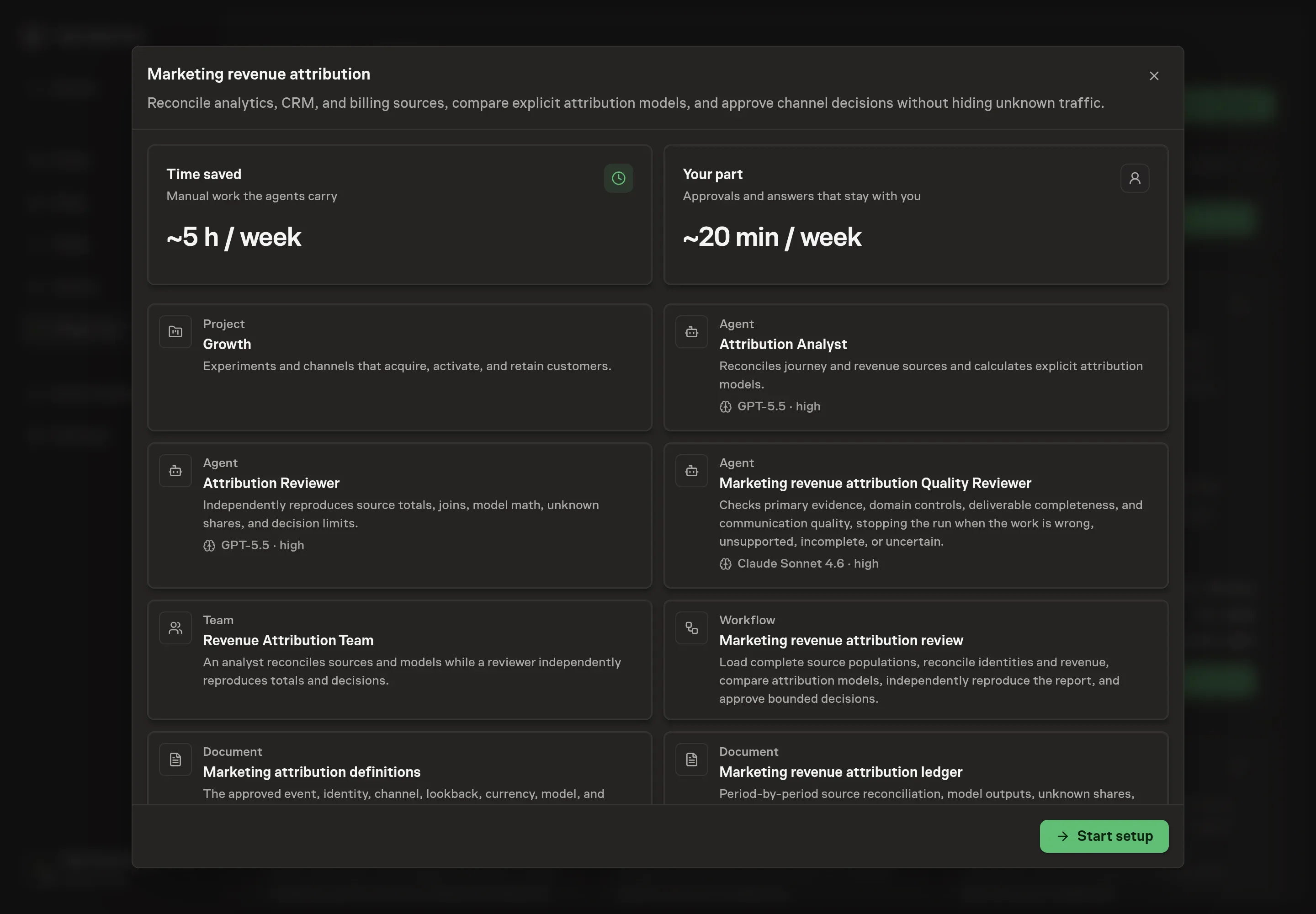
Choose Set up Marketing revenue attribution. Task Machine opens a dedicated Chat with the Playbook card and an editable, unsent request. Read the intended job and outcome. Add your situation and send it when ready. Opening the draft does not install anything or start work. This walkthrough uses settings that require approval of the proposed Playbook.
3. Agree the services
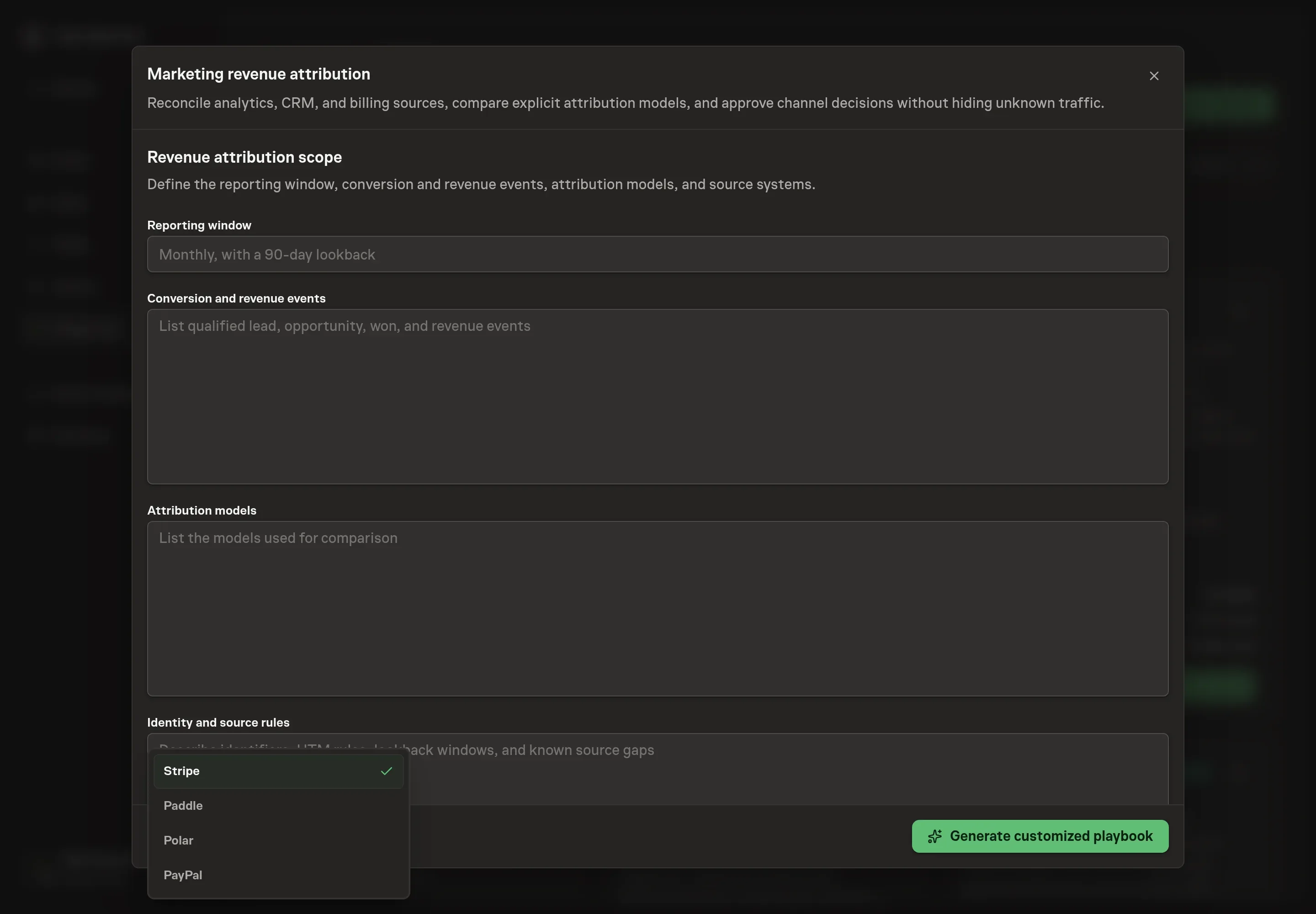
Tell the Agent which services you use. The catalog offers these starting choices:
- Product analytics providers: PostHog, Mixpanel. Optional.
- CRM providers: HubSpot, Attio. Optional.
- Billing providers: Stripe, Paddle, Polar, PayPal. Optional.
Discuss any missing access or export-based alternative before generation. Check the exact proposal includes only the services you agreed. Enter credentials only through secure setup, never in Chat.
4. Agree the working brief
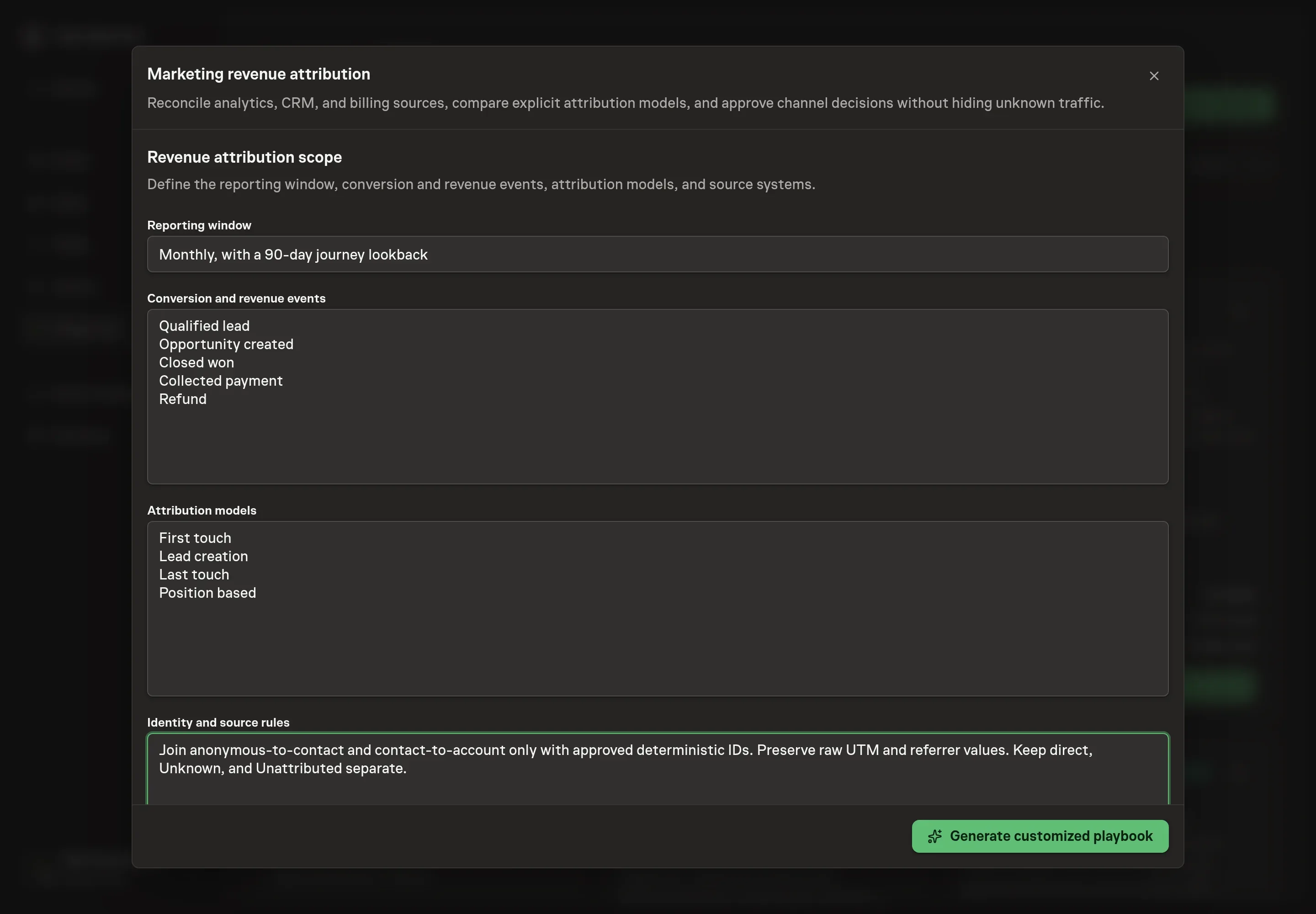
Use Chat to agree the inputs, expected output and limits before asking for a proposal. Discuss the reporting window, conversion and revenue events, models, identity rules, source precedence, lookbacks, and known gaps. A monthly B2B review might use a 90-day journey lookback, qualified lead, opportunity, won, collected payment, and refund events, with first-touch, lead-creation, last-touch, and position-based comparisons.
5. Review the proposed Playbook
Ask the Agent to generate the Playbook from the agreed brief. Open its proposal in Chat and check the instructions and resources it will install, which carry more detail than the conversational summary. Confirm that source reconciliation precedes model calculation, Unknown and Unattributed remain visible, every model uses one population, the reviewer independently reproduces totals, and approval does not authorize a budget change. Ask for a revised proposal if anything is missing or changes the job.
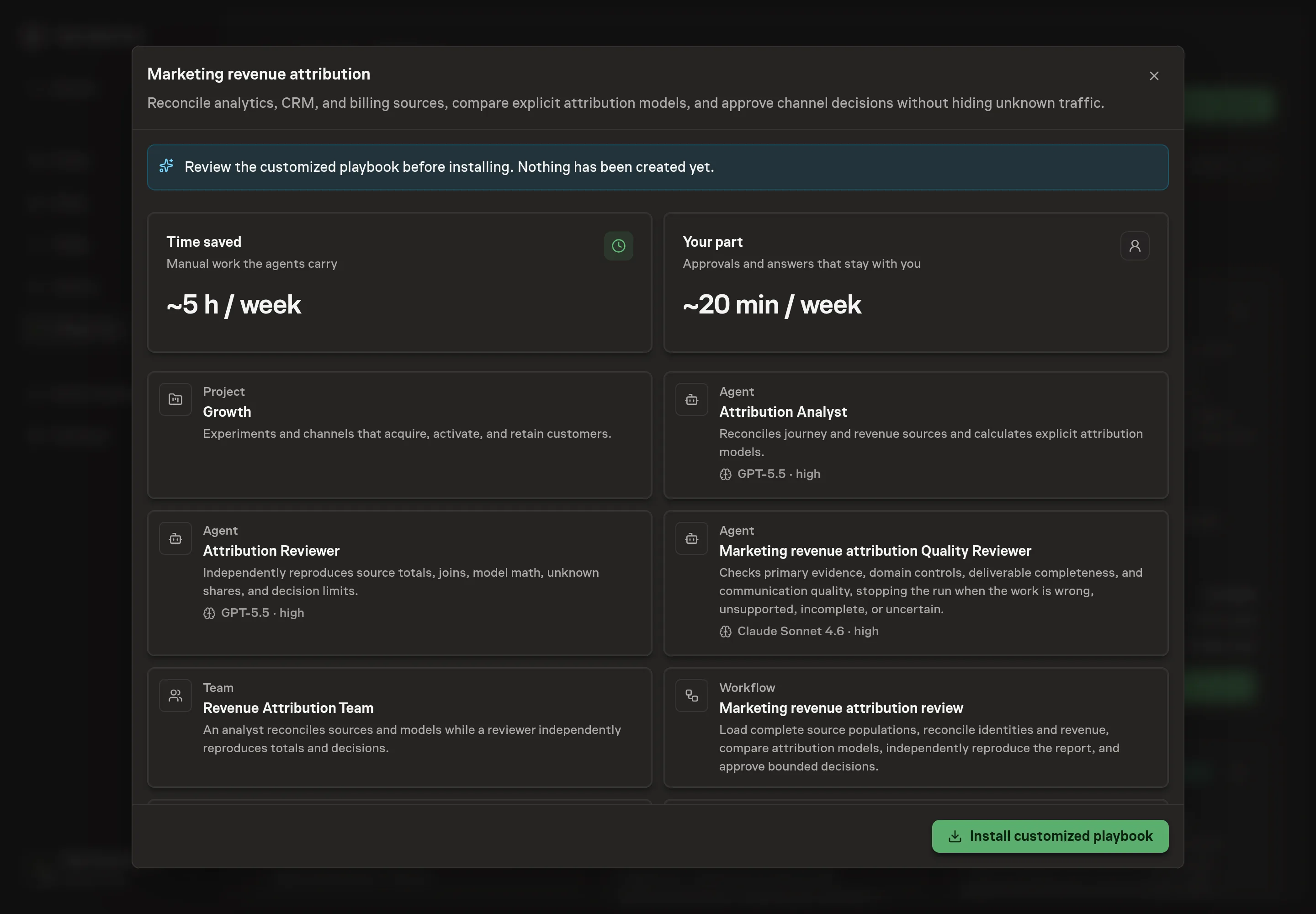
6. Approve and prepare the first work
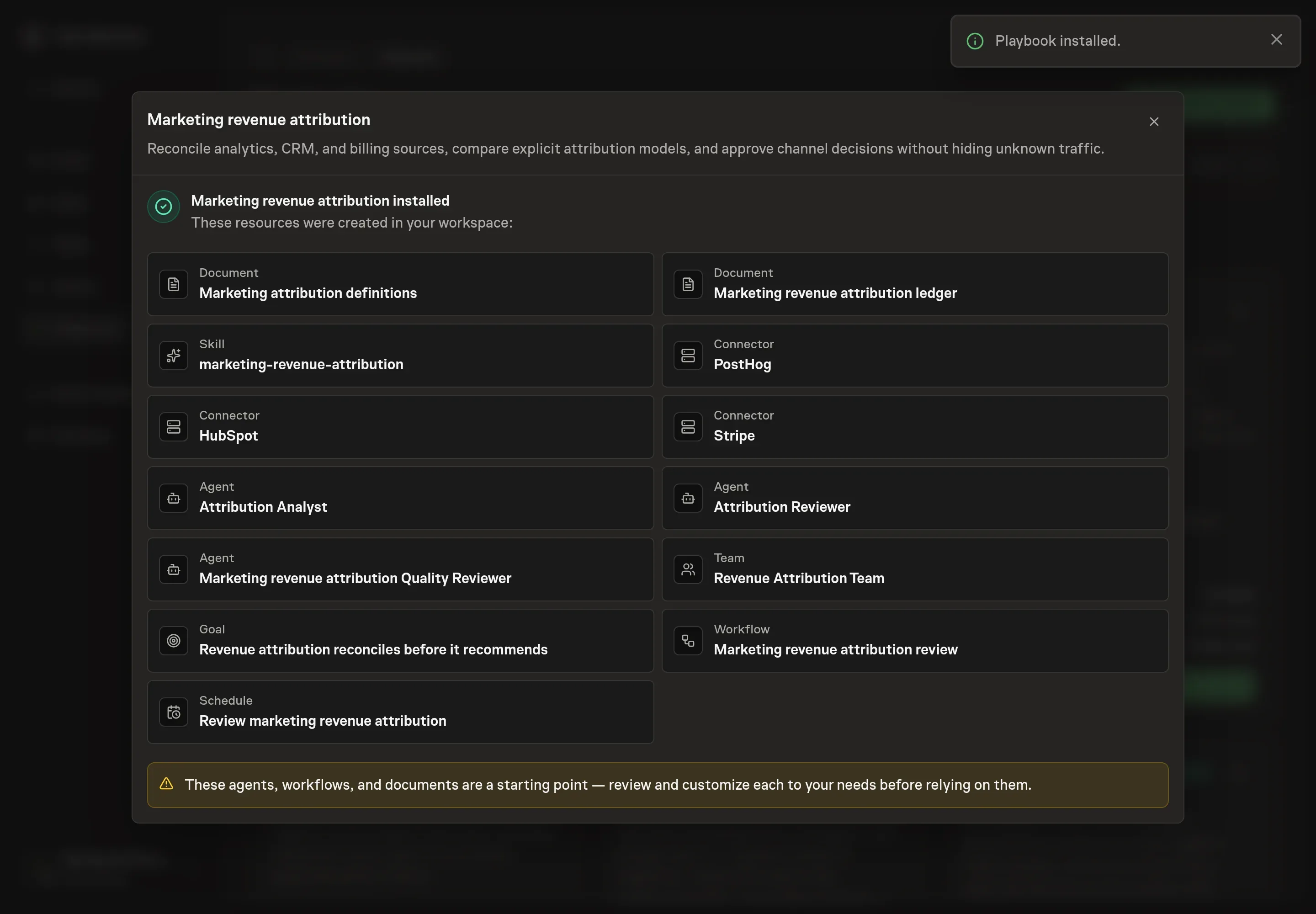
Choose Approve on the proposal in Chat when the configuration matches your brief. Task Machine installs that reviewed configuration. The approved item retains its review details. If your autonomy settings allow direct installation, this approval may not be required. Check the resulting configuration in that case too.
Complete any remaining secure service setup from the installation details in Chat. Inbox keeps those setup items available if you return later. Prepare the source documents and inputs before starting the first Task or Workflow. Installation does not authorize sending, publishing or changing an external service beyond the boundaries you agreed. Confirm each schedule's cadence and timezone, and resolve any pending schedule setup before it starts. A readback must wait for its agreed observation window and source data. Check the reviewed tracker or results document before the first cycle so evidence and human decisions have a durable home.
What good looks like
A useful attribution report passes three checks:
- Source totals reconcile visibly. Gross billing, refunds, net billing, CRM won value, joined revenue, exclusions, and unexplained differences remain traceable.
- Every model feet to one population. Channel credit plus Unknown, Unattributed, and explicit exclusions equals the same eligible total.
- Decisions survive model disagreement. The report shows caveats and counterevidence instead of choosing the model that favors a preferred channel.
The unknown share is a guardrail on confidence, not a target to manipulate. Its acceptable level depends on the journey and collection limits, and unexplained changes should trigger investigation.
How the loop learns
Each recurring review closes a mature reporting period under one definitions version. Analytics, CRM, and billing are the source systems. Joined net revenue is reconciled before channel credit. Qualified pipeline and won deals provide downstream context. Duplicate, orphan, late, Unknown, Unattributed, refund, and reconciliation-difference measures diagnose data quality.
The same population is evaluated under first touch, lead creation, last touch, and the approved position-based model. Material confounders include changed tracking, identity loss, campaign-tag changes, sales-cycle lag, currency conversion, offline touches, stage-definition changes, and late billing events.
The reviewer reproduces the evidence before a person approves a tracking investigation, preserves the current interpretation, or proposes a separate channel experiment. Attribution alone never proves incrementality. Budget decisions that need causal confidence should use a holdout, randomized test, geo experiment, or another suitable design.
Common questions
Which attribution model is best? No single descriptive model is universally best. Compare models over the same population and choose rules that match the question. Use experiments when the decision requires causal evidence.
What should happen to unknown traffic? Keep it visible as Unknown. Do not distribute it proportionally across known channels or infer a source from a model guess.
Should CRM won revenue equal billing revenue? Not automatically. Bookings, collected cash, refunds, timing, currency, and recurring revenue differ. Define the revenue basis and reconcile the difference explicitly.
Can the agent change campaign budgets from the report? No. It can prepare a bounded observation or experiment proposal. Human approval records that decision, and any budget or campaign change happens separately.
How are historical reports corrected? Add a restatement with the definitions version, reason, changed totals, approver, and date. Do not silently overwrite a closed period.