How to Automate Ad Creative Drafting
A practical guide to drafting ad creative with an agent: offer sharpening, distinct angles, platform-spec copy, and a channel plan behind approval.

Founder, Task Machine
Ad creative drafting is the process of turning one offer into ad sets that are ready to launch: the sharpened offer behind them, a set of distinct creative angles, headline and copy variants written to each platform's character limits, and a channel and ad-set plan for whoever runs the campaign. It is everything that happens between deciding to run ads and the first campaign going live.
It is worth doing well because creative is where paid acquisition is won or lost. In creative testing, the concept and angle move results more than the hook, the visual, the body copy, or the call to action, and a campaign built on a weak offer wastes every dollar behind it. The drafting itself is slow, repetitive work, which is why most small teams ship one angle, three lines of copy, and hope.
Why a single-angle ad set teaches you nothing
An ad set drafted in the campaign editor five minutes before launch fails in predictable ways. One angle means one reason to click, and if that reason misses the audience there is nothing else running to learn from. Copy written without checking specs gets rejected or truncated, because platforms cut over-limit lines whether the sentence was finished or not. And copy written on top of an unexamined offer inherits the offer's weakness: better copy on a weak offer compounds slowly, while a stronger offer with average copy converts immediately.
When nobody owns the drafting, the ads still go out. They just go out as whatever the person with account access could write under deadline, unmoored from the brand voice, untested against any bar, and impossible to iterate on because nobody recorded which angle each variant was supposed to carry.
What the manual process looks like
Done by hand, drafting a campaign's creative is a per-offer ritual with five steps:
- Restate the offer plainly: the core promise, the proof behind it, any guarantee, the price, and the one action the ad should drive.
- Brainstorm angles, meaning different reasons to click: the pain point, the outcome, social proof, curiosity, comparison, identity.
- Write headline, primary-text, and description variants per angle for each platform, checking every line against character limits (Google search headlines cap at 30 characters, Meta shows roughly the first 125 characters of primary text).
- Plan the account structure: campaigns, ad sets by targeting variation, two to three creative variations per set, a naming convention, and targeting notes.
- Review the whole set against a quality bar before handing it to whoever launches, trimming anything vague, over-limit, or off-voice.
Each step is teachable. Together they take hours per campaign, reward discipline over inspiration, and lose steps under deadline pressure. The steps that get skipped first, angles and the spec check, are the ones that decide whether the campaign teaches you anything.
What an agent can automate
Every step of that ritual except the launch decision is drafting work, which makes it a good fit for an agent running a fixed workflow:
- Sharpen the offer first. The agent runs the offer through the value equation (the dream outcome and the proof that makes it believable, weighed against how long the first win takes and what effort it costs) and through the six-part offer anatomy: core deliverable, bonus, guarantee, real scarcity, name, and price. Missing components get flagged before a single line is written, because a creative built on a weak offer is wasted work.
- Define distinct angles. Three to five different reasons to click, not reworded twins, each mapping back to one audience and one call to action. Angle is the biggest creative lever, so this step gets its own pass instead of being folded into copywriting.
- Draft copy to spec. Variants per angle on a proven frame (problem-agitate-solve, before-after-bridge, or a social-proof lead), with every line validated against the target platform's character limits. Over-limit lines get flagged and trimmed rather than left for the platform to cut.
- Lay out the channel and ad-set plan. Channels matched to the offer and audience, an ad-set structure with a clear naming convention, targeting notes as recommendations (lookalikes built off best customers, retargeting segmented by funnel stage, exclusions so spend never chases people who already bought), and a first angle to test with the reason why.
- Self-critique before handoff. The agent runs the finished set through a creative bar (offer sharpened, angles distinct, specs valid, copy specific and on-voice, channel plan runnable) and fixes every failure before you see the draft.
What stays with you is judgment: whether a claim is truthful given the proof you have, whether the offer is strong enough to spend behind, and the launch itself.
The guardrails that make it safe
Paid ads are one of the few places where an automation mistake costs real money in real time, so the shape of the automation matters more than usual. The safe shape here is strictly draft-only: the agent never launches a campaign, never connects to an ad account, and never spends money. Humans run the ads.
The workflow ends with an explicit approval step. The agent sharpens, drafts, plans, and self-critiques, then the finished ad sets wait for your approval, and nothing moves past that point without you. The agent also stops and asks rather than guessing when the offer is too weak to carry a creative, when the proof needed to make a claim truthful is not available, or when a compliance constraint is unclear. The method itself carries the same discipline: no fake urgency, no unearned superlatives, and no claims the landing page cannot deliver.
Set it up in Task Machine
The Ad creative writing playbook provides a starting point for the method above. You need an active Task Machine workspace with Chat, workspace-management and Playbook-installation access (workspace owners have it). Web research access is optional: until the agent's web search and fetch tools are available, it works from the offer brief and brand voice you supply and labels the gaps.
1. Find the playbook
Open Search in your workspace and enter "Ad creative writing". The command center lists Set up Ad creative writing under Playbook setup.
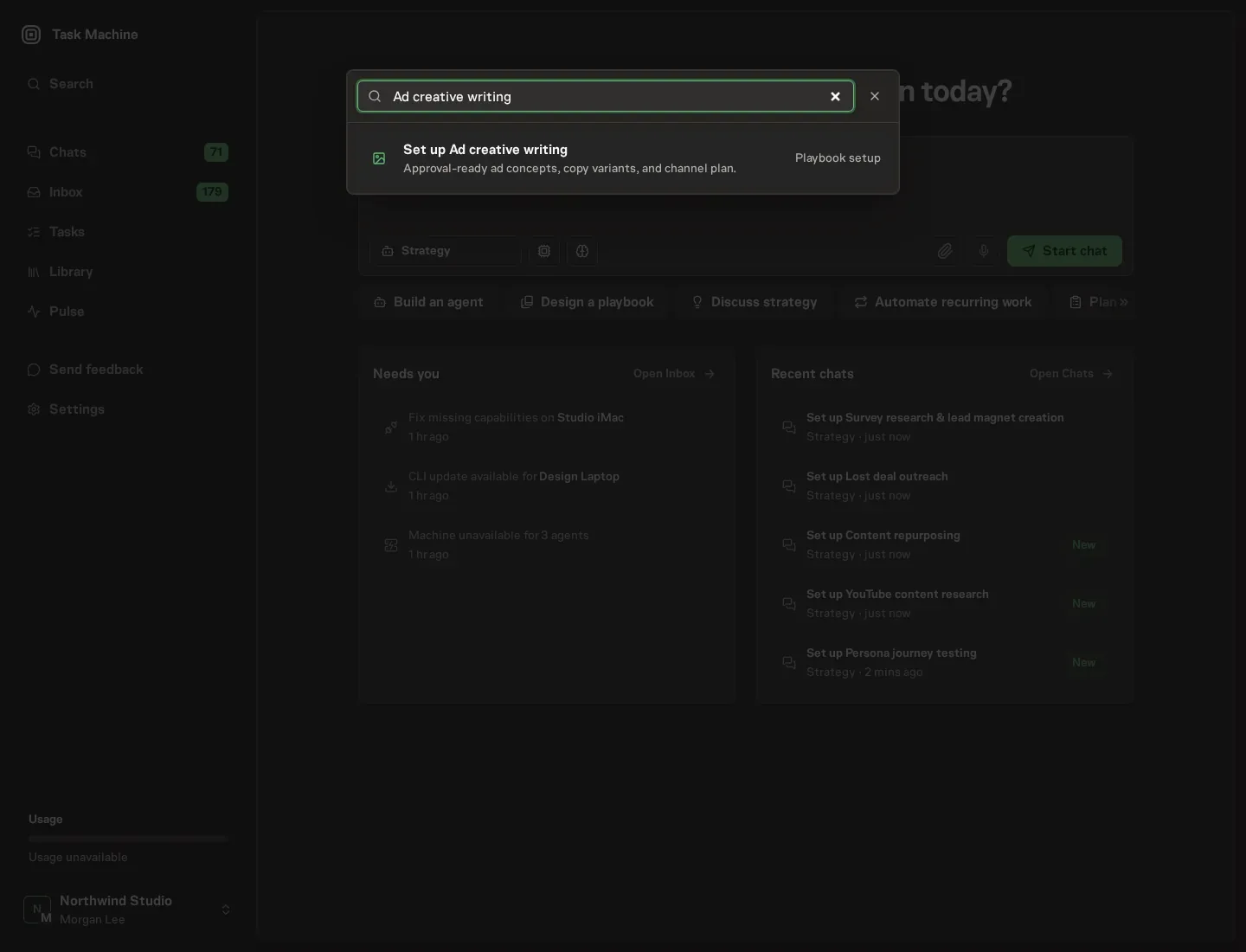
2. Start the conversation
Choose Set up Ad creative writing. Task Machine opens a dedicated Chat with the Playbook card and an editable, unsent request. Read the intended job and outcome. Add your situation and send it when ready. Opening the draft does not install anything or start work. This walkthrough uses settings that require approval of the proposed Playbook.
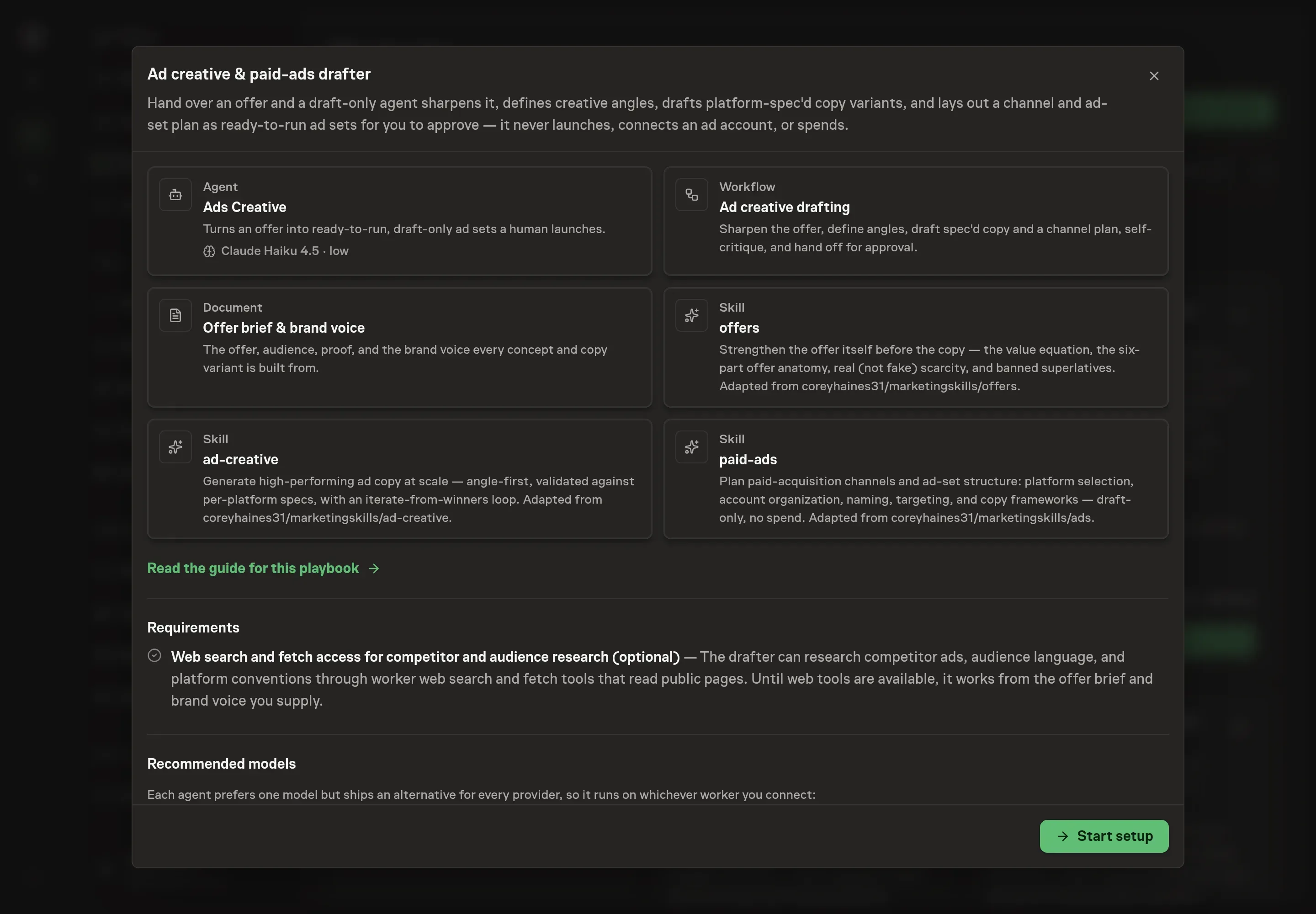
3. Agree the working brief
Use Chat to agree the inputs, expected output and limits before asking for a proposal. The Agent needs the brief that shapes every draft. Campaign goal sets the one outcome the ads should drive. Target audience describes who the ads are for and the pain they remove, which anchors every angle. Offer or product names what is being advertised, the raw material the value-equation pass sharpens. Ad channels lists the platforms you plan to run on, and the copy is validated against each one's character limits.
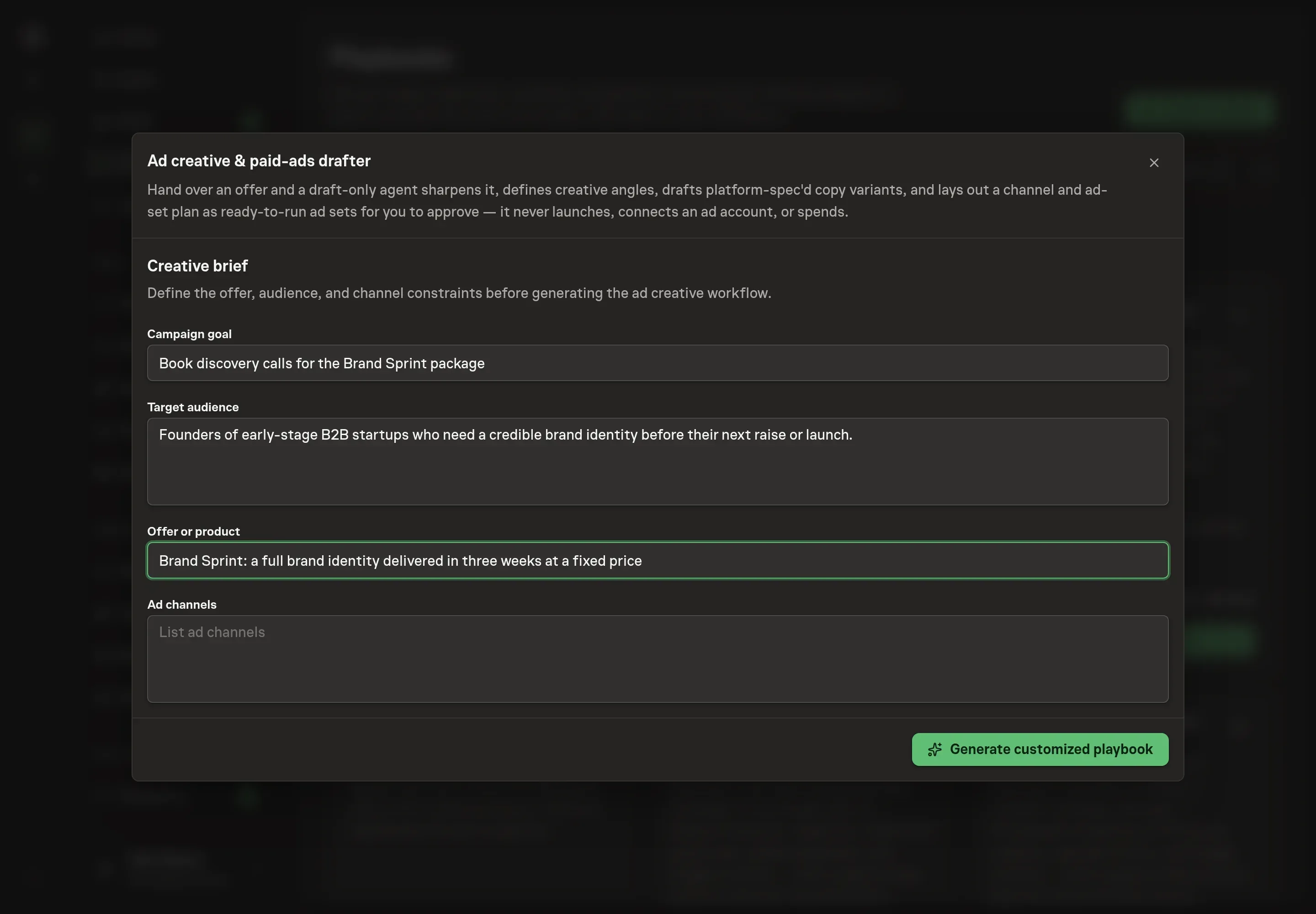
4. Review the proposed Playbook
Ask the Agent to generate the Playbook from the agreed brief. Open its proposal in Chat and check the instructions and resources it will install, which carry more detail than the conversational summary. Read through the agent and workflow cards, and confirm the goal, audience, and channels you agreed landed where the drafts will draw from. Ask for a revised proposal if anything is missing or changes the job.
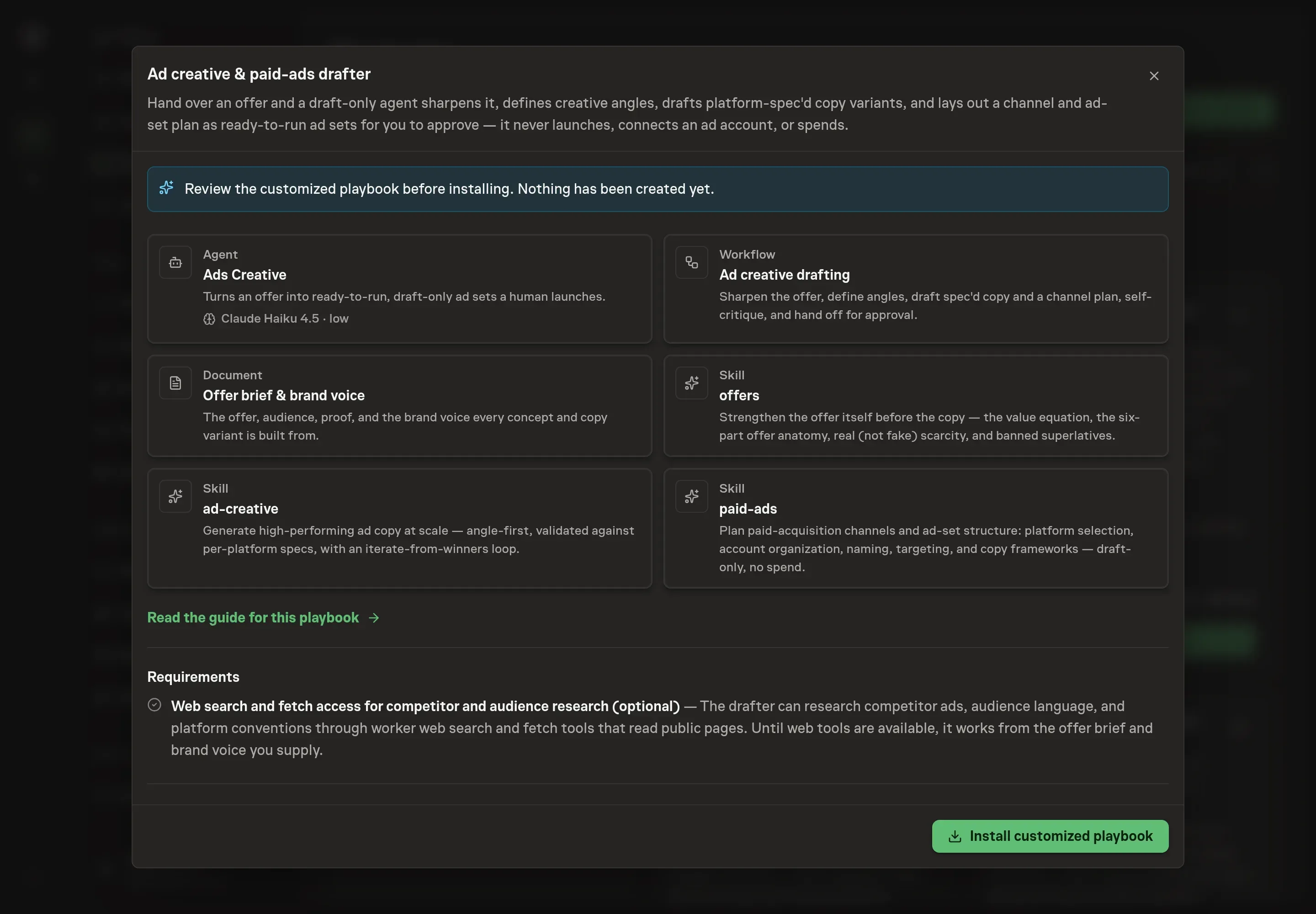
5. Approve and prepare the first work
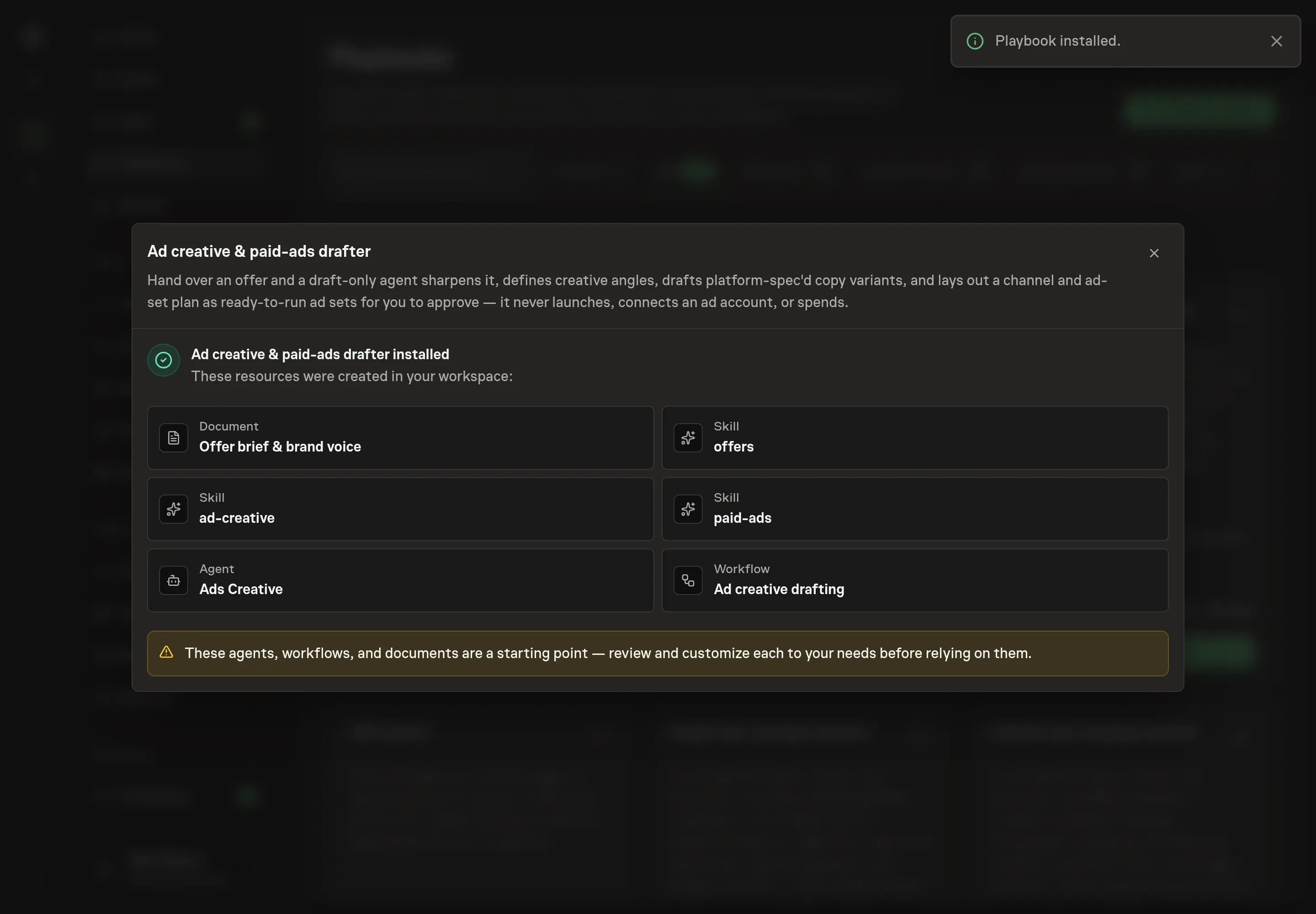
Choose Approve on the proposal in Chat when the configuration matches your brief. Task Machine installs that reviewed configuration. The approved item retains its review details. If your autonomy settings allow direct installation, this approval may not be required. Check the resulting configuration in that case too.
Complete any remaining secure service setup from the installation details in Chat. Inbox keeps those setup items available if you return later. Prepare the source documents and inputs before starting the first Task or Workflow. Installation does not authorize sending, publishing or changing an external service beyond the boundaries you agreed.
What good looks like
Three checks tell you whether a draft set is worth launching:
- Angles that are distinct. Three to five different reasons to click, each traceable to one audience and one call to action. If two angles read as the same idea in different words, the set will not teach you which motivation works.
- Every line within spec. Nothing over a platform's character limits, so nothing gets truncated mid-promise after launch.
- A plan someone can run without follow-up questions. Named ad sets, two to three creative variations per set, targeting notes, and a first angle to test with the reason why.
Once the ads run, iteration follows the same discipline. Analyze the winners and losers, double down on winning themes with fresh phrasing, and keep roughly seventy percent of test budget on proven angles and thirty on new ones. Honest expectations help here too: fixing one weak lever of an offer typically lifts results by ten to forty percent, not by multiples.
Common questions
Does the agent launch or spend anything? No. The whole process is draft-only by design: the agent never launches a campaign, never connects to an ad account, and never spends money. It produces ad sets you approve, and you launch them.
Can it draft without web research access? Yes. With web search and fetch tools available, the agent can study competitor ads and audience language. Without them, it works from the offer brief and brand voice you supply and labels the gaps, which is why the first follow-up asks you to finish that brief.
How many angles and variants should a draft set have? Three to five distinct angles, then two to three creative variations per ad set. More variants of one angle is not more coverage. Distinct angles are what let a test tell you which motivation moves your audience.
What happens when the offer itself is weak? The agent flags it and asks rather than papering over it with copy. Better copy on a weak offer compounds slowly, so the offer gets run through the value equation and the six-part anatomy first, and missing components (a guarantee, real scarcity, proof) are named before drafting starts.
Which platform should the first test run on? It depends on where the intent lives: search platforms fit people actively looking for the answer, visual feeds fit demand generation, and professional networks fit business audiences at higher price points. The channel plan names a first-test pick for your offer and the reason behind it, and you decide whether to follow it.