How to Automate Backlog Grooming and Prioritization
A practical guide to grooming a product backlog with an agent: framework selection, recomputable scoring, ranked top sets, and approval on every ranking.

Founder, Task Machine
Backlog grooming is the recurring work of turning a pile of raw product ideas into a ranked list you can act on: reading each item, scoring it against consistent criteria, ranking the results, and flagging anything too vague to judge. Prioritization is the scoring half of that job, and it only works when the same framework is applied the same way, cycle after cycle.
A groomed backlog is the difference between choosing the next bet and arguing about it. When every candidate carries a score a reader can recompute, the debate moves from opinions to assumptions. When nothing carries a score, the loudest voice in the room sets the roadmap.
An ungroomed backlog restarts every planning conversation
An ungroomed backlog does not fail loudly. Ideas arrive faster than anyone scores them, the unscored ones go stale at the bottom, and planning conversations restart from zero because there is no shared basis for comparison. Without any framework, prioritization defaults to whoever argues hardest, and any structure beats that.
The failure modes on the other side are just as common. A framework that does not fit the situation wastes effort: heavy weighted scoring kills the speed a pre-product-market-fit team needs, and a formula like RICE is the wrong instrument for a strategic bet. Switching methods every quarter produces framework whiplash, where scores from different cycles cannot be compared and the history of past decisions loses its meaning.
What the manual process looks like
Done by hand, backlog grooming is a recurring ritual with six steps:
- Confirm the product objective and the success metric this cycle is trying to move.
- Gather every candidate idea with its context, noting which items are missing the problem, reach, or outcome needed to score them honestly.
- Pick the framework that fits your stage and data, and stick with it across cycles.
- Score each item factor by factor and compute the result, keeping the arithmetic visible.
- Rank by score, then adjust for strategic fit, reversibility, and dependency unblocking, writing down the reason for every override.
- Present the top set with a rationale, the trade-offs considered, and what was deprioritized and why.
None of these steps is hard. Together they take real time, reward discipline over cleverness, and get skipped in busy weeks, which is exactly when the backlog grows fastest.
What an agent can automate
Most of that loop is mechanical once the method is written down, which makes it a good fit for an agent running a fixed workflow:
- Read and gather. The agent reads the raw ideas backlog and collects every candidate with its context. Items missing the problem, reach, or outcome needed for an honest score get noted up front instead of discovered mid-ranking.
- Choose the framework. Four context questions drive the choice: product stage, team context, decision need, and data availability. Minimal data points to ICE, some data with an aligned team points to RICE, and rich customer data points to Opportunity Score or Kano. The agent states its choice and holds it across runs to avoid framework whiplash.
- Score factor by factor. Every score shows its factors and its formula, so a reader can recompute it. Opportunity Score is Importance × (1 − Satisfaction). ICE is Impact × Confidence × Ease. RICE is (Reach × Impact × Confidence) / Effort. Confidence stays honest rather than inflated to favor an item.
- Rank and adjust. The agent sorts by score, then adjusts for strategic fit, reversibility, and dependency unblocking, justifying every override in writing. Scores are input, not gospel: "A scored 8000, B scored 7999, therefore A" is a misuse of the method.
- Flag what cannot be scored. An item too vague to score honestly is marked "needs clarification" rather than given an invented number that would poison the ranking's comparability.
- Self-critique the ranking. Before anything reaches you, the agent re-reads its own work against the method's bar: framework fit stated, factors explicit, confidence honest, overrides justified, vague items flagged. It fixes every miss first.
What stays with you is judgment. Naming the product objective, deciding when strategy outweighs a score, and approving the final ranking are calls the agent hands over rather than makes.
The guardrails that make it safe
A ranked backlog shapes what a team builds next, so no ranking should take effect on an agent's say-so. The workflow ends at an explicit human approval step: the agent reads, scores, ranks, and self-critiques, then the proposed ranking waits in your inbox alongside the self-critique notes. You review, adjust anything you disagree with, and approve before the backlog changes.
The agent also knows when to stop and ask. An unclear product objective, a top ranking that depends on data it does not have, or a high-scoring item that conflicts with a stated strategic priority all pause the run for your input instead of producing a confident-looking guess. Because every score is recomputable and every override is justified in writing, you can always audit how the ranking was reached.
Set it up in Task Machine
The Backlog review & prioritization playbook provides a starting point for the method above. You need an active Task Machine workspace with Chat, workspace-management and Playbook-installation access (workspace owners have it). No external services need to be authorized. The agent works from the backlog source you name during setup.
1. Find the playbook
Open Search in your workspace and enter "Backlog review & prioritization". The command center lists Set up Backlog review & prioritization under Playbook setup.
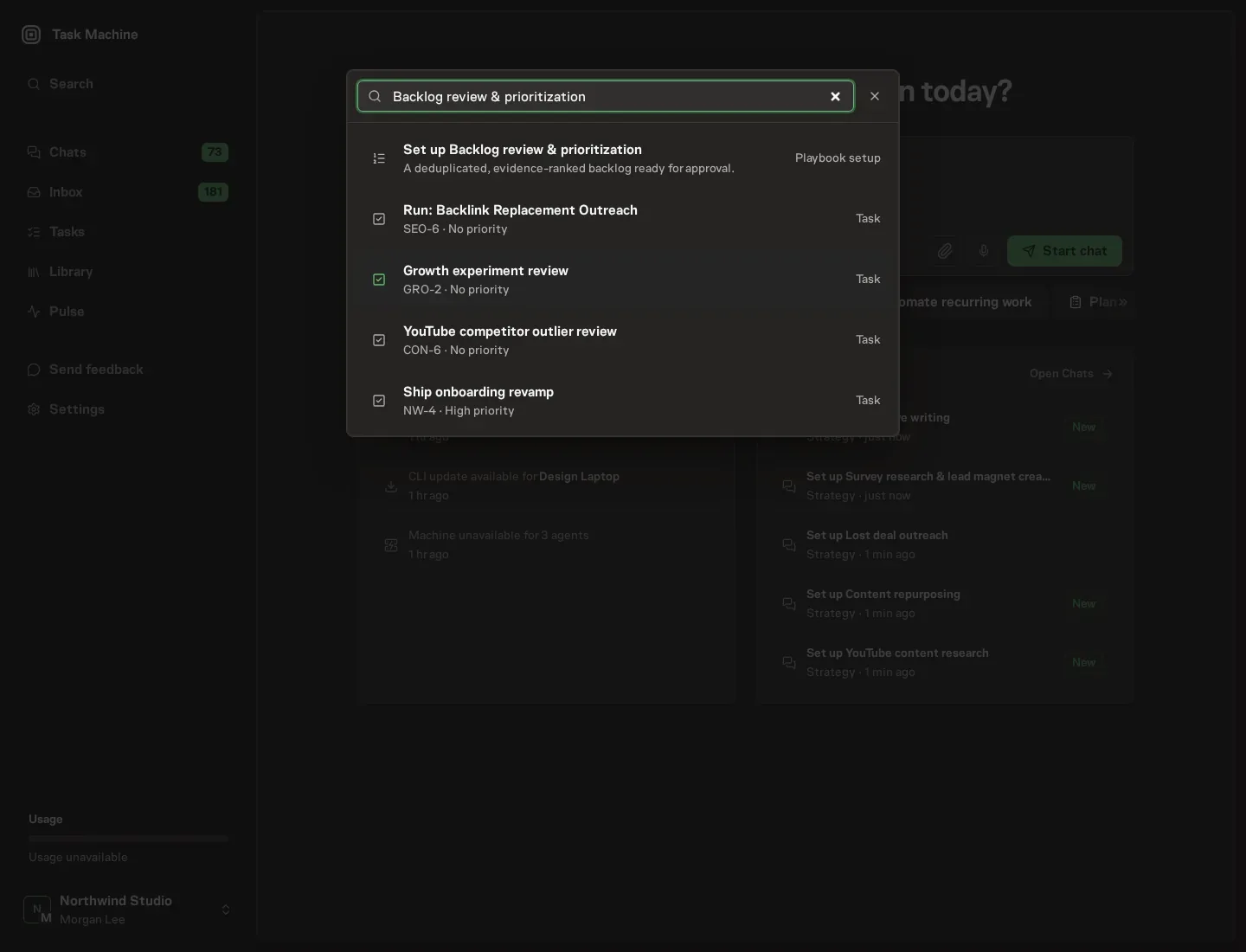
2. Start the conversation
Choose Set up Backlog review & prioritization. Task Machine opens a dedicated Chat with the Playbook card and an editable, unsent request. Read the intended job and outcome. Add your situation and send it when ready. Opening the draft does not install anything or start work. This walkthrough uses settings that require approval of the proposed Playbook.
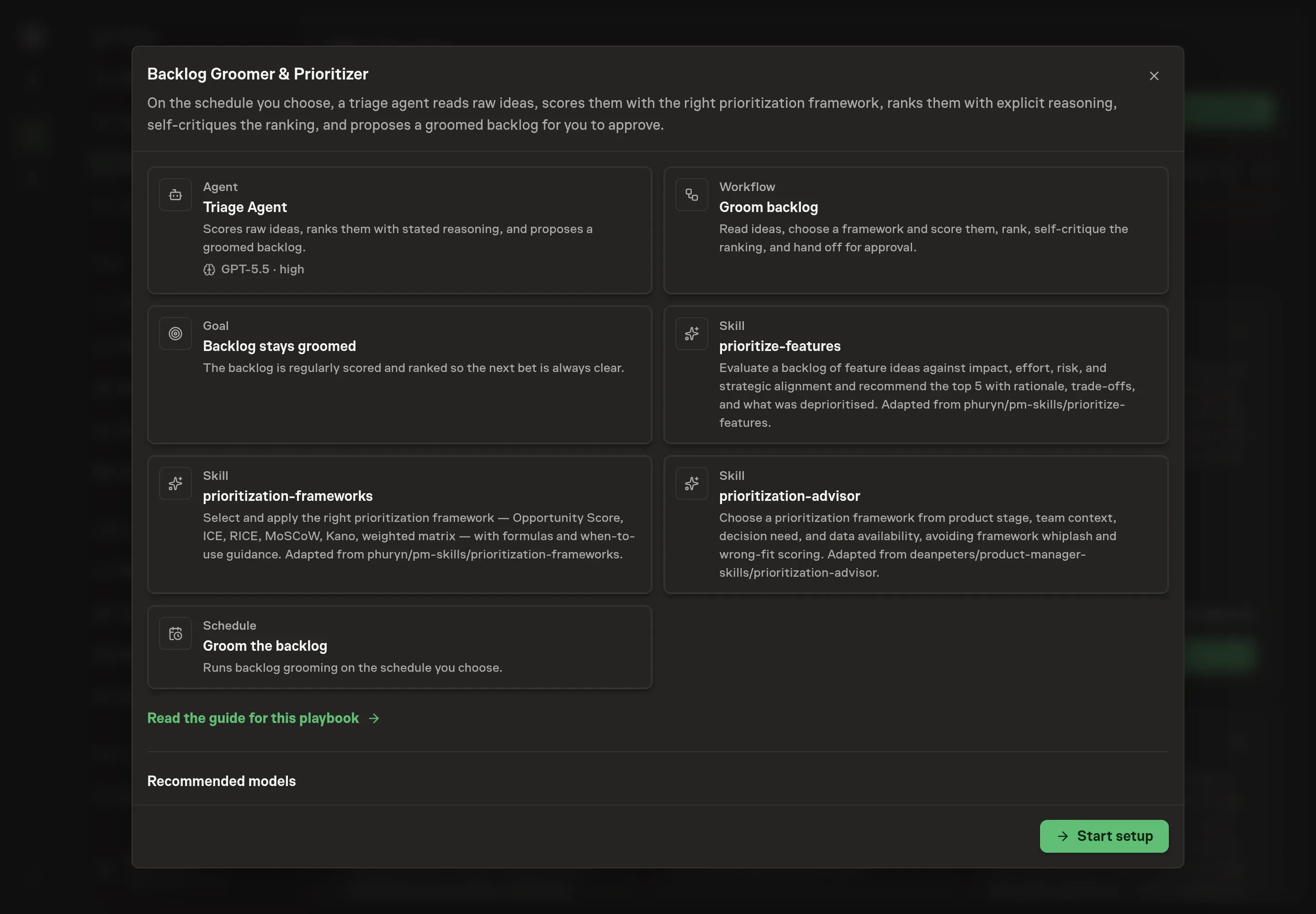
3. Agree the working brief
Use Chat to agree the inputs, expected output and limits before asking for a proposal. The Agent needs the backlog triage scope, the details that shape every run. Project identifies where the groomed backlog lives. Backlog source names where your raw ideas accumulate, so the agent reads the right list. Prioritization criteria lists the factors that matter most in your ranking, and Planning window sets the horizon the top set should plan for.
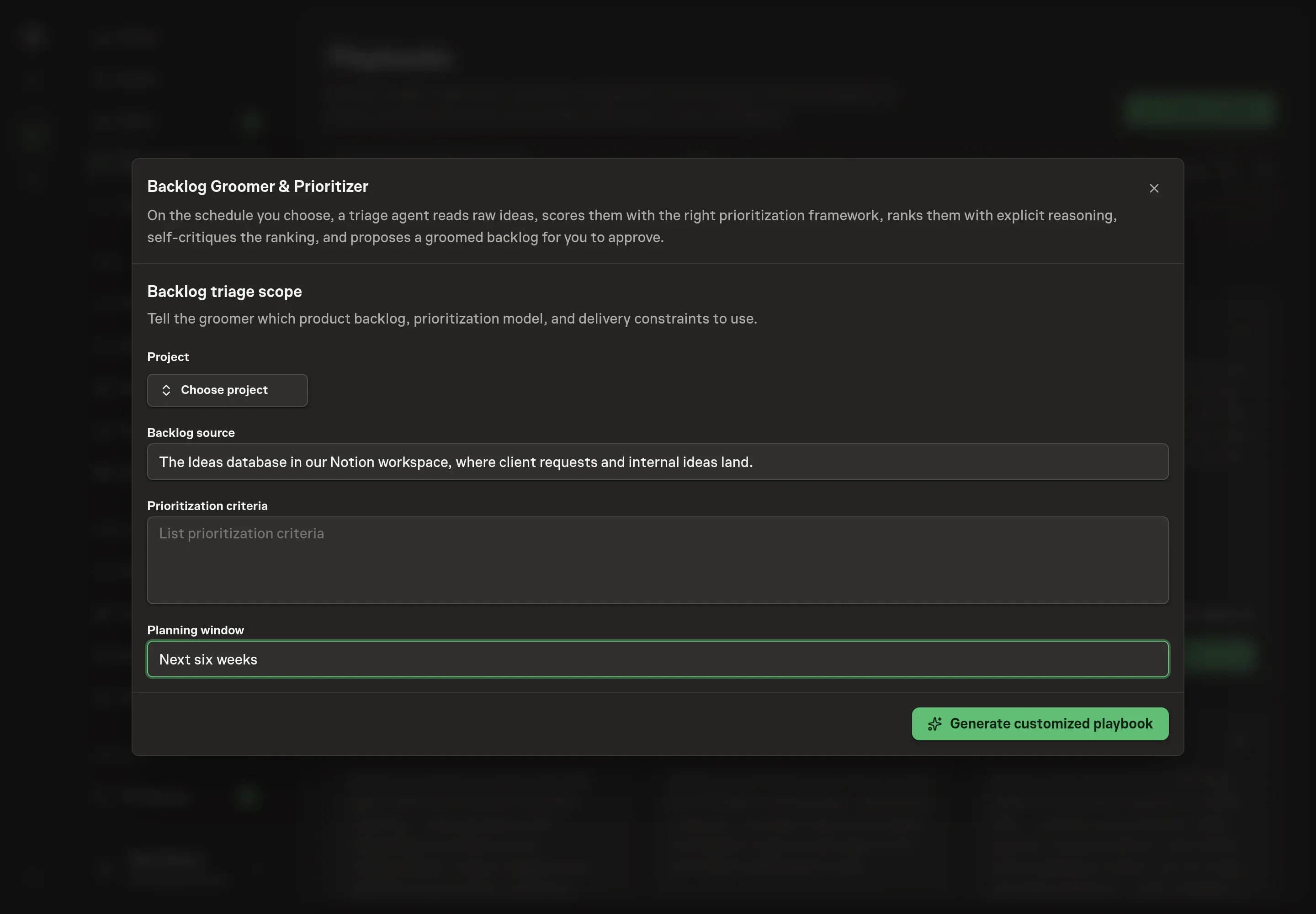
4. Review the proposed Playbook
Ask the Agent to generate the Playbook from the agreed brief. Open its proposal in Chat and check the instructions and resources it will install, which carry more detail than the conversational summary. Read through the agent and workflow cards and confirm the backlog source, criteria, and planning window landed the way you meant them. Ask for a revised proposal if anything is missing or changes the job.
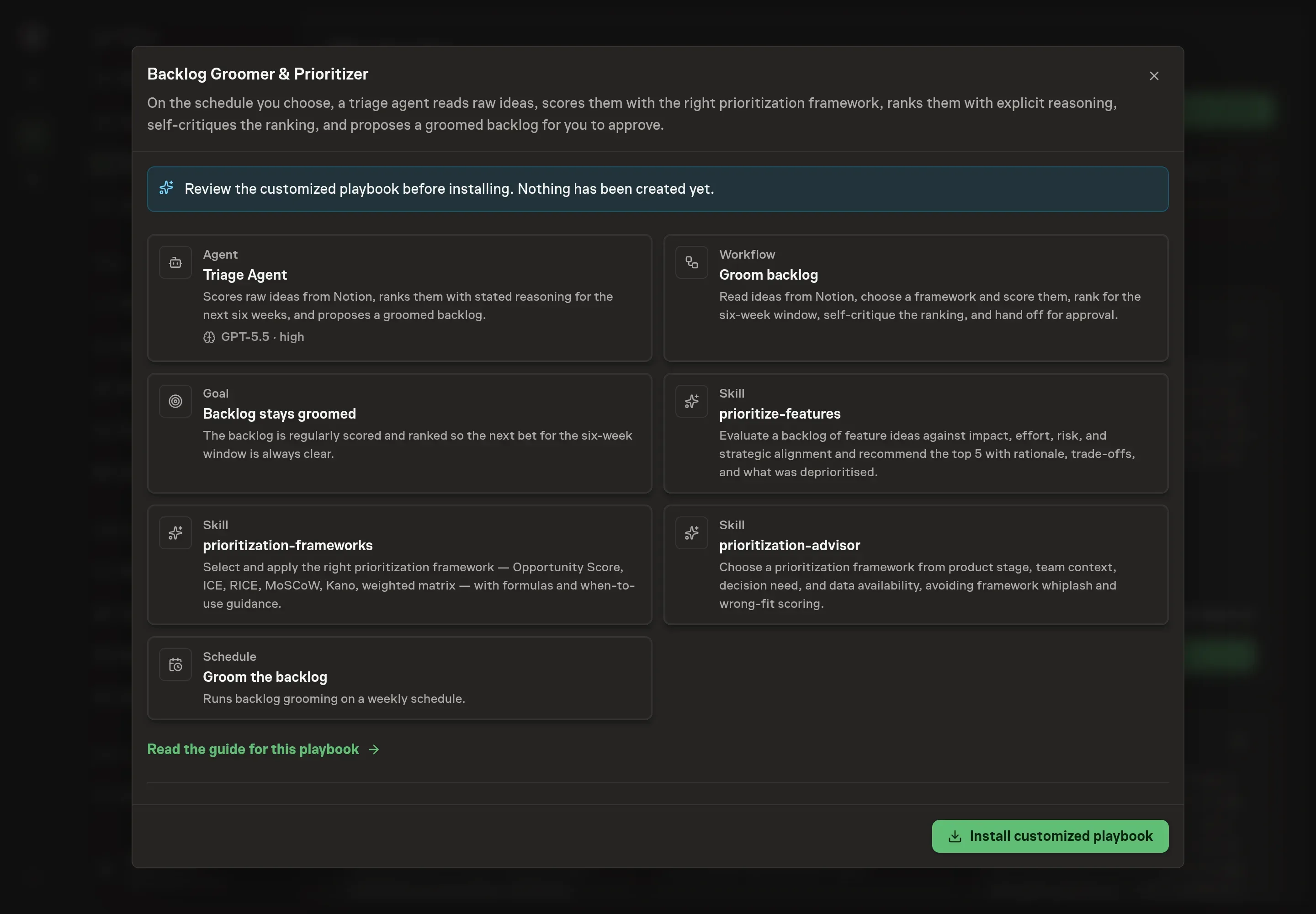
5. Approve and prepare the first work
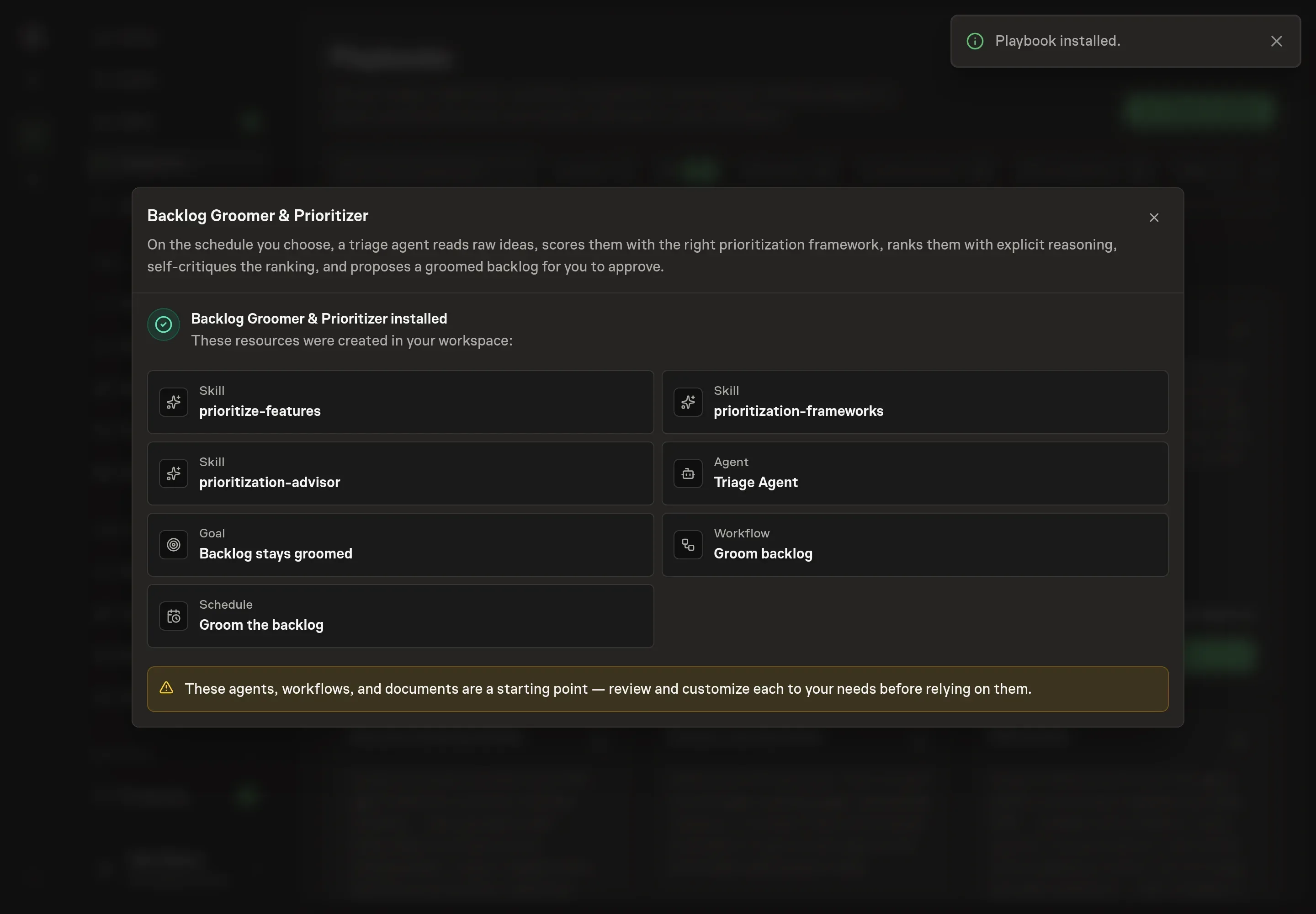
Choose Approve on the proposal in Chat when the configuration matches your brief. Task Machine installs that reviewed configuration. The approved item retains its review details. If your autonomy settings allow direct installation, this approval may not be required. Check the resulting configuration in that case too.
Complete any remaining secure service setup from the installation details in Chat. Inbox keeps those setup items available if you return later. Prepare the source documents and inputs before starting the first Task or Workflow. Installation does not authorize sending, publishing or changing an external service beyond the boundaries you agreed. Confirm each schedule's cadence and timezone, and resolve any pending schedule setup before it starts. A readback must wait for its agreed observation window and source data.
What good looks like
A working grooming process shows up in the artifact itself:
- Every score is recomputable. Each ranked item shows its factors and its formula, so anyone reading the ranking can redo the arithmetic and challenge the assumptions instead of the conclusion.
- The top set is complete. Each recommended item (typically the top five) carries a rank, a brief rationale, the trade-offs considered, and what was deprioritized and why.
- Vague items are flagged, not guessed. After each run, every backlog item is either scored under the chosen framework or marked "needs clarification". No stale, unscored items linger.
- One framework, held steady. Keep one method for six to twelve months and reassess only when the product stage, the team, or the stakeholder dynamics change.
Common questions
How do you choose a prioritization framework? Match the framework to your stage and data. With minimal data, use ICE or a simple value-versus-effort grid, because you need experiments rather than rigorous scoring. With some data and an aligned team, RICE adds structure without overwhelming. With rich customer data, Opportunity Score or Kano put that data to work. When stakeholders are misaligned, a transparent weighted matrix helps because the process itself builds buy-in.
Are the scores the final word? No. Scores are input, not gospel. An item may score lower yet matter more, such as a bet that opens an enterprise segment, and judgment overrides the score when strategy demands it. The discipline is that every override is justified in writing, and ties break on strategic fit, reversibility, and dependency unblocking.
What happens to ideas that are too vague to score? They get flagged "needs clarification" instead of receiving an invented number. A guessed score looks precise but corrupts the whole ranking's comparability. Flagging turns a vague idea into a concrete follow-up: gather the missing problem, reach, or outcome, then score it in the next run.
Can the agent change the backlog without approval? No. The workflow ends at a human approval step. The agent proposes a ranking with its self-critique notes attached, and you review, adjust, and approve before anything takes effect.
How often should grooming run? Pick a cadence that matches how fast ideas arrive and hold it, because consistency is what keeps the backlog from going stale. The more important constant is the framework: keep one method for six to twelve months so scores stay comparable, and reassess only when the product stage or team context changes.