How to Build a Client Research Dossier
A practical guide to kickoff-ready client research with agents: four-axis research, cited claims, adversarial verification, and human approval.

Founder, Task Machine
A client research dossier is the brief an account team walks into a kickoff with: who the prospective client is, what their leadership says the company is trying to become, what market they compete in, who their direct competitors are, what tools and technology they run on, and where the engagement can create an edge. Done properly, every claim in it traces to a public source with a date, and the analysis is kept clearly separate from the facts.
For an agency, that first meeting is one of the highest-leverage hours in the whole engagement. The team that has done the reading asks sharper questions, skips the discovery the client has already answered publicly, and starts earning trust in the first hour instead of the first month.
Kickoff prep gets skipped because it is never urgent
The kickoff happens whether the prep happened or not, which is exactly why the prep gets skipped. Research on a prospect is never the urgent thing. It loses to billable work all week, gets compressed into a skim of the client's homepage the night before, and nobody on the team formally owns it.
The cost shows up in the room. A generic first meeting spends its time on questions the client's own press page answers. Worse is the confident wrong fact: a stale funding number or a misremembered quote repeated to the people who know better. Either way the client leaves the kickoff having taught you their business instead of having watched you understand it.
What the manual process looks like
Done by hand, kickoff research is a ritual with six steps:
- Read the client's site, press, and executive interviews to work out what the business does and where its leadership says it is heading.
- Map the market: the segment, the customer base, and where the client sits in it.
- Identify the direct competitors and read each one's positioning, pricing, and customer reviews.
- Work out the tools and technology the client relies on, often from job postings and the pages themselves.
- Write it all up into something the account team can read before the meeting.
- Check the claims that matter, because a wrong number in the kickoff room is worse than no dossier at all.
Each step rewards thoroughness over cleverness. Together they amount to a serious block of reading and writing that has to happen in the busiest week of the engagement, right before the kickoff.
What an agent can automate
Almost all of that ritual is disciplined legwork rather than judgment, which makes it a good fit for a pair of agents running a fixed workflow:
- Research all four axes. A lead researcher covers the business, market, competitor, and stack as focused research passes. The business axis follows an executive-insights frame: company overview, the leadership's vision in their own quoted words, product strategy and recent launches, transformation initiatives, and the forward roadmap.
- Cite as it goes. Every finding carries a source URL and an access date. Critical claims, such as funding, revenue, market size, leadership, and positioning, need two or more independent sources or they are flagged Low-confidence instead of asserted. Gaps are admitted rather than papered over.
- Profile the competitive set. Around five direct competitors, each with positioning, strengths, weaknesses, and pricing, and across the set the differentiation gaps and unmet needs the engagement's pitch is built from.
- Compile into your format. The findings land in a fixed dossier structure: business, market, competitors, stack, angles, confidence and gaps, and sources. Facts are attributed to their sources, and the Angles section is labeled as analysis grounded in the cited facts, hedged as analysis, never asserted as fact.
- Verify adversarially. A second agent spot-checks the load-bearing claims against their cited sources: every claim an angle rests on, the critical facts, and every direct quote. Unsupported claims get removed or rewritten to what the source says, and stale ones get demoted.
What stays with you is judgment: which angles to lead with in the room, what the dossier means for the pitch, and the final approval.
The guardrails that make it safe
The failure mode of automated research is confident fabrication. A made-up funding round or a misattributed quote reaching a kickoff is worse than an empty section, so the process is built to prevent exactly that.
Three guardrails do the work. The researcher halts when web research is unavailable rather than inventing business facts from memory. A separate verifier opens the cited source behind each load-bearing claim and confirms the source supports it, so nothing fabricated or unsupported survives into an angle. And the finished dossier goes nowhere on its own: it waits in your inbox as an approval, where you read it, request a deeper dig into any section that feels thin, and sign off. The sources section lists every URL with its access date, so anything can be re-checked later.
Set it up in Task Machine
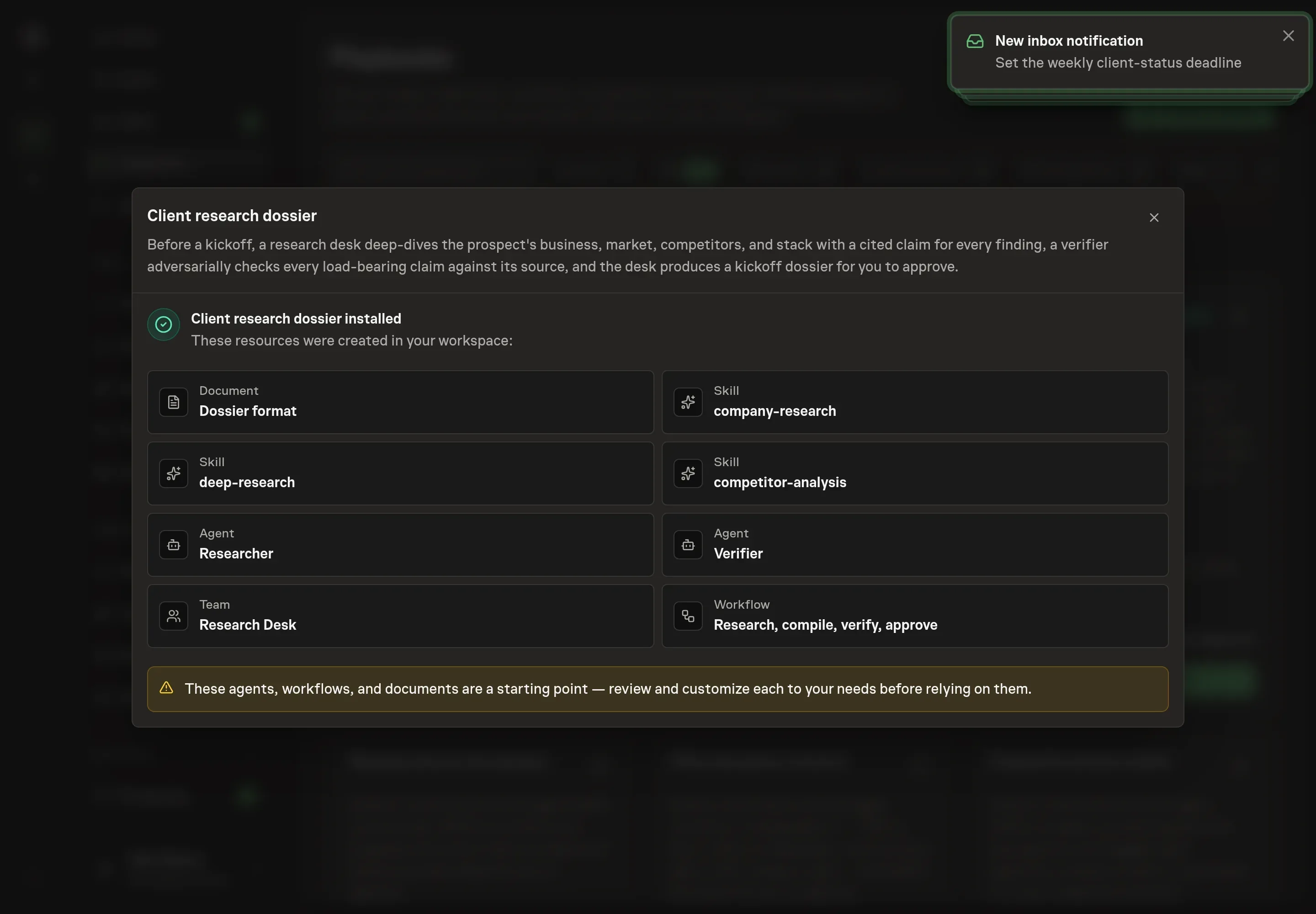
The Client research playbook provides a starting point for the method above. You need an active Task Machine workspace with Chat, workspace-management and Playbook-installation access (workspace owners have it). No access to the client's systems is needed. The desk researches entirely from public web pages and pauses for your approval on the final dossier.
1. Find the playbook
Open Search in your workspace and enter "Client research". The command center lists Set up Client research under Playbook setup.
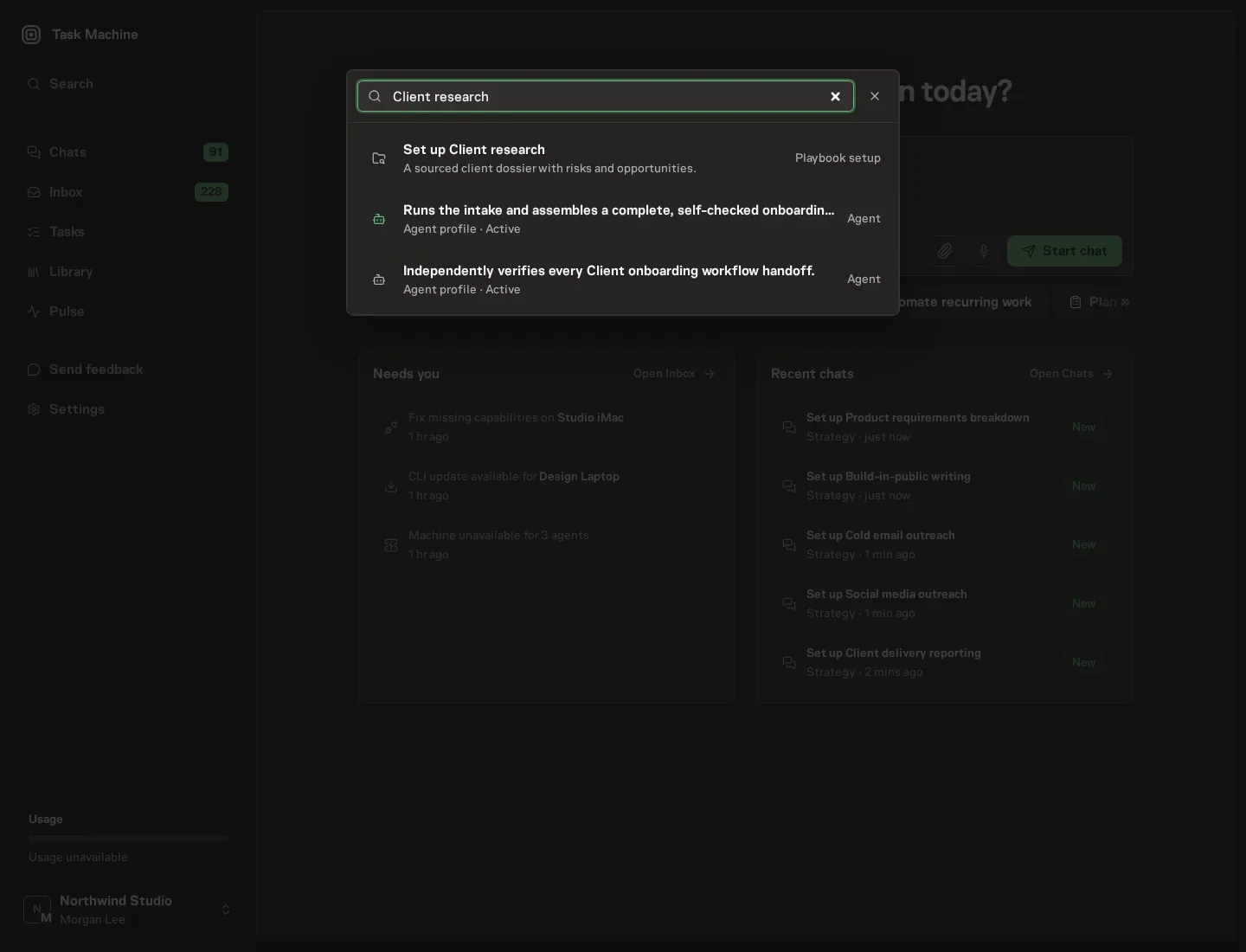
2. Start the conversation
Choose Set up Client research. Task Machine opens a dedicated Chat with the Playbook card and an editable, unsent request. Read the intended job and outcome. Add your situation and send it when ready. Opening the draft does not install anything or start work. This walkthrough uses settings that require approval of the proposed Playbook.
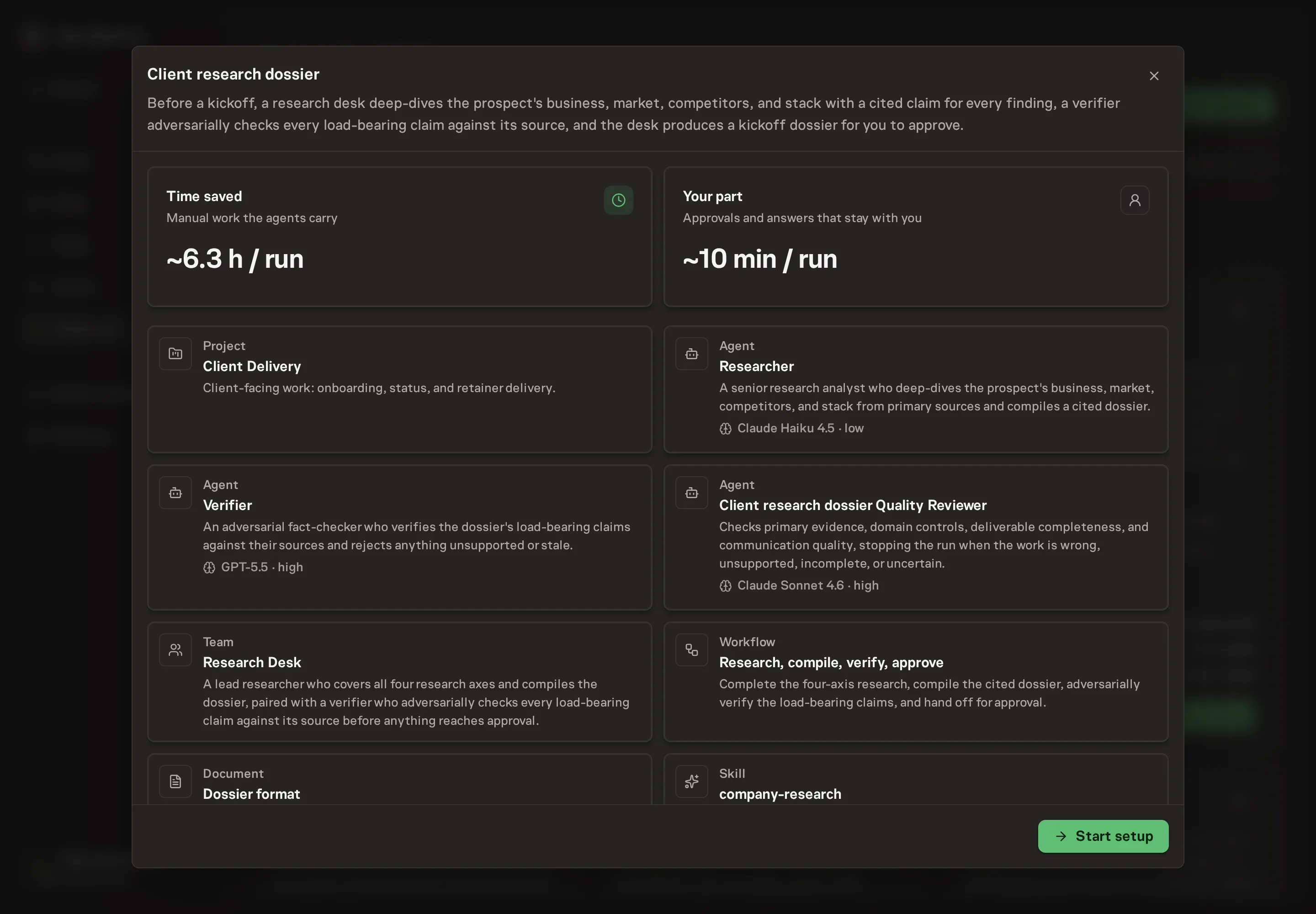
3. Agree the working brief
Use Chat to agree the inputs, expected output and limits before asking for a proposal. The Agent needs the details that shape the research. Client or account name names the prospect the desk researches. Client website URL gives the researcher its first primary source. Research questions are the specific questions the dossier must answer, and they steer where the research digs deepest. Sales or delivery context describes what you are pitching and when, which points the Angles section at the engagement you want to win.
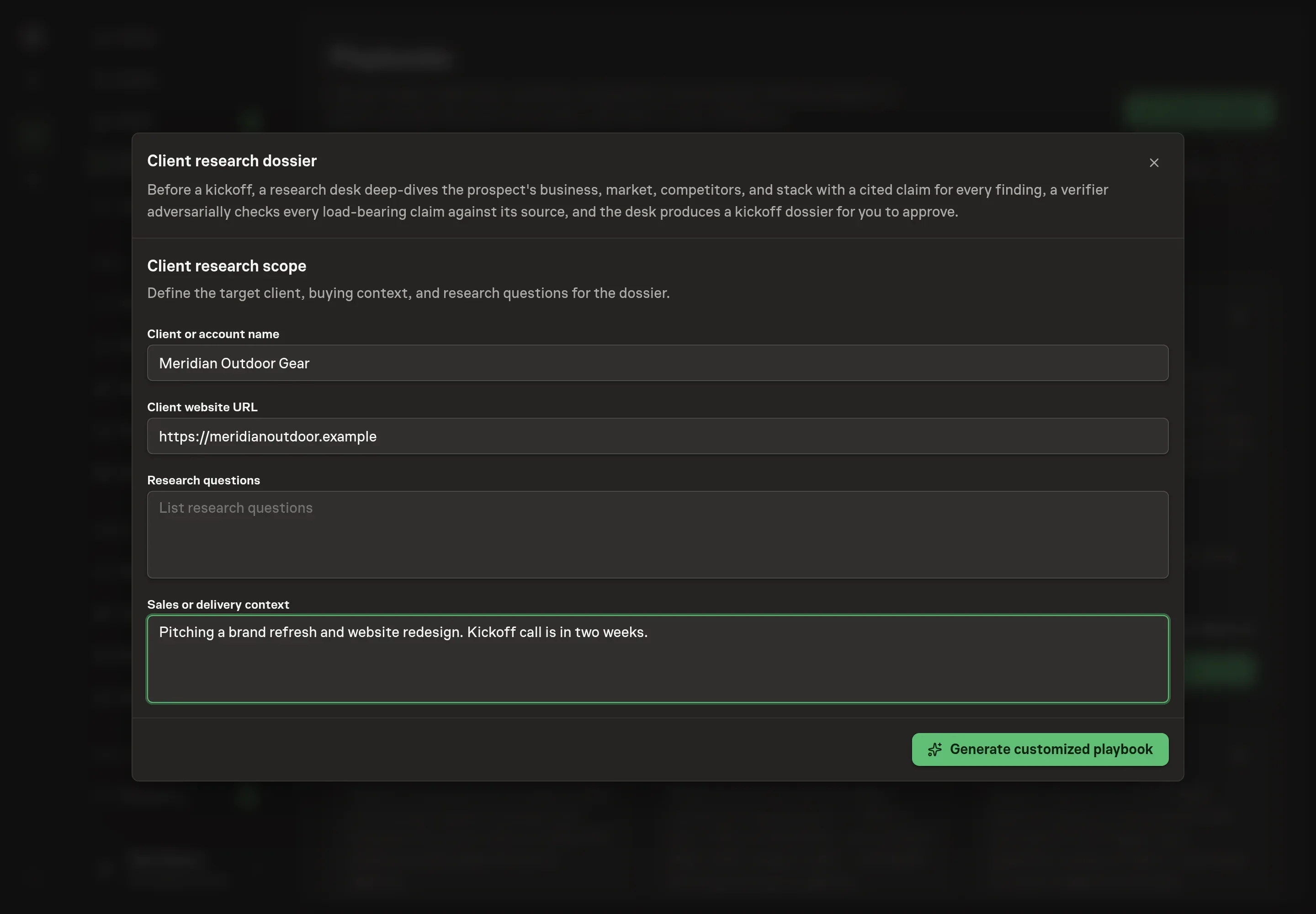
4. Review the proposed Playbook
Ask the Agent to generate the Playbook from the agreed brief. Open its proposal in Chat and check the instructions and resources it will install, which carry more detail than the conversational summary. Read the Researcher and Verifier cards, check that your research questions shaped the workflow, and confirm the dossier sections match what your account team expects. Ask for a revised proposal if anything is missing or changes the job.
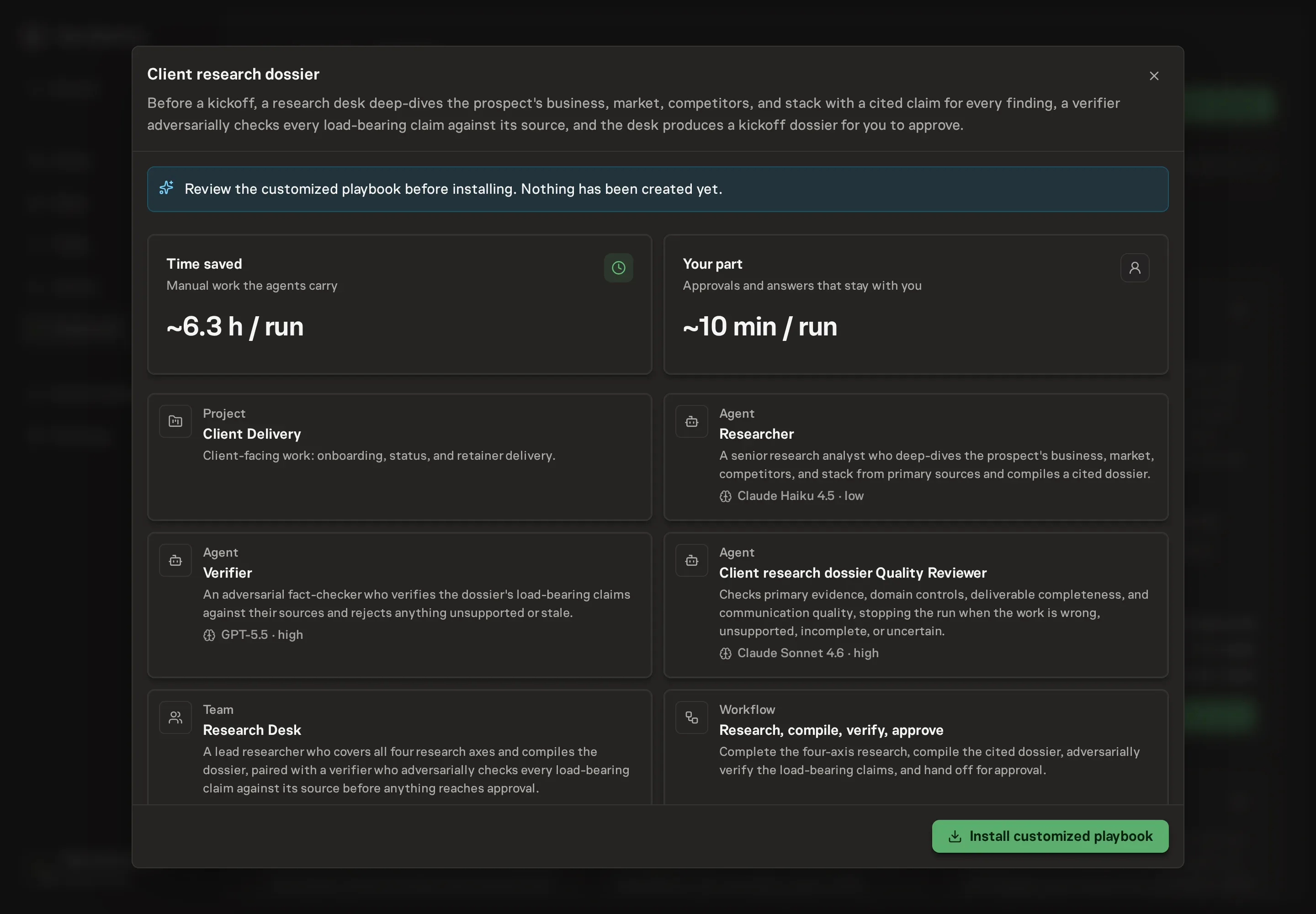
5. Approve and prepare the first work
Choose Approve on the proposal in Chat when the configuration matches your brief. Task Machine installs that reviewed configuration. The approved item retains its review details. If your autonomy settings allow direct installation, this approval may not be required. Check the resulting configuration in that case too.
Complete any remaining secure service setup from the installation details in Chat. Inbox keeps those setup items available if you return later. Prepare the source documents and inputs before starting the first Task or Workflow. Installation does not authorize sending, publishing or changing an external service beyond the boundaries you agreed.
What good looks like
A dossier that is safe to walk into a kickoff with passes three checks:
- Citation coverage. Every claim carries a source URL and an access date, and the sources section lists them all, so anything can be re-checked in a minute.
- Confidence on the critical facts. Funding, revenue, market size, leadership, and positioning claims each trace to two or more independent sources, or they are marked Low-confidence rather than asserted.
- A verified competitive read. Around five direct competitors profiled with strengths and weaknesses, and every angle grounded in cited facts that survived verification, because a thin or one-sided competitive read produces a weak pitch.
Common questions
Does the desk need access to the client's systems? No. The research runs entirely on public sources: the client's site, press, executive interviews, review sites, job postings, and competitor pages. Nothing contacts the prospect, and nothing gets published. The only thing the desk asks of you is the final approval.
How do you stop the agents from making things up? Three ways. The researcher halts when web research is unavailable instead of writing from memory, every claim must cite a source with an access date, and a separate verifier opens the cited sources behind the load-bearing claims and rejects anything they do not support. A claim that fails verification is removed or rewritten before the dossier reaches you.
Is this a recurring workflow? No. It answers "who is this client and how do we win the work" once, produces one dossier per prospect, and installs no schedule. Run the workflow again for the next kickoff.
Can the dossier structure be changed? Yes. The Dossier format document is an editable template. Reorder, rename, add, or drop sections, ask for a one-page executive summary up top or a different competitor count, and the desk follows whatever shape you set. The research method and the verification bar live in the agents' skills, so changing the format does not weaken them.
How current is the research? It is a snapshot. Sources from the last 12 to 24 months are prioritized, older claims get demoted or flagged for refresh during verification, and for anything volatile it is worth re-checking the key claims right before the meeting.