How to Build a Competitive Intelligence Report
A practical guide to competitive intelligence with agents: three-wave discovery, four-lane research, a fact-checked matrix, and human approval.

Founder, Task Machine
A competitive intelligence report is a structured snapshot of the market you compete in: who your real rivals are, how each one positions and prices, what they ship that you do not, and where you win or lose head to head. It is compiled from public sources, and every claim in it traces back to a page someone can open.
It is worth building because pricing, positioning, and roadmap decisions get made against some picture of the market either way. When nobody compiles that picture deliberately, decisions run on a mental model assembled from memory, a few sales calls, and whatever a rival tweeted last month. A report replaces that with a set of facts you can check.
Watching the wrong competitors is the common failure
The failure mode is rarely knowing nothing. It is knowing the wrong set. Teams research the two or three rivals they hear about in deals and miss the ones positioned by category who never mention them, so a new entrant undercuts a pricing decision that looked safe.
The second failure is fabrication by inference. A comparison table filled from marketing prose confidently marks a competitor as SOC 2 compliant because their site has a trust badge, or open source because a blog post said so. Decisions made on cells like that are worse than decisions made on no table at all, because the table looks authoritative.
Both failures compound unnoticed. Nobody owns the job, so the picture ages until a lost deal or a surprise launch forces a scramble, and the scramble produces exactly the shallow, unverified table that caused the problem.
What the manual process looks like
Done by hand, a competitive intelligence report is a multi-day research project:
- List the competitors you can name from memory, then run a few "alternatives to" searches to catch obvious misses.
- Open each rival's site and copy positioning, pricing tiers, and feature claims into a spreadsheet.
- Search for each one's external footprint: review threads, discussion posts, news mentions, published benchmarks.
- Build a side-by-side comparison table and write up where you are ahead and where you are behind.
- Fact-check the claims you are least sure of, which in practice is the step that gets skipped.
Each step is tractable. Together they take days of focused browsing, the set you start from shapes everything downstream, and the whole thing goes stale the week after you finish. So it gets done once a year, if at all.
What an agent can automate
Almost all of that loop is disciplined web research, which an agent can run as a fixed pipeline while the judgment calls stay with you:
- Profile your own company first. The agent researches your company with the same rigor as any rival, from primary sources rather than memory, and produces a precise one-sentence category definition, include keywords, and an exclusion list. Discovery quality depends entirely on this profile.
- Discover in three search waves. Wave one runs the generic "alternatives to" and "competitors" queries. Wave two searches the precise category verbatim, which catches rivals who position by category and never mention you. Wave three searches "your company vs" and "seed vs", then parses "X vs Y" pairs out of the result titles, surfacing competitors that never appear as their own search hit. The agent over-discovers roughly three times the target count, filters out directories, review aggregators, and databases, and dedupes by hostname.
- Gate candidates by category fit. Each candidate's homepage hero text gets fetched and classified against the include keywords and exclusion list, so research budget is not spent on a different product category.
- Research each confirmed rival through four lanes. Marketing surface covers positioning, pricing tiers with real numbers, features, integrations, and compliance claims. External signal collects dated mentions from discussion boards, social posts, and news. Public benchmarks pull performance posts, benchmark repositories, and the actual uptime commitment. Strategic diff maps where the rival beats you and where you beat them, grounded only in already-cited facts.
- Synthesize the matrix. The agent builds a shared taxonomy of 12 to 20 atomic yes/no features and 10 to 20 integrations across the whole set, with your company as column zero. Every cell traces to a cited finding with a URL.
- Compile four report views. An overview with the competitor table and "where you're winning / losing" cards, a deep dive per competitor, the side-by-side feature and pricing matrix, and a chronological mentions feed tagged by source type.
Two things stay yours: confirming which discovered candidates are real competitors, and deciding what the finished report changes about your pricing or roadmap.
The guardrails that make it safe
Automated discovery has known blind spots. The category gate misses real competitors when a homepage is script-heavy and returns near-empty text, when a bot-challenge page replaces the title, or when a rival's positioning is a semantic variant that never matches a keyword. On one real run over 101 discovered candidates, the gate auto-passed 22 and still missed four direct competitors for exactly these reasons. So the pipeline treats human confirmation of the competitive set as mandatory: the agent presents the passed, unknown, and rejected buckets, and research runs only on the set you tick.
The matrix gets a second line of defense. A separate verifier agent spot-checks the high-stakes cells against first-party evidence within a hard call budget: every cell named in the winning/losing summary, compliance claims, open-source licenses, and pricing numbers. A status page is not an uptime commitment, a trust badge is not a passed audit, and "open source" without a checked license file is a guess. The verifier flips cells only on first-party evidence, logs each flip with its URL, and rewrites the summary so the prose reflects only verified cells.
And the report ends at an explicit approval step. Nothing is published or posted anywhere. The compiled report waits in your inbox, you read it, and you approve it or send the desk back to dig deeper into a specific competitor.
Set it up in Task Machine
The Competitive intelligence research playbook provides a starting point for the method above. You need an active Task Machine workspace with Chat, workspace-management and Playbook-installation access (workspace owners have it). No external accounts need authorizing: the agents research through web search and page fetches, with browser access as the fallback for pages that block plain fetches.
1. Find the playbook
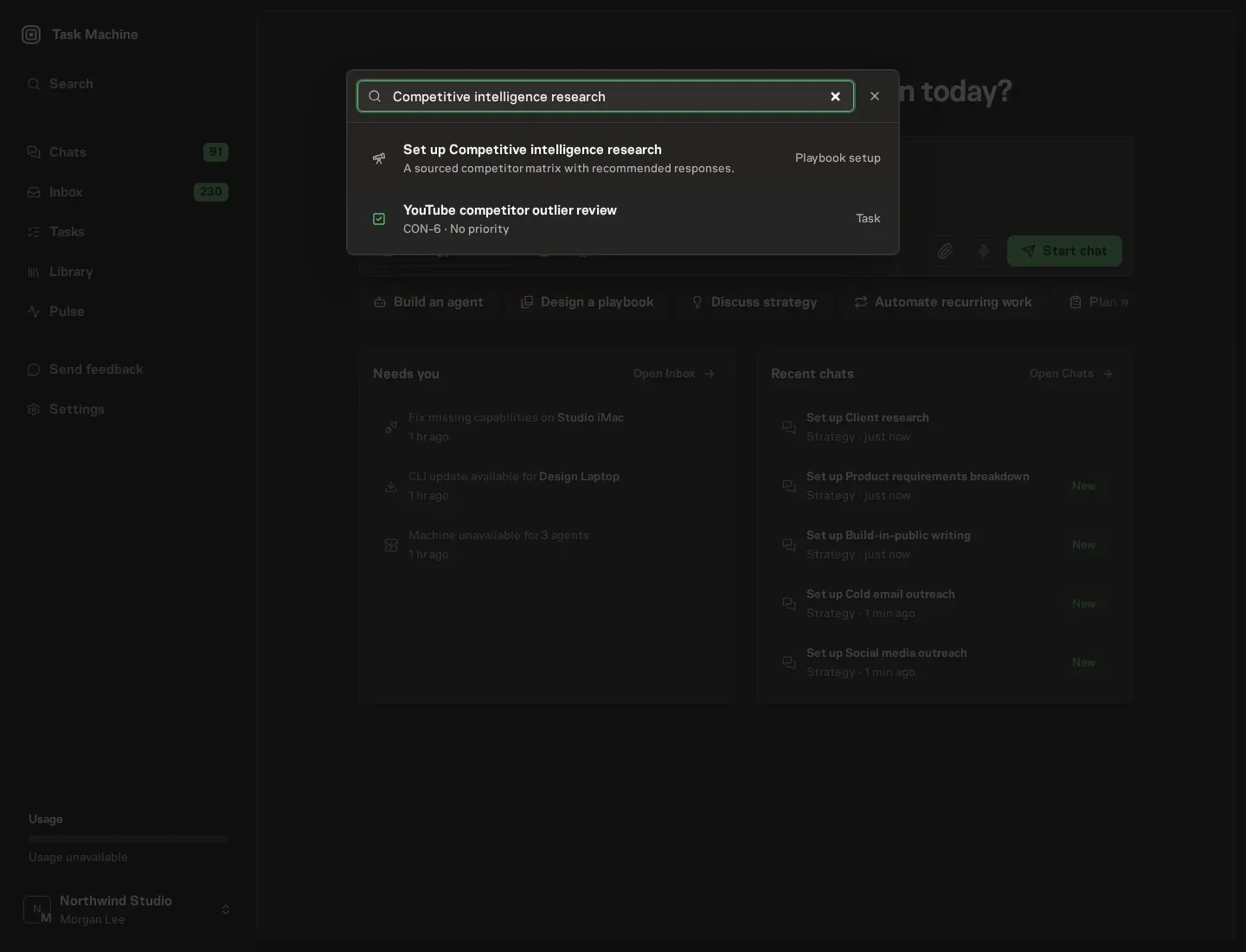
Open Search in your workspace and enter "Competitive intelligence research". The command center lists Set up Competitive intelligence research under Playbook setup.
2. Start the conversation
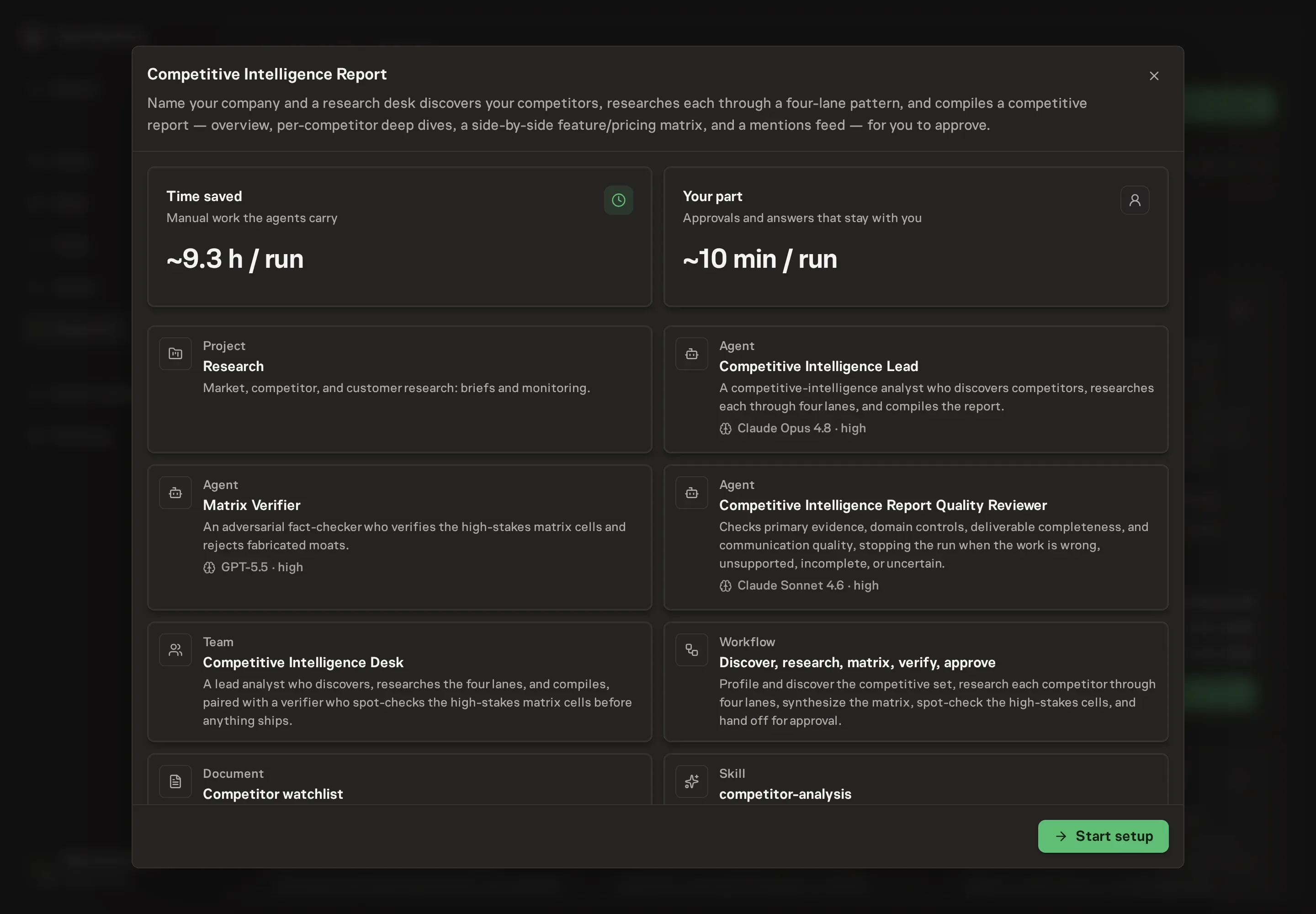
Choose Set up Competitive intelligence research. Task Machine opens a dedicated Chat with the Playbook card and an editable, unsent request. Read the intended job and outcome. Add your situation and send it when ready. Opening the draft does not install anything or start work. This walkthrough uses settings that require approval of the proposed Playbook.
3. Agree the working brief
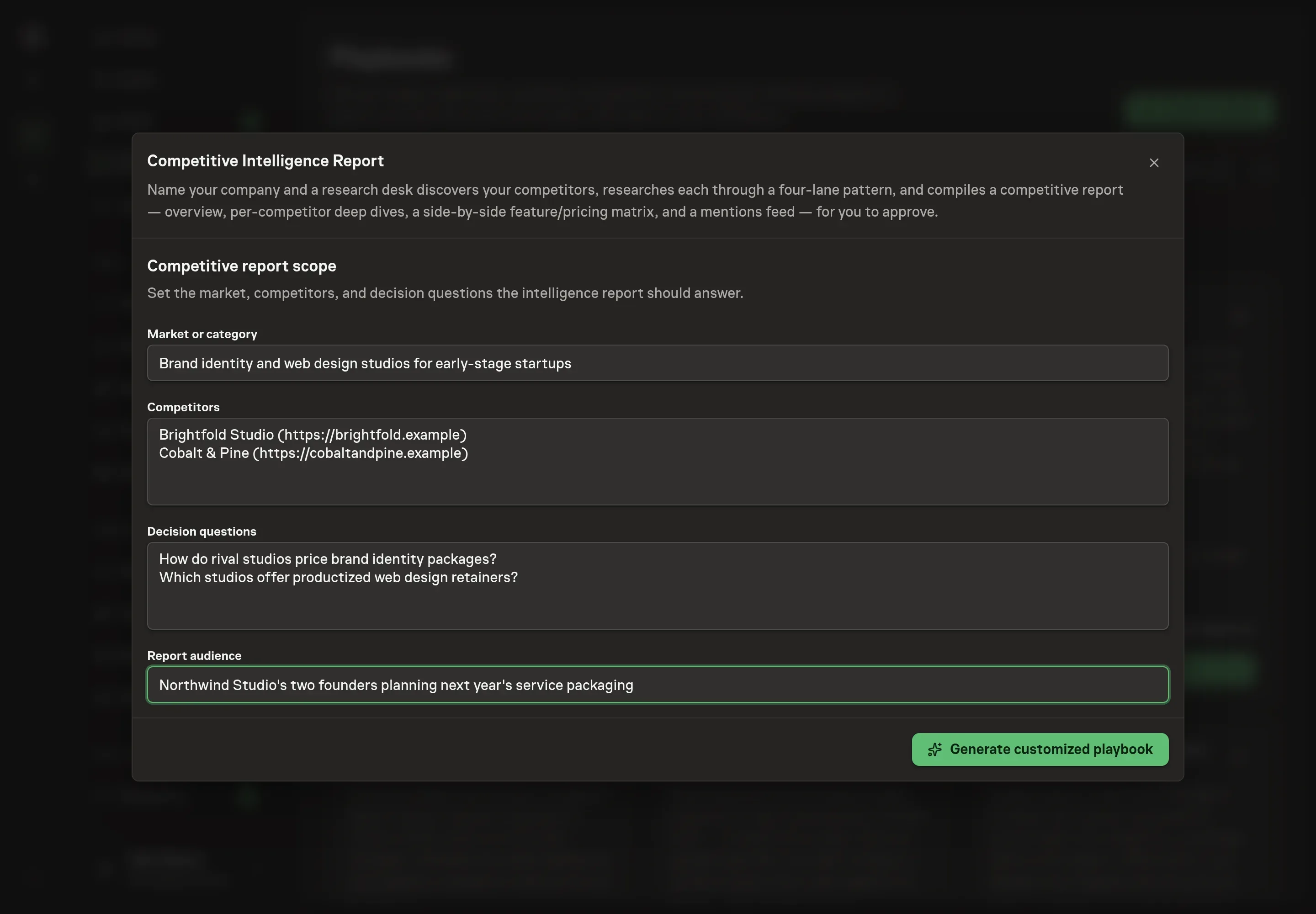
Use Chat to agree the inputs, expected output and limits before asking for a proposal. The Agent needs the details that shape the report. Market or category anchors the precise category definition that drives discovery and the fit gate. Competitors seeds the set with the rivals you already know, which also powers the "X vs Y" comparison searches. Decision questions tell the desk which comparisons would change a decision, so the matrix and summaries lead with what you care about. Report audience sets who the overview and the winning/losing cards are written for.
4. Review the proposed Playbook
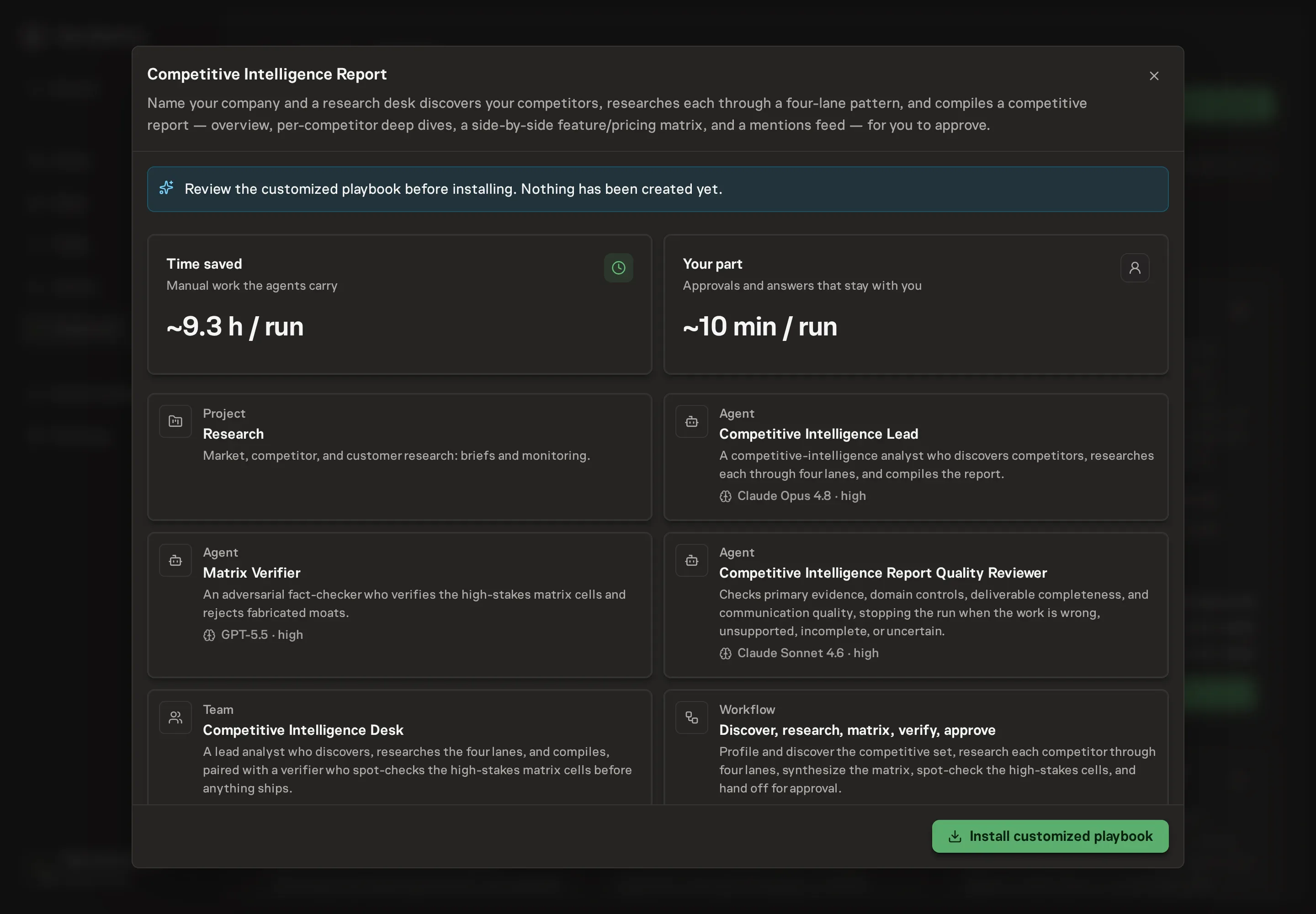
Ask the Agent to generate the Playbook from the agreed brief. Open its proposal in Chat and check the instructions and resources it will install, which carry more detail than the conversational summary. Read through the agent and workflow cards and confirm the scope matches the market and competitors you named. Ask for a revised proposal if anything is missing or changes the job.
5. Approve and prepare the first work
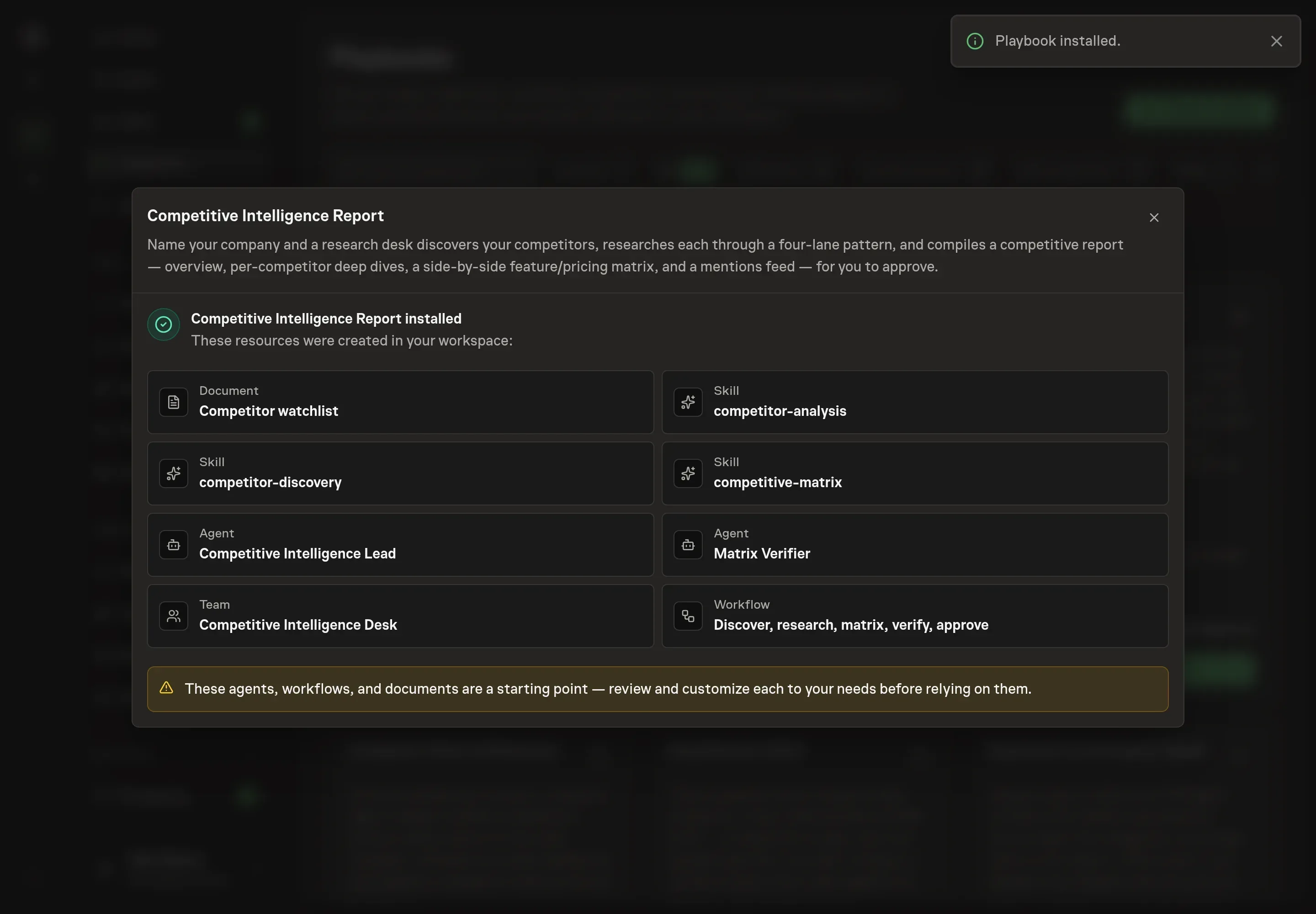
Choose Approve on the proposal in Chat when the configuration matches your brief. Task Machine installs that reviewed configuration. The approved item retains its review details. If your autonomy settings allow direct installation, this approval may not be required. Check the resulting configuration in that case too.
Complete any remaining secure service setup from the installation details in Chat. Inbox keeps those setup items available if you return later. Prepare the source documents and inputs before starting the first Task or Workflow. Installation does not authorize sending, publishing or changing an external service beyond the boundaries you agreed.
What good looks like
Three signals tell you whether the process works:
- Discovery breadth before the gate. A healthy run over-discovers roughly three times the target count and lets the fit gate drop 40 to 60% of candidates. If nearly everything passes, the category definition is too loose to trust.
- Traceability of the matrix. Every cell in the finished matrix traces to a cited URL. A cell nobody can trace is an inference, and inferences are what the fact-check exists to catch.
- A summary that survives verification. The winning/losing cards should describe the same moats and gaps after the verifier's pass as before it. Flips that change the narrative mean the claims were coming from marketing prose, and the rewrite is the guardrail doing its job.
Common questions
How many competitors should the report cover? It depends on the depth you pick. A quick pass researches only the marketing lane and scans on the order of 30 to 50 competitors. A deep pass adds external signal for roughly 15 to 25. The full four-lane treatment with benchmarks and the strategic diff suits about 5 to 15. Fewer rivals researched deeply usually beats a long shallow list.
Can the agent pick the competitive set on its own? No, and it should not. The category gate has known blind spots: script-heavy homepages that return empty text, bot-challenge pages, and rivals whose positioning is a semantic variant of yours. On one real 101-candidate run the gate passed 22 and still missed four direct competitors. Confirming the set is a mandatory human step, not a courtesy.
How does the report avoid made-up claims about competitors? Two mechanisms. Every matrix cell must trace to a cited finding with a URL, so a claim without a source never becomes a cell. Then a separate verifier agent spot-checks the high-stakes cells (compliance, licenses, pricing, and anything named in the winning/losing summary) against first-party evidence and rewrites the summary to reflect only what survived.
Does the report refresh itself on a schedule? No. This is deliberately a one-off: it answers who you are up against and how you compare right now, then ends at your approval. Keeping watch on competitor mentions over time is a different recurring job with its own process, and bolting a schedule onto a full report run would re-research the whole set when what changes week to week is mostly the mentions feed.