How to Develop Machine Learning Models
A practical guide to model development with baselines, leakage-safe pipelines, metric-driven evaluation, error analysis, and review.

Founder, Task Machine
Machine learning model development is the process of turning a prediction objective and dataset into a reproducible modeling pipeline, then proving the candidate model beats a baseline on the declared metric. It includes preprocessing, train and validation separation, leakage checks, evaluation, error analysis, and a reviewable artifact.
The work is risky to automate casually because model output can look scientific while hiding broken methodology. A model can improve on the training set, leak target information through preprocessing, overfit a convenient split, or report a metric that does not match the business decision.
Most model failures happen before algorithm choice
Most model failures happen before algorithm choice. The objective is vague, the target is defined after looking at the data, preprocessing is fitted before the split, or the evaluation metric rewards the wrong behavior.
The bundle's method starts with the baseline and the evaluation boundary. A complex model must beat a simple baseline, preprocessing must live inside the pipeline, train and validation data must be separated correctly, and the final artifact must include commands, seeds, data limits, and error analysis.
What the manual process looks like
Done by hand, a responsible model-development task follows a repeatable path:
- Define the prediction target, dataset, deployment boundary, and metric that decides whether the model is better.
- Inspect the data and decide whether the split must be random, time-aware, or grouped.
- Build a simple baseline that any candidate model must beat.
- Put preprocessing inside the model pipeline so training and inference transform data the same way.
- Train candidates, evaluate on the declared metric, and inspect errors by slice, residuals, confusion matrix, calibration, or ranking quality.
- Write a report or pull request with metrics, commands, seeds, artifacts, limits, and deployment caveats for review.
The step that protects the team is the baseline. Without it, a more complex model can look like progress while adding cost, fragility, and no measurable gain.
What an agent can automate
An ML engineer agent can perform the repeatable engineering work while leaving acceptance and deployment to humans:
- Clarify the modeling brief. The agent asks for repository, objective, data sources, target, metric, and evaluation command before changing code.
- Create a baseline. It builds or documents a simple baseline so candidate models have a real bar to clear.
- Prevent leakage. It keeps preprocessing inside the pipeline, respects train, validation, and test separation, and uses time-aware or grouped splits when the data requires it.
- Evaluate by the declared metric. The agent reports baseline versus candidate results and adds error analysis instead of relying on a single headline score.
- Produce a reviewable artifact. The output is a pull request or report with commands, seeds, assumptions, data limits, and artifacts.
The agent develops and evaluates. It does not deploy a model or overwrite production artifacts without explicit approval.
The guardrails that make it safe
Model development needs hard boundaries because the cost of a wrong model often arrives after it has influenced decisions or production behavior. The first guardrail is the declared metric and evaluation command. The agent cannot call a model better unless it beats the baseline against the stated test.
The second guardrail is the review artifact. The human reviewer sees the split strategy, leakage checks, metric table, error analysis, commands run, and limits. Deployment, retraining cadence, and model governance stay out of scope unless the reviewer explicitly approves them.
Set it up in Task Machine
The Machine learning model development playbook provides a starting point for the method above. You need an active Task Machine workspace with Chat, workspace-management and Playbook-installation access (workspace owners have it). The agent needs access to the repository or notebook workspace and a dataset or sample before the first assignment can be completed.
1. Find the playbook
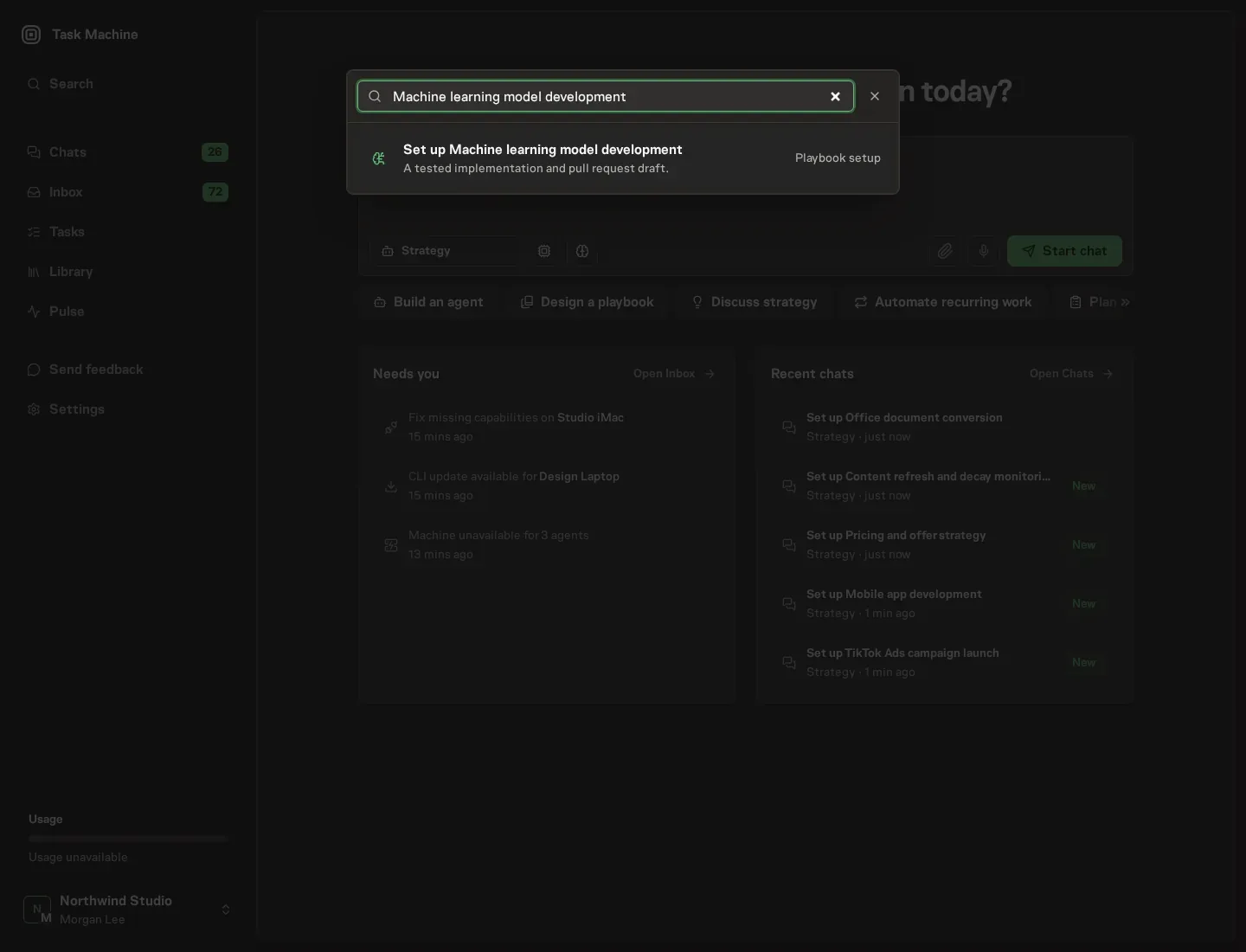
Open Search in your workspace and enter "Machine learning model development". The command center lists Set up Machine learning model development under Playbook setup.
2. Start the conversation
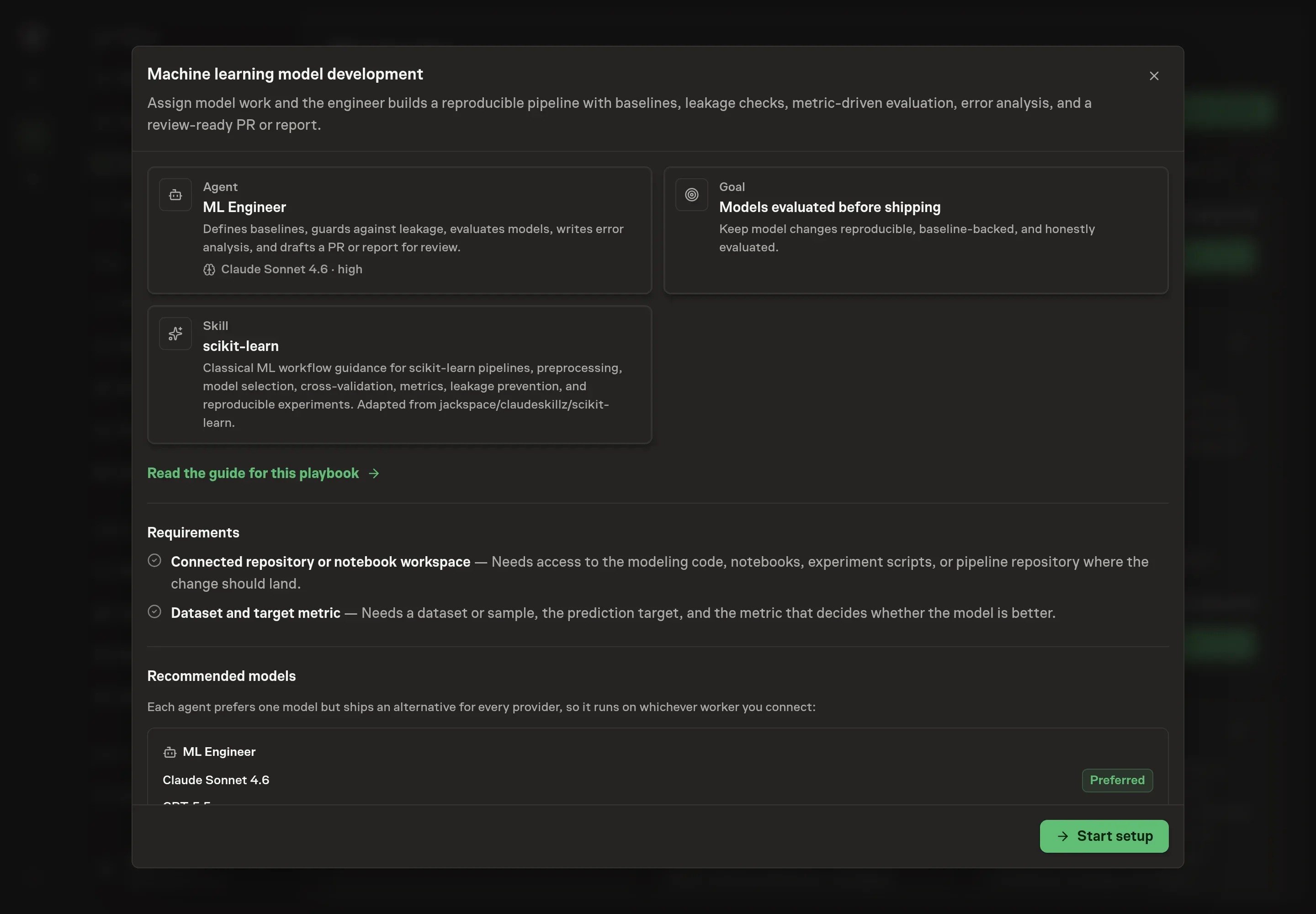
Choose Set up Machine learning model development. Task Machine opens a dedicated Chat with the Playbook card and an editable, unsent request. Read the intended job and outcome. Add your situation and send it when ready. Opening the draft does not install anything or start work. This walkthrough uses settings that require approval of the proposed Playbook.
3. Agree the working brief
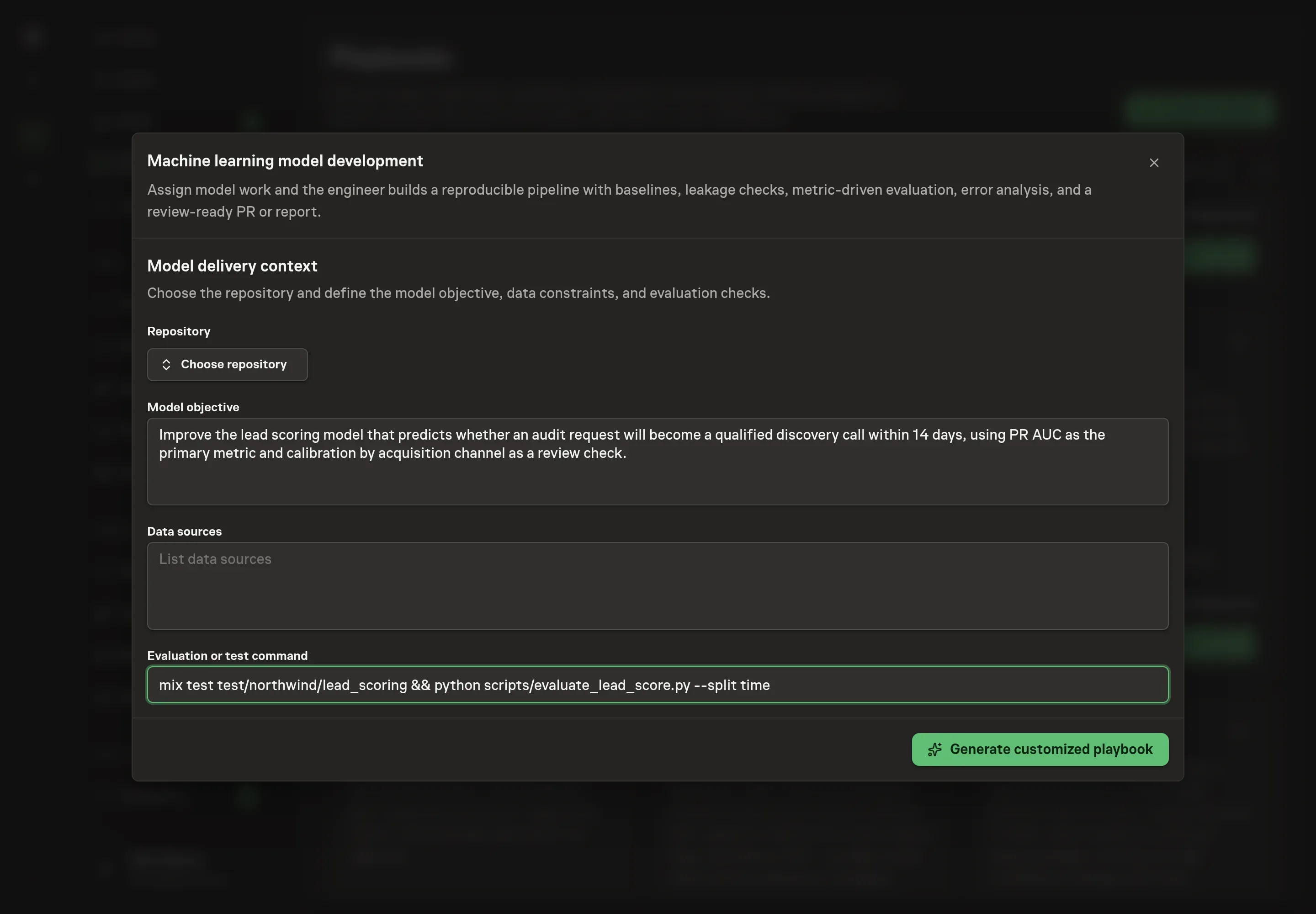
Use Chat to agree the inputs, expected output and limits before asking for a proposal. Name the repository in Chat, then describe the model objective, data sources, and evaluation or test command. Good inputs name the target, metric, dataset boundaries, and command the reviewer trusts.
4. Review the proposed Playbook
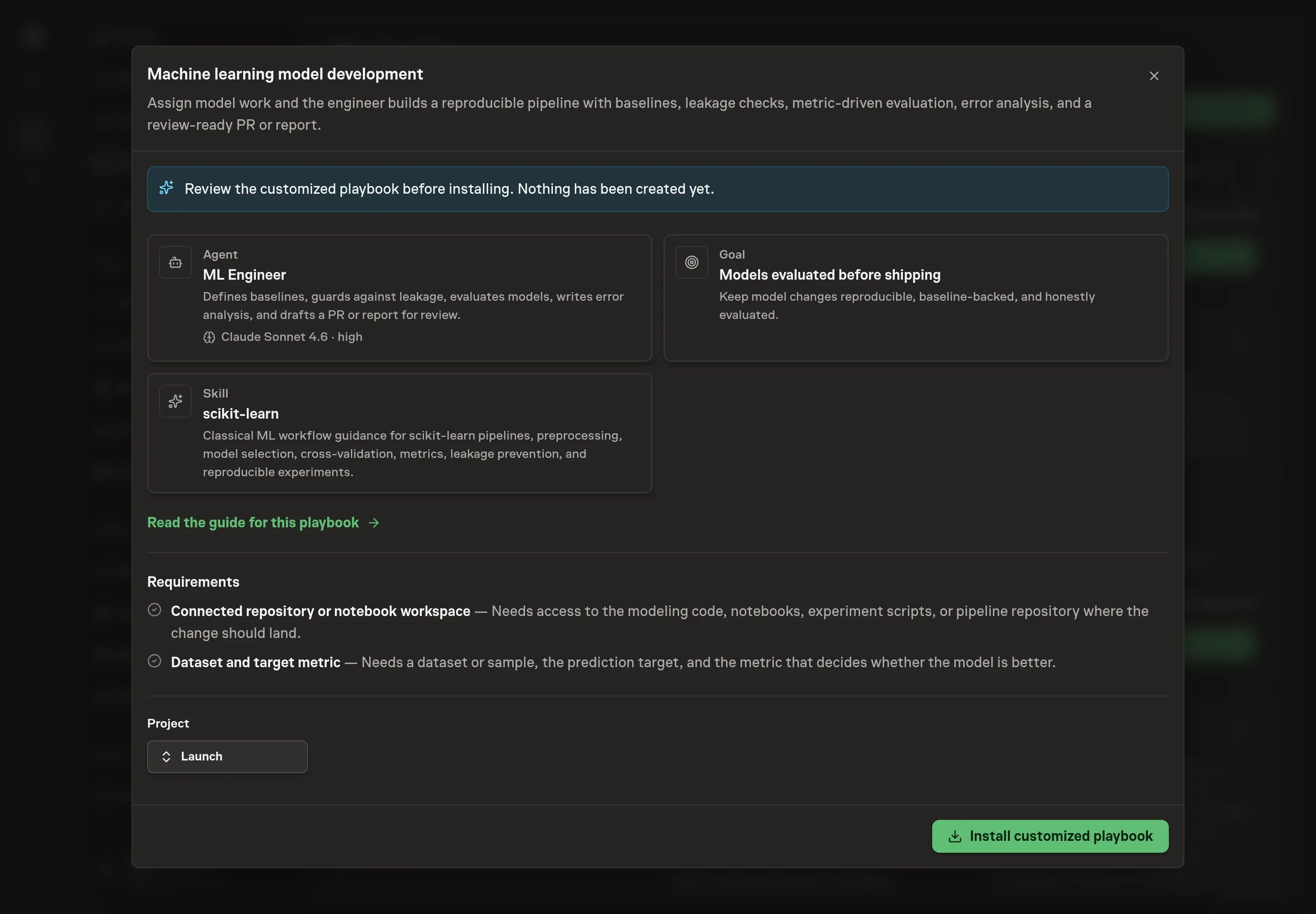
Ask the Agent to generate the Playbook from the agreed brief. Open its proposal in Chat and check the instructions and resources it will install, which carry more detail than the conversational summary. Confirm that the agent instructions require baselines, leakage-safe pipelines, declared metrics, error analysis, and a reviewable PR or report. Ask for a revised proposal if anything is missing or changes the job.
5. Approve and prepare the first work
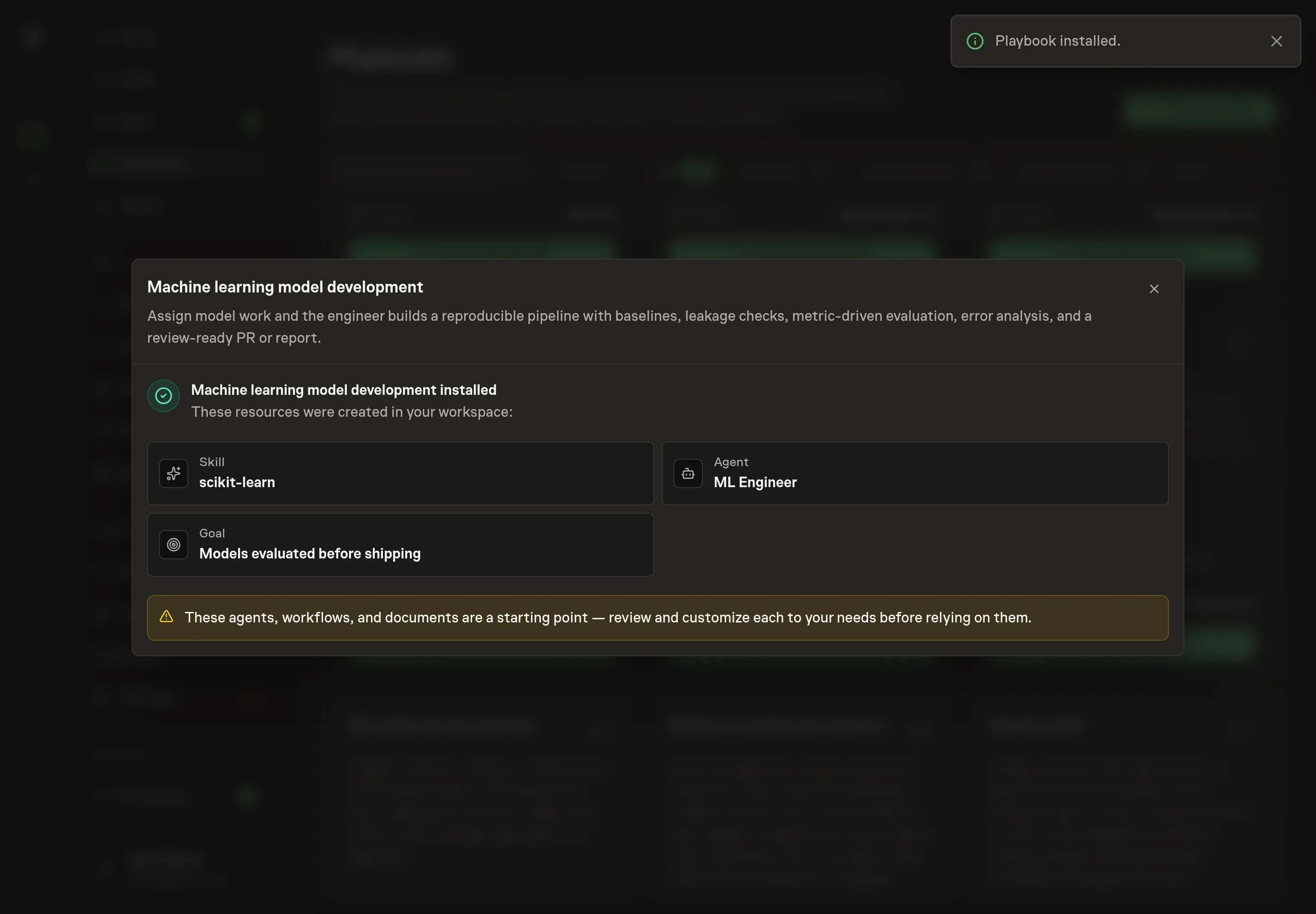
Choose Approve on the proposal in Chat when the configuration matches your brief. Task Machine installs that reviewed configuration. The approved item retains its review details. If your autonomy settings allow direct installation, this approval may not be required. Check the resulting configuration in that case too.
Complete any remaining secure service setup from the installation details in Chat. Inbox keeps those setup items available if you return later. Prepare the source documents and inputs before starting the first Task or Workflow. Installation does not authorize sending, publishing or changing an external service beyond the boundaries you agreed.
What good looks like
A model-development task is ready for review when the evidence is complete:
- The baseline is visible. The candidate model is compared against a simple baseline instead of a prior guess.
- The split strategy is defensible. Time-aware or grouped data is not treated like random independent rows.
- Preprocessing stays inside the pipeline. Cross-validation cannot learn from validation or test data.
- The report names limits. Data constraints, weak slices, commands, seeds, and artifacts are recorded.
Common questions
Can the agent deploy the model after training? No. This playbook is for model development and evaluation. Deployment needs explicit human approval and may need a separate production workflow.
Does it only work with scikit-learn? The installed skill is scikit-learn-oriented, so it is best for classical ML pipelines. The same review principles apply elsewhere, but the bundle is not a general deep-learning deployment system.
What if there is no evaluation command yet? The agent can propose one, but the reviewer should approve the metric and command before treating results as evidence.
Can it work from notebooks? Yes, if the notebook workspace or repository is available. The output should still record commands, seeds, data limits, and artifacts so the work is reproducible.