How to Run a Structured Brainstorming Session
A practical guide to structured brainstorming with an agent: problem reframing, judgment-free divergence, scoring, and a reasoned shortlist you approve.

Founder, Task Machine
A structured brainstorming session generates and selects ideas in deliberate phases: frame the problem, reframe it to widen the option space, generate ideas without judgment, cluster and score what came out, and curate a shortlist worth pursuing. The structure exists to enforce one rule that unmanaged brainstorms break constantly: divergence (generating ideas) and convergence (evaluating them) never happen at the same time.
The ideas a team chooses to pursue set a ceiling on everything built afterward, which makes a disciplined ideation hour one of the highest-leverage hours in the week. Most teams skip the discipline and pay for it later, in features nobody wanted and in the better option that never got said out loud.
Unstructured brainstorms solve the wrong problem first
An unfacilitated brainstorm fails in predictable ways. The group solves the first framing of the problem instead of the right one, because every problem statement smuggles in assumptions about the goal, the constraints, and the user. The obvious ideas all live inside those assumptions.
Then critique creeps into generation. Someone floats a bold idea, someone else points out why it will not work, and the room stops offering anything bold. What survives is the safe cluster of ideas everyone had before the meeting started. The session ends with a raw list in a document, no reasoning attached, and no decision. Two weeks later nobody can say why the list exists.
What the manual process looks like
Run properly by a person, a structured session is a ritual with six steps:
- Write the problem down and restate it as "How might we…".
- Reframe it a few ways before anyone pitches an idea, to break fixation on the first framing.
- Run a timeboxed generation round where critique is off-limits and quantity is the goal.
- Cluster the raw ideas into themes to reveal the real option space underneath the long list.
- Score the themes against impact and feasibility, and only now allow evaluation.
- Write up a shortlist with the reasoning for each pick, then decide what to pursue.
Every step is teachable, but holding the discipline is hard. The facilitator has to stop critique mid-sentence, push the group past its first obvious cluster of ideas, and make sure the write-up captures why each pick made the cut. In a small team the facilitator is usually also a participant, which means nobody is holding the line.
What an agent can automate
The facilitation itself is method, not judgment, which makes it a good fit for an agent running a fixed workflow:
- Reframe before diverging. The agent restates the problem as "How might we…" and generates three to five reframings using named moves: zoom out to the goal behind the problem, zoom in to the real bottleneck, flip a constraint, change the unit from feature to workflow to outcome, shift the actor, invert the problem, or borrow an analogy from another domain. A real reframe changes the option space rather than rewording the same narrow problem.
- Generate wide, without judgment. The agent diverges from three perspectives (product manager, designer, and engineer) against each chosen reframing, because each lens surfaces ideas the others miss. It never critiques while generating, and it pushes past the first obvious cluster. The good ideas rarely come first.
- Cluster and score. Only after divergence ends does evaluation start. The agent groups ideas into themes and scores them against impact and feasibility, weighting selection toward core value delivery, speed to validate, and differentiation. It kills nothing too early: a high-impact, low-feasibility idea gets reshaped rather than dropped.
- Curate with reasoning. The output is a shortlist of three to seven ideas, each stated crisply with its impact and feasibility reasoning, the key assumption to test, and the trade-offs of choosing it. A ranked, reasoned shortlist rather than a raw idea dump.
- Self-check the discipline. Before handing anything off, the agent verifies its own run: divergence and convergence stayed separate, the reframing happened before ideation, the generation went past the obvious, and every pick carries its reasoning.
What stays with you is the judgment the whole process exists to serve: deciding which idea to pursue.
The guardrails that make it safe
The risk in agent-run ideation is drift from proposing to deciding. An agent that picks the direction has taken over the one call that should stay human.
The safe shape is a workflow that ends in an explicit approval step. The agent reframes, diverges, converges, and self-checks, and then the curated shortlist waits in your inbox. You read the reasoning behind each pick, challenge the assumptions that look thin, approve the shortlist, and choose what to pursue. The agent facilitates and curates. It does not choose for you. Because every run follows the same workflow, you can also see exactly how a shortlist was produced: which reframings were explored, what the divergence covered, and how the scoring went.
Set it up in Task Machine
The Brainstorming and ideation playbook provides a starting point for the method above. You need an active Task Machine workspace with Chat, workspace-management and Playbook-installation access (workspace owners have it). The playbook needs no connected services, so there is nothing to authorize.
1. Find the playbook
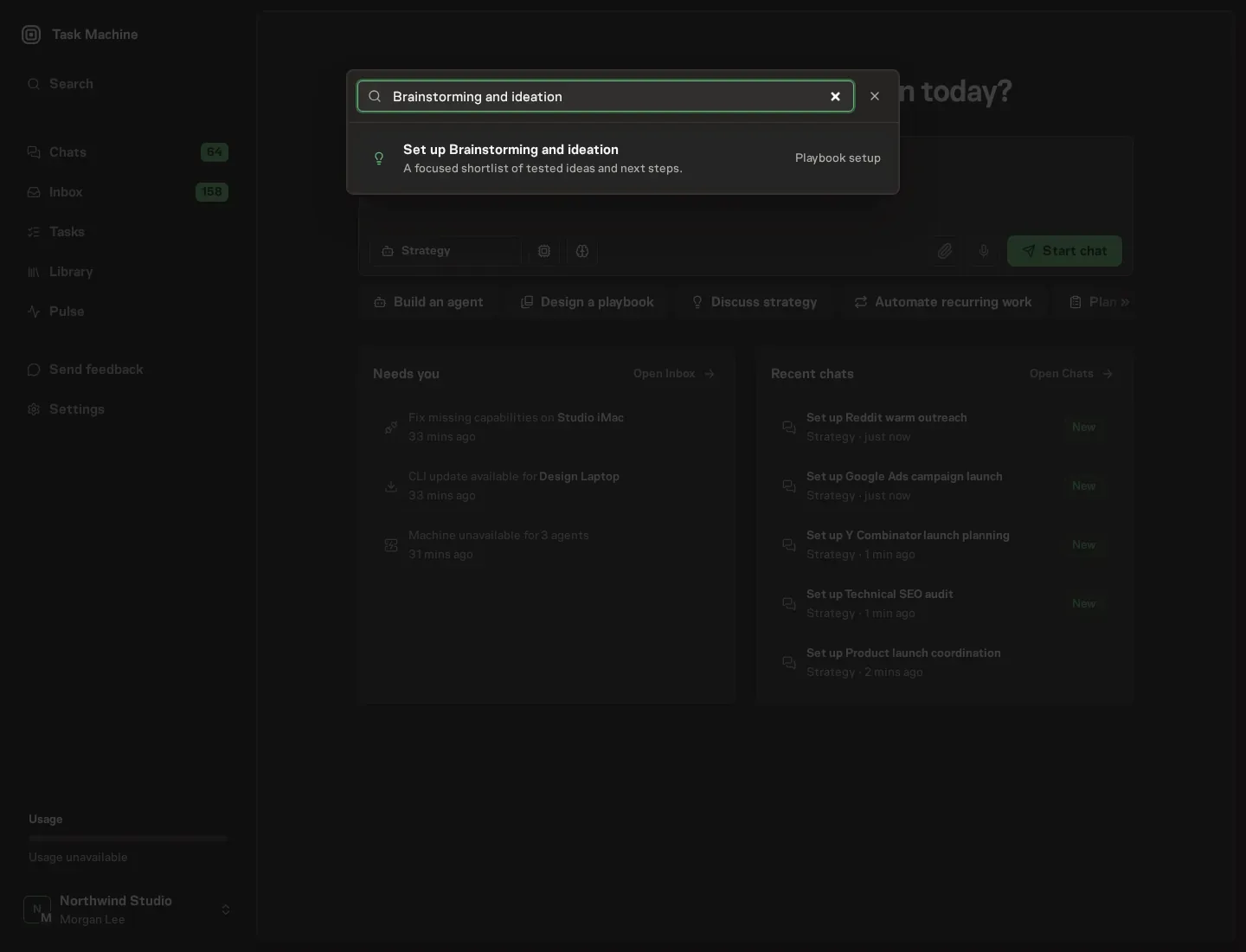
Open Search in your workspace and enter "Brainstorming and ideation". The command center lists Set up Brainstorming and ideation under Playbook setup.
2. Start the conversation
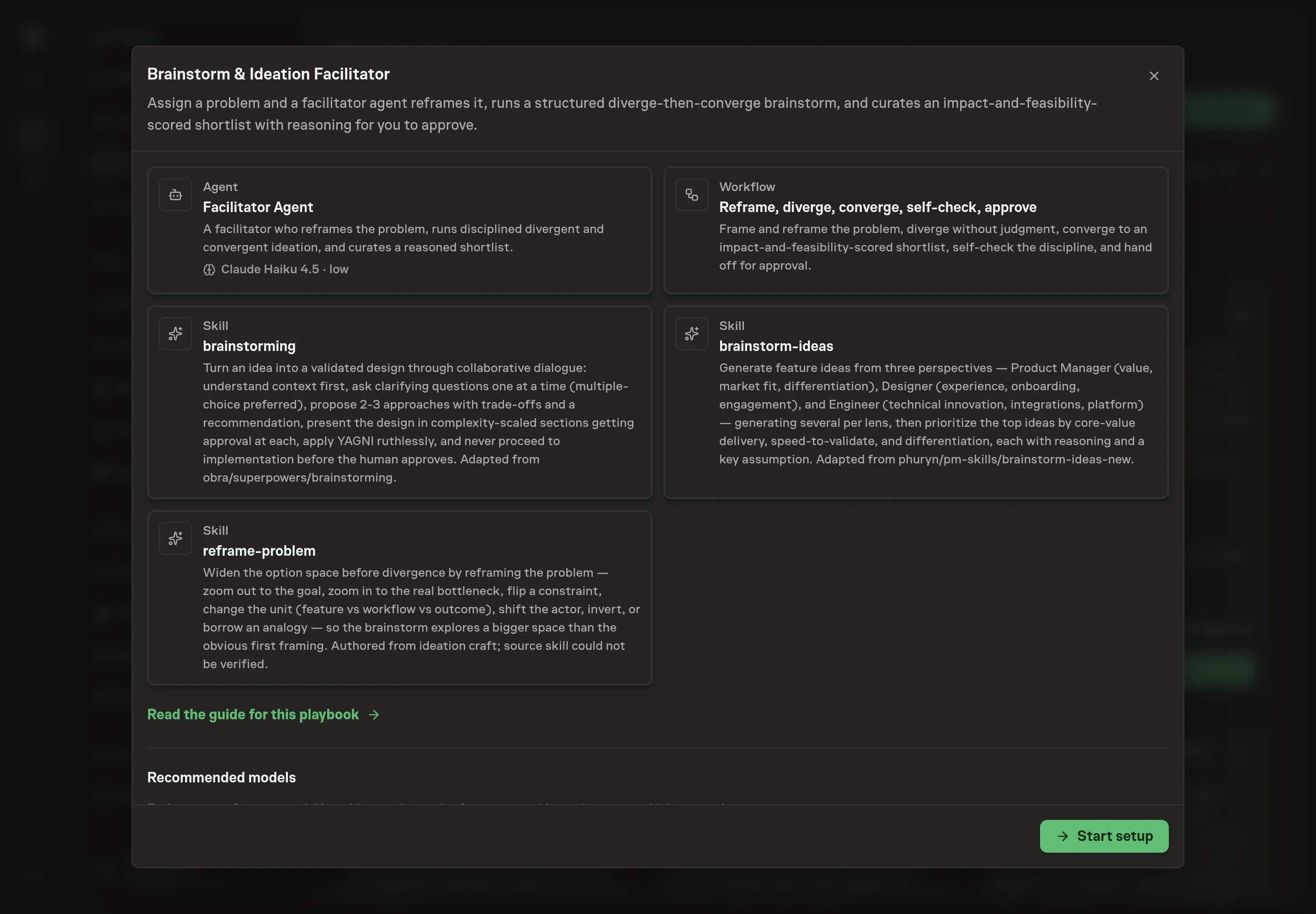
Choose Set up Brainstorming and ideation. Task Machine opens a dedicated Chat with the Playbook card and an editable, unsent request. Read the intended job and outcome. Add your situation and send it when ready. Opening the draft does not install anything or start work. This walkthrough uses settings that require approval of the proposed Playbook.
3. Agree the working brief
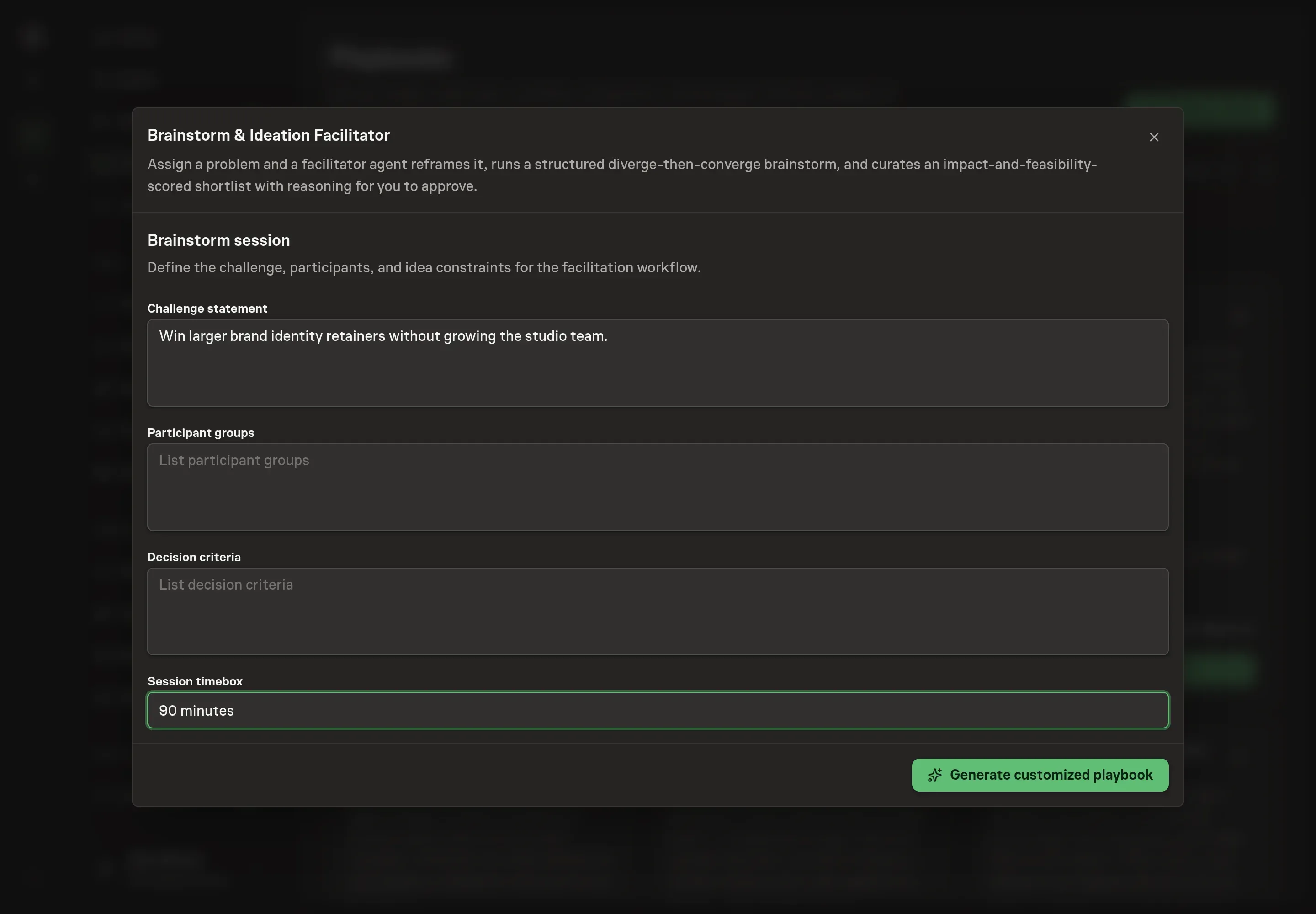
Use Chat to agree the inputs, expected output and limits before asking for a proposal. The Agent needs the details that shape the facilitation. The Challenge statement is the problem the first session frames and reframes, stated as concretely as you can. Participant groups names whose viewpoints the session should represent. Decision criteria adds your own scoring dimensions alongside impact and feasibility. Session timebox bounds how long a session should take.
4. Review the proposed Playbook
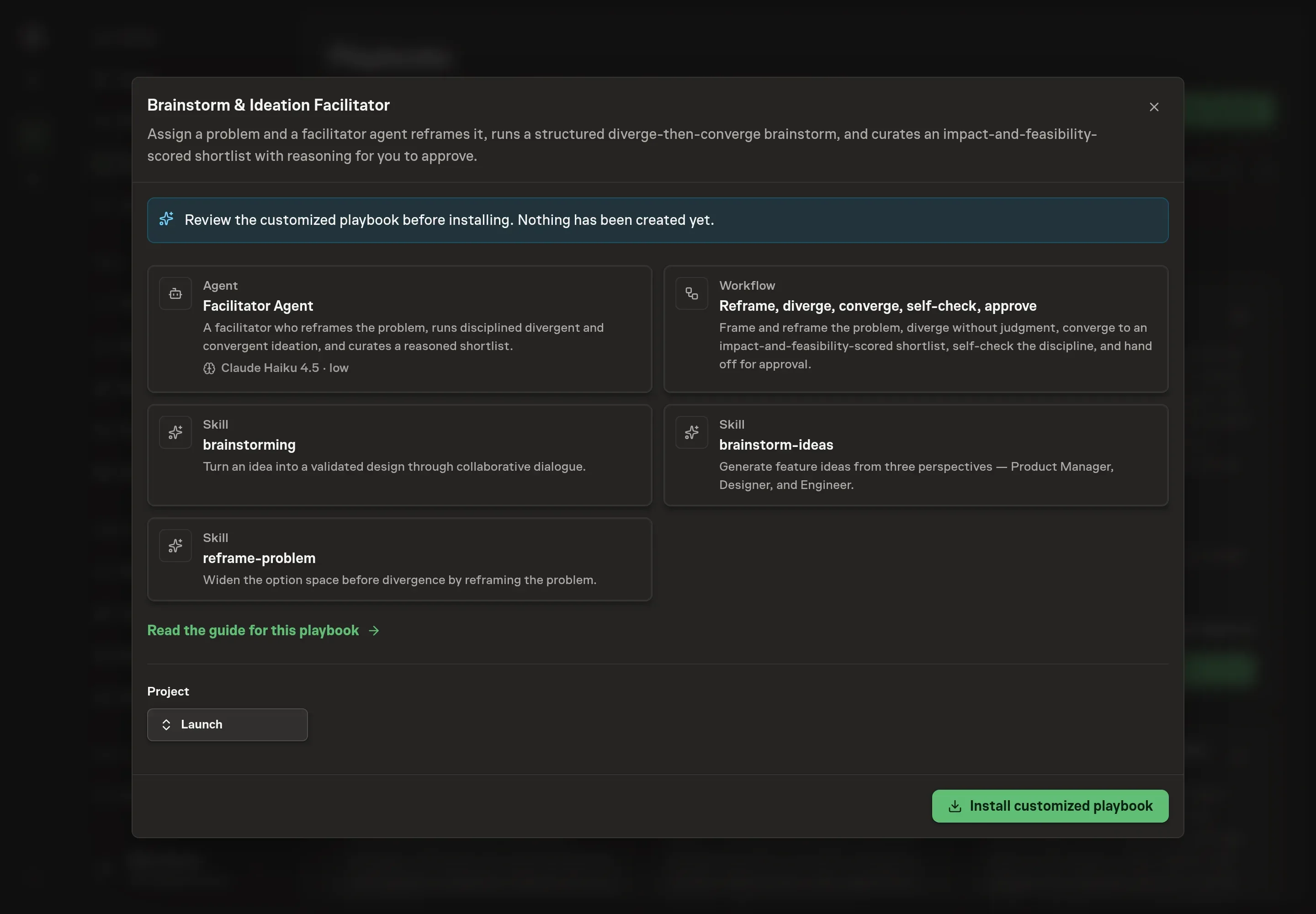
Ask the Agent to generate the Playbook from the agreed brief. Open its proposal in Chat and check the instructions and resources it will install, which carry more detail than the conversational summary. Read through the agent and workflow cards, and confirm the challenge, participants, and criteria you gave are reflected in how the session will run. Ask for a revised proposal if anything is missing or changes the job.
5. Approve and prepare the first work
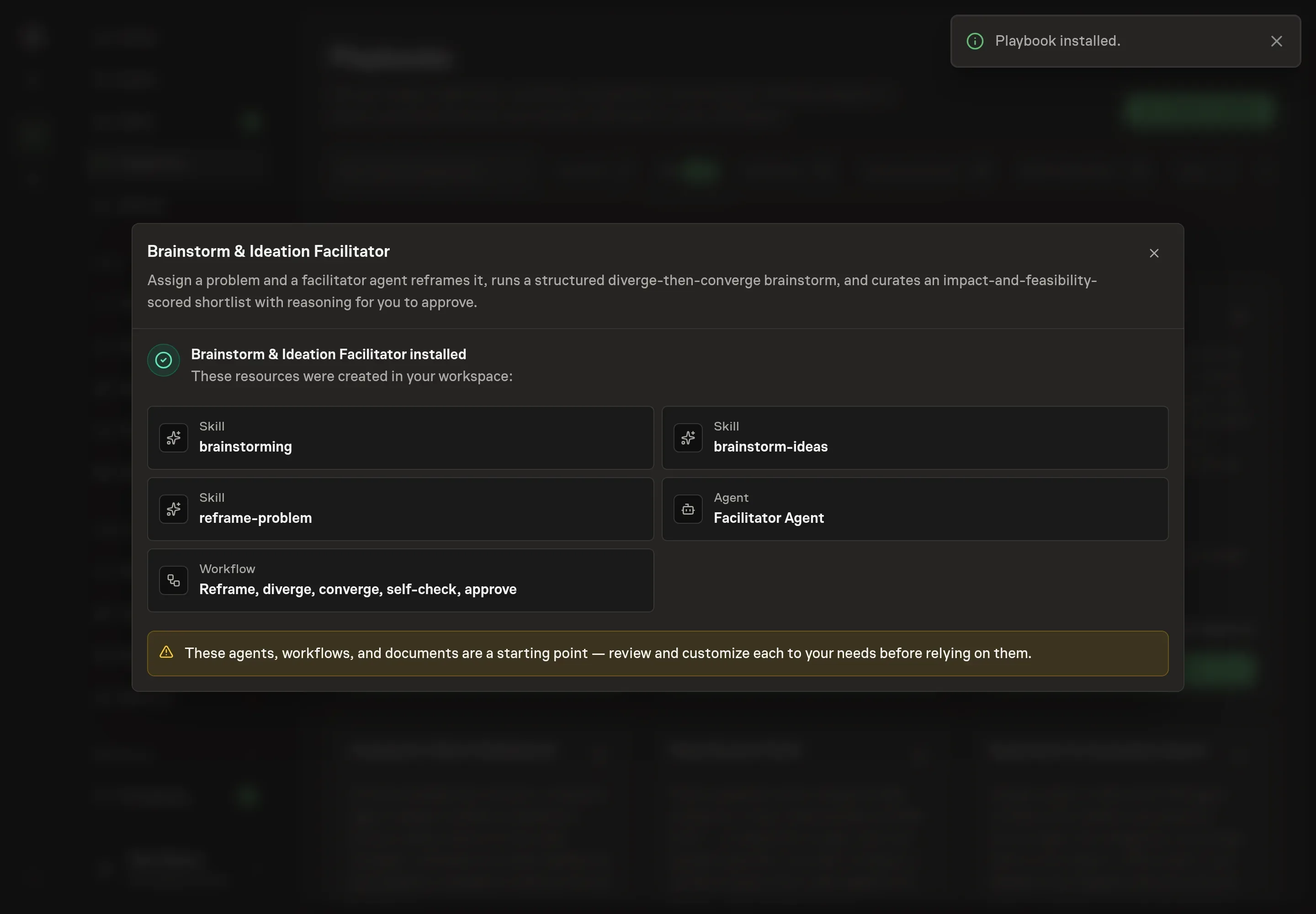
Choose Approve on the proposal in Chat when the configuration matches your brief. Task Machine installs that reviewed configuration. The approved item retains its review details. If your autonomy settings allow direct installation, this approval may not be required. Check the resulting configuration in that case too.
Complete any remaining secure service setup from the installation details in Chat. Inbox keeps those setup items available if you return later. Prepare the source documents and inputs before starting the first Task or Workflow. Installation does not authorize sending, publishing or changing an external service beyond the boundaries you agreed.
What good looks like
Three checks tell you whether a session worked:
- The reframings changed the option space. Three to five reframings that open different problems, not reworded versions of the same narrow one.
- Divergence went past the obvious. The raw list runs well past the first cluster of ideas everyone already had, and the perspectives are visibly different from each other.
- Every shortlist pick carries its full reasoning. Three to seven ideas, each with impact and feasibility reasoning, a key assumption to test, and named trade-offs. A pick you cannot explain is a pick that has not converged.
Common questions
Why keep idea generation and evaluation separate? Critiquing while generating kills bold ideas before they form, and generating while critiquing produces a pile no one can choose from. Running the phases in strict order protects both: divergence gets a wide, unjudged space, and convergence gets a full option set to score.
Does an agent-run brainstorm replace the team's input? No. The agent represents the perspectives you name and generates against them, but the shortlist is an input to a human decision, not the decision. The approval step at the end of every run exists so a person weighs the reasoning and picks what to pursue.
How many ideas should a session produce? During divergence, as many as possible. The good ideas rarely come first, which is exactly why the method pushes past the first obvious cluster. The shortlist that survives convergence is three to seven ideas, each with its reasoning attached.
What if the problem statement itself is wrong? That is what reframing is for. The session generates several reframings before any ideation starts, so a mis-stated problem gets caught while it is still cheap to fix. Accepting the first framing as fixed is the single biggest cause of a weak brainstorm.