How to Validate Product Ideas With a Sprint
A practical guide to validating product ideas with a lean canvas, cited research, a demand test, and a keep/pivot/kill gate.

Founder, Task Machine
A product idea validation sprint is a short, evidence-driven process for deciding whether an idea deserves more work. It frames the business hypothesis, finds the riskiest assumption, researches the market and customer, drafts the cheapest demand test, and ends with a keep, pivot, or kill decision.
The point is not to prove that the idea could work. Most ideas can be made to sound plausible. The point is to find the assumption that would kill the idea if false, then test that assumption before the team spends weeks building around it.
Why product ideas absorb months
Early product work often feels productive because every activity creates artifacts: a deck, a roadmap, a prototype, a landing page, a pricing model. None of those artifacts prove demand unless the team names the assumption behind them and decides in advance what evidence would change its mind.
The risk is goalpost movement. A weak signal becomes "early interest", a vague interview quote becomes "validation", and a competitor's existence becomes proof that the market is waiting. A sprint prevents that by fixing the validation question, the evidence bar, and the kill threshold before the demand test would run.
What the manual process looks like
A disciplined validation sprint has five steps:
- Frame the idea on a lean canvas: problem, customer segments, value proposition, proposed approach, channels, revenue, costs, metrics, and advantage.
- Name the riskiest assumption, usually demand or reach, not whether the team can build the feature.
- Research the market, competitors, and customer language with sources, dates, confidence labels, and explicit gaps.
- Draft the cheapest honest demand test, such as a landing page and outreach plan for 20 to 50 early adopters.
- Verify the evidence, revise unsupported claims, then make a keep, pivot, or kill decision.
The process is uncomfortable because a good sprint makes it possible to kill an idea. That is the value. A cheap kill frees the team for a better bet.
What an agent can automate
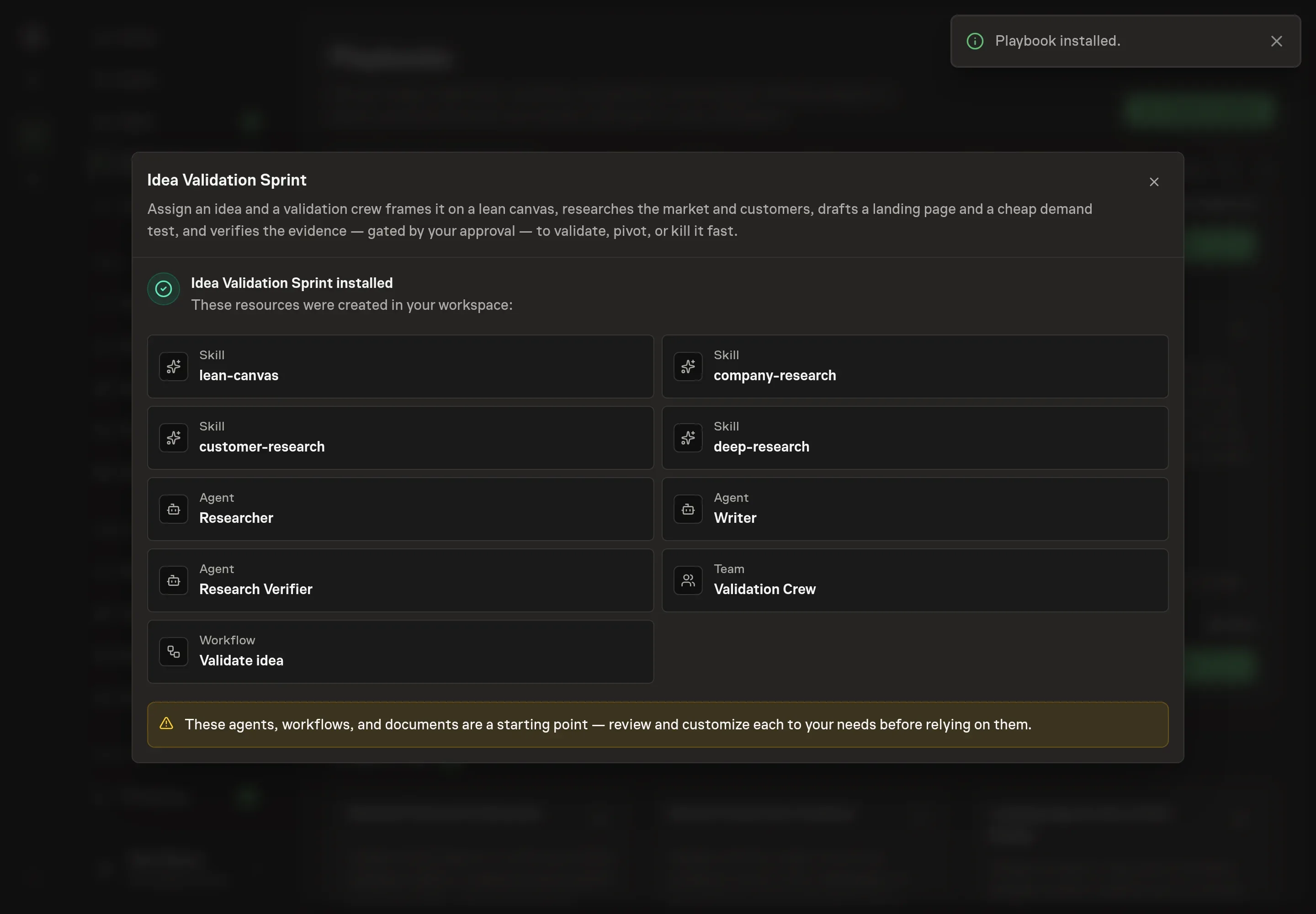
The Idea validation playbook uses a small crew because the job has distinct roles:
- Frame the hypothesis. The researcher builds the lean canvas and names the assumption that would kill the idea if false.
- Run cited research. The researcher looks at market, competitor, company, and customer evidence, labels confidence, distinguishes facts from synthesis, and cites source URLs for load-bearing claims.
- Mine customer language. The sprint pulls pains, trigger events, desired outcomes, alternatives considered, and verbatim phrases from transcripts, reviews, tickets, or online communities.
- Draft the demand test. The writer turns the evidence into a landing-page headline, pitch, call to action, outreach plan, validation threshold, and kill threshold.
- Verify the evidence. The research verifier checks critical claims against their sources, looks for single-source or stale claims, and confirms the test targets the riskiest assumption.
The human decision remains at the end. The agents prepare the evidence and recommendation. They do not decide the company's direction.
The guardrails that make it safe
Validation work is vulnerable to motivated reasoning, so the guardrails are about evidence. Every load-bearing claim needs a source URL when web research is available. Critical claims need more than one independent source or a low-confidence label. Customer personas come from real data, not imagined averages.
The workflow also separates production from verification. The researcher and writer create the validation doc, while the verifier attacks the evidence and the test design. If the demand test drifts toward an easier assumption, the verifier sends it back. The final approval is where a human chooses keep, pivot, or kill.
Set it up in Task Machine
The Idea validation playbook provides a starting point for the method above. You need an active Task Machine workspace with Chat, workspace-management and Playbook-installation access (workspace owners have it). Web research is useful but not required up front. Until it is available, the crew works from attached research, transcripts, reviews, and exports.
1. Find the playbook
Open Search in your workspace and enter "Idea validation". The command center lists Set up Idea validation under Playbook setup.
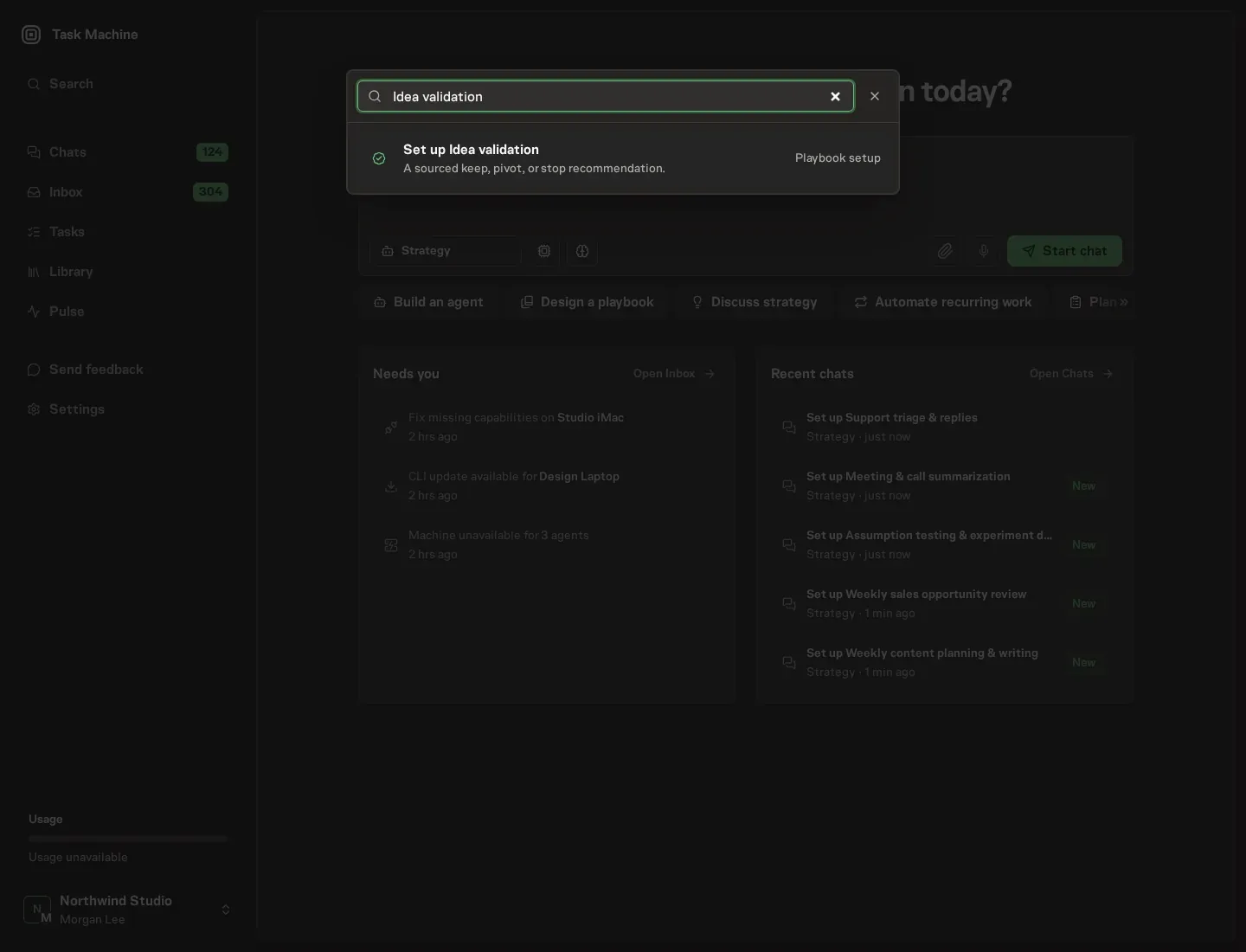
2. Start the conversation
Choose Set up Idea validation. Task Machine opens a dedicated Chat with the Playbook card and an editable, unsent request. Read the intended job and outcome. Add your situation and send it when ready. Opening the draft does not install anything or start work. This walkthrough uses settings that require approval of the proposed Playbook.
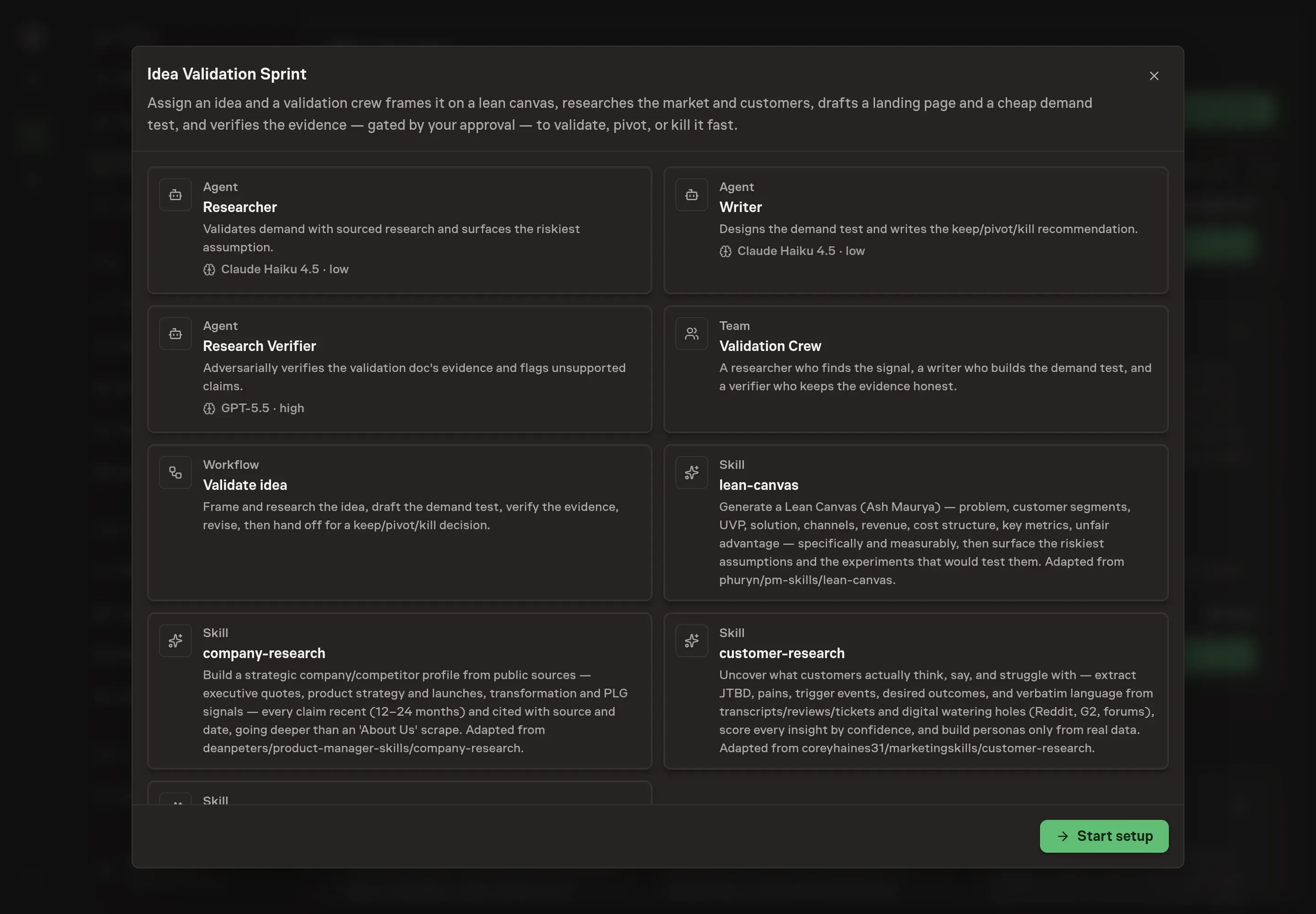
3. Agree the working brief
Use Chat to agree the inputs, expected output and limits before asking for a proposal. The Agent needs the idea summary, target customer, validation questions, and success criteria. Write the success criteria as decision rules, not hopes: what would count as validation, what would force a pivot, and what would kill the idea.
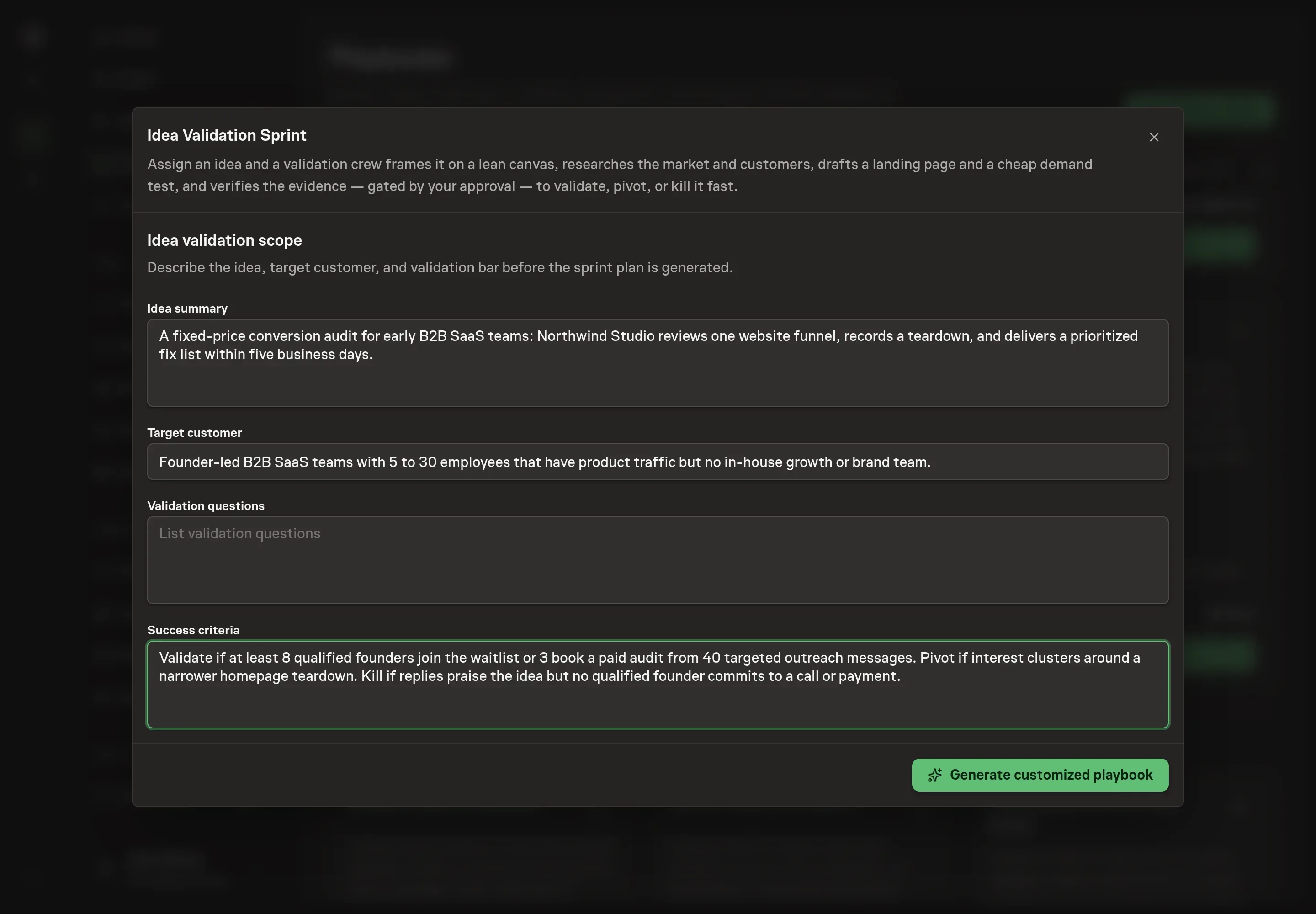
4. Review the proposed Playbook
Ask the Agent to generate the Playbook from the agreed brief. Open its proposal in Chat and check the instructions and resources it will install, which carry more detail than the conversational summary. Review the generated crew and workflow before installation. Check that the verifier is present and that the approval step asks for a keep, pivot, or kill decision. Ask for a revised proposal if anything is missing or changes the job.
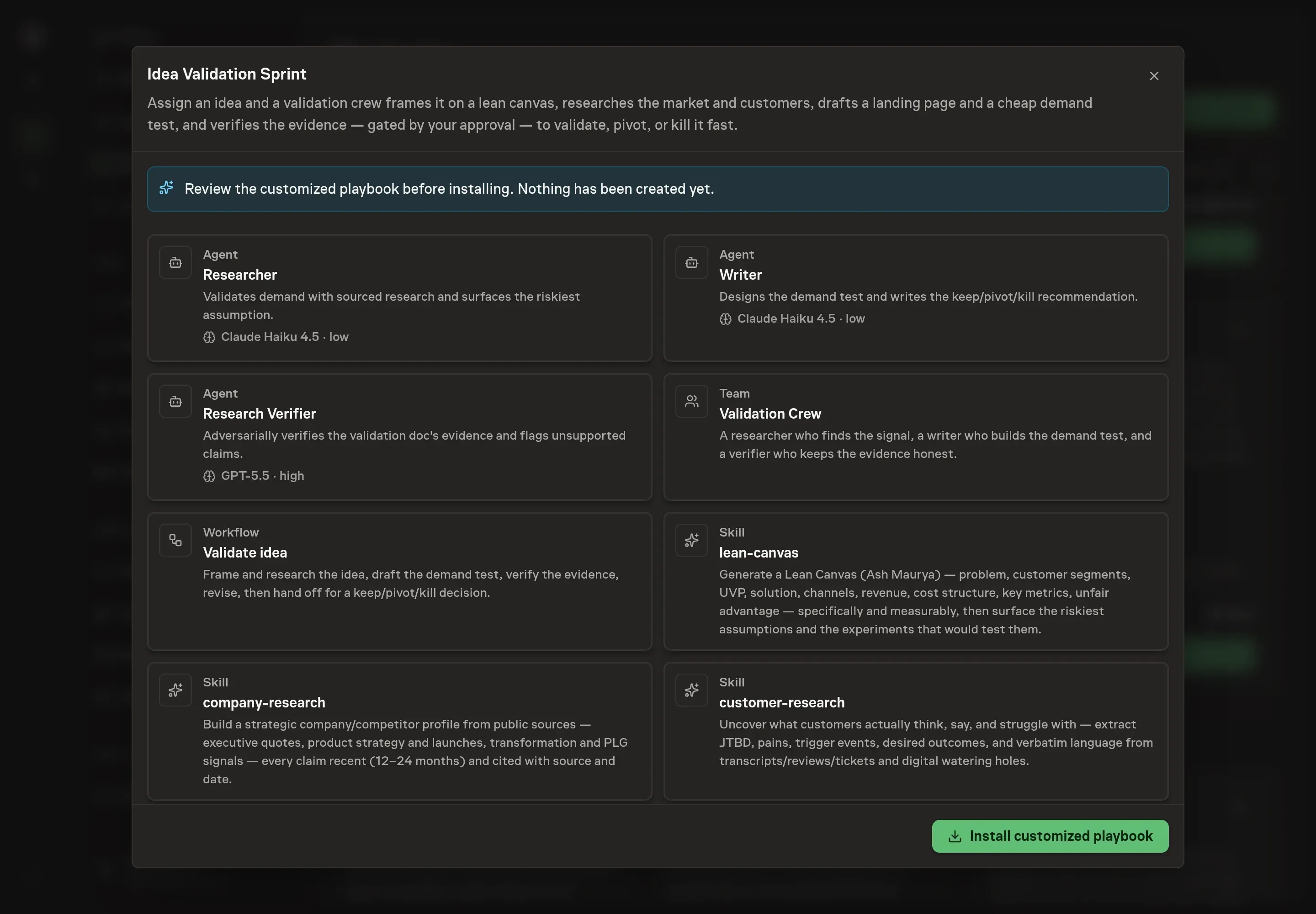
5. Approve and prepare the first work
Choose Approve on the proposal in Chat when the configuration matches your brief. Task Machine installs that reviewed configuration. The approved item retains its review details. If your autonomy settings allow direct installation, this approval may not be required. Check the resulting configuration in that case too.
Complete any remaining secure service setup from the installation details in Chat. Inbox keeps those setup items available if you return later. Prepare the source documents and inputs before starting the first Task or Workflow. Installation does not authorize sending, publishing or changing an external service beyond the boundaries you agreed.
What good looks like
Three outputs matter more than the length of the report:
- One named riskiest assumption. The sprint identifies the assumption that could kill the idea, not a vague list of risks.
- Cited customer evidence. Claims about demand, pain, and alternatives trace back to real sources or are labeled as uncertain.
- Decision thresholds set early. The landing page and outreach plan include the signal that validates the idea and the signal that kills it before the test runs.
Common questions
Is a validation sprint the same as market research? No. Market research can describe a category. A validation sprint uses research to decide whether one specific idea should continue, pivot, or stop.
What if there is not enough source material? The workflow should say what is missing and lower confidence. It can still design a cheap demand test, but it should not present gaps as evidence.
Can the agents decide to kill the idea? No. They can recommend keep, pivot, or kill based on the evidence. The approval step keeps that decision with the human owner.
Why include a landing page draft before the idea is validated? The landing page is the test artifact. Its headline, pitch, and call to action make the demand assumption concrete enough to evaluate.