How Small Software Teams Should Operate AI Agent Work
Real task data shows why small teams need shared ownership, focused decision queues, clear checks, and task-level agent costs.

Founder, Task Machine
One developer can remember what a coding agent is doing. A team with several developers and agents quickly loses that shared context. Questions reach different people, review expectations vary, and one person's approved shortcut becomes another person's unexplained production risk.
The coordination problem appears before the team feels large. Two developers, a founder, and a few agents can create more parallel work than a stand-up or chat channel can reconstruct. The team needs shared ownership and history for each outcome.
We analyzed an anonymized, platform-wide 30-day window from August 6 through September 4, 2026. It covered 534 tasks with active time, 533 tasks with recorded cost, and 68 completed tasks across real workspaces using Task Machine.
Tasks with active time
534
Average recorded cost
$21.43
Tasks completed
68
The interface screenshots use fictional examples. The published figures come from the anonymized 30-day dataset.
The dataset suggests six lessons for small teams coordinating developers, founders, and agents.
1. Use the task as the shared unit of work
Model sessions belong to terminals and providers. The work belongs to a product or customer outcome. Its history needs to survive a stopped process, a different reviewer, another implementation attempt, and a handoff between people and agents.
A task record should answer:
- What outcome is being pursued?
- Who owns execution and who accepts the result?
- Which context and constraints apply?
- Which runs occurred and what did they produce?
- Which checks passed or failed?
- Which question or review comment changed the next attempt?
- Why was the final result accepted?
The reporting period contained 1,541 agent comments, 1,171 human comments, 237 agent questions, and 395 approval decisions. Coordination was part of execution.
Agent questions
237
Approval decisions
395
A Task Machine task keeps the outcome, runs, questions, review comments, and acceptance record available to everyone assigned to the work.
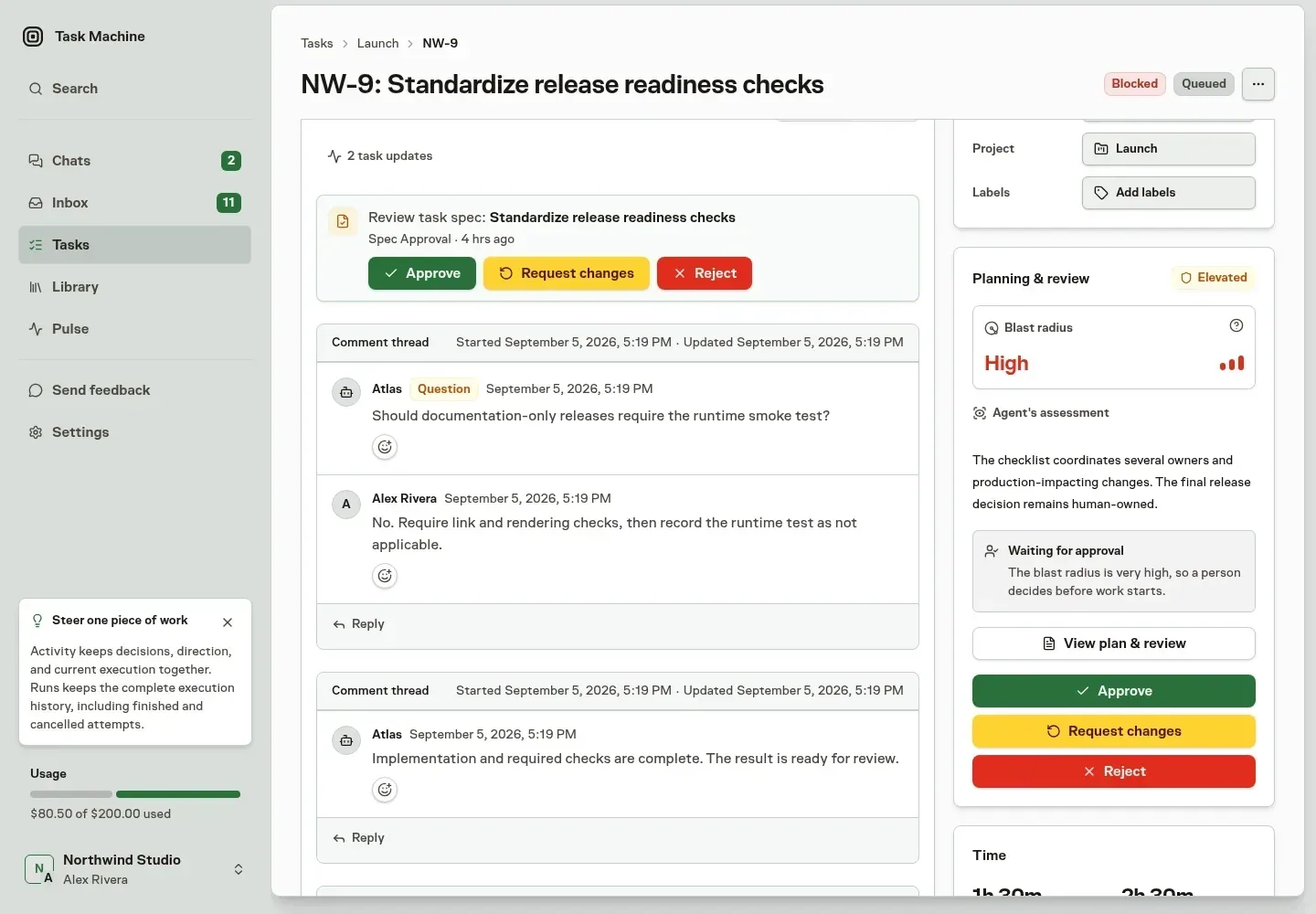
The task activity gives developers, agents, and reviewers one durable account of how the outcome was produced.
2. Give every decision an explicit owner
Routing an agent question to whoever is online feels fast until that person lacks the context or authority to answer. The response can create another review cycle or change product behavior without the right owner.
Decide ownership before running parallel work:
| Decision | Default owner | Context they need |
|---|---|---|
| Product behavior | Product owner or founder | User problem, current behavior, proposed change, preserved constraints |
| Architecture boundary | Technical owner | Alternatives, affected systems, migration and rollback consequences |
| Code review | Repository owner or assigned reviewer | Diff, tests, runtime proof, known limitations |
| External action | Authorized person | Exact action, audience, spend, and reversibility |
| Client-specific choice | Engagement owner | Client brief, approved scope, delivery consequence |
Routine retries can stay with the assigned agent when the rule and limit are already clear. Product choices, external actions, and changed client scope should reach a person with authority.
For roughly one hour of routine, well-scoped agent work, our experience is 5 to 10 minutes of human attention. Longer tasks and coding work with manual review usually need more. The dataset contains no human-attention timing, so teams should measure their own review time by task type.
Task Machine's role defaults assign planner and reviewer responsibilities before the team increases parallel work.
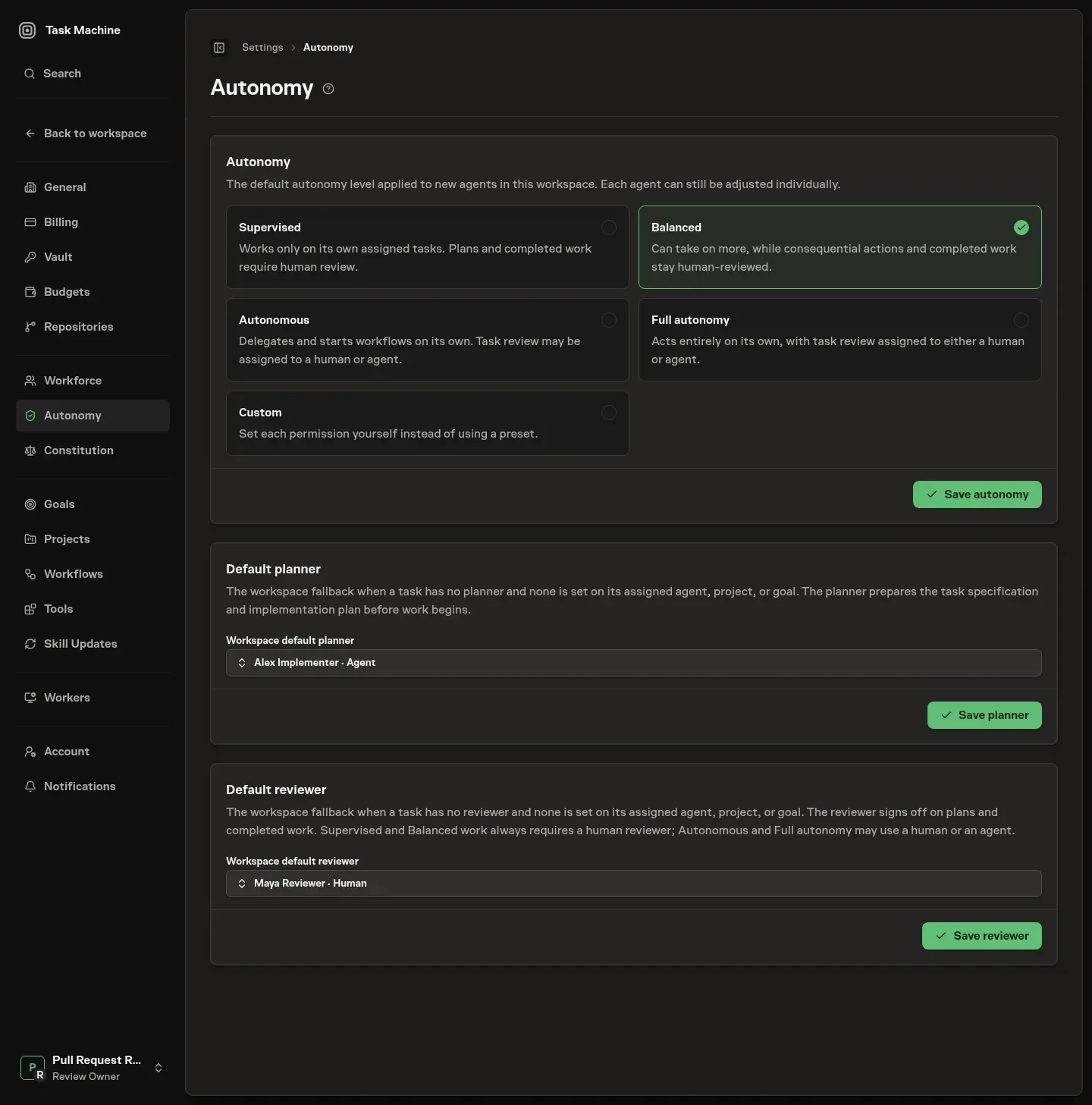
Role defaults route recurring planning and review decisions to people or agents with the right context and authority.
3. Plan worker capacity and cost across the task portfolio
The average task used 1 hour 43 minutes of active agent execution and recorded $21.43 in cost. Twenty tasks at that average represent roughly 34 hours of worker time. Parallel or overnight execution still occupies repositories, browsers, rate limits, and review capacity.
The cost distribution was highly skewed.
Average recorded task cost
Across 533 tasks with recorded cost
$21.43
Individual estimates need model selection and comparable past tasks. A small cap can interrupt valid complex work. An unlimited retry loop can consume budget while nobody decides whether the task still makes sense.
Active agent time helps plan worker capacity. Recorded cost shows task-attributed spend, including positive spend from attempts that failed to produce the accepted result. Keep both measures visible because they lead to different decisions. Task-level usage and duration show active time, total elapsed time, and stage spend without collapsing them into one measure.
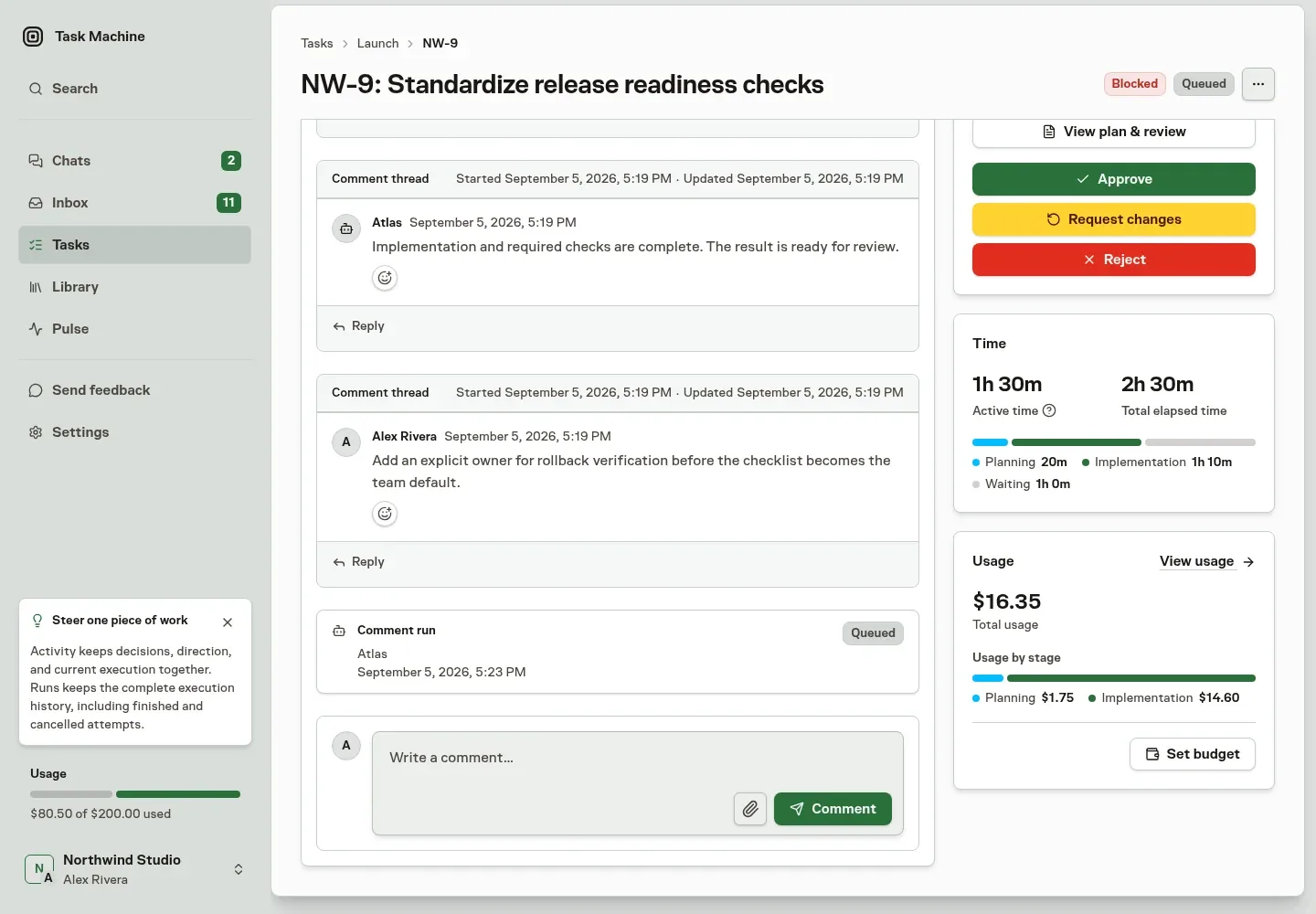
The task detail makes capacity and cost visible before the team adds more concurrent agent work.
4. Fix repeated correction patterns at the team level
Implementation accounted for 43.0% of recorded cost, while rework accounted for 40.5%. Rework includes expected changes from human review and avoidable corrections caused by missing context or repeated errors. The percentage measures cost share only. Task failure rate requires a separate count.
Three recurring patterns deserve different responses:
- The same acceptance criterion is missed across tasks. Add it to the task template and required checks before assigning more related work.
- Agents repeatedly fail because a repository or environment detail is missing. Document the setup once and make it available to every future task.
- Review introduces a new product preference after implementation. Record it as a new decision, update related open tasks, and keep it separate from repeated mistakes.
A team can preserve necessary iteration while preventing the same avoidable correction from consuming several people's budgets. Shared guidance belongs in task templates, repository instructions, or workflows. Within each task, the Work Spec carries that task's outcome, constraints, and required checks into every implementation and correction run.
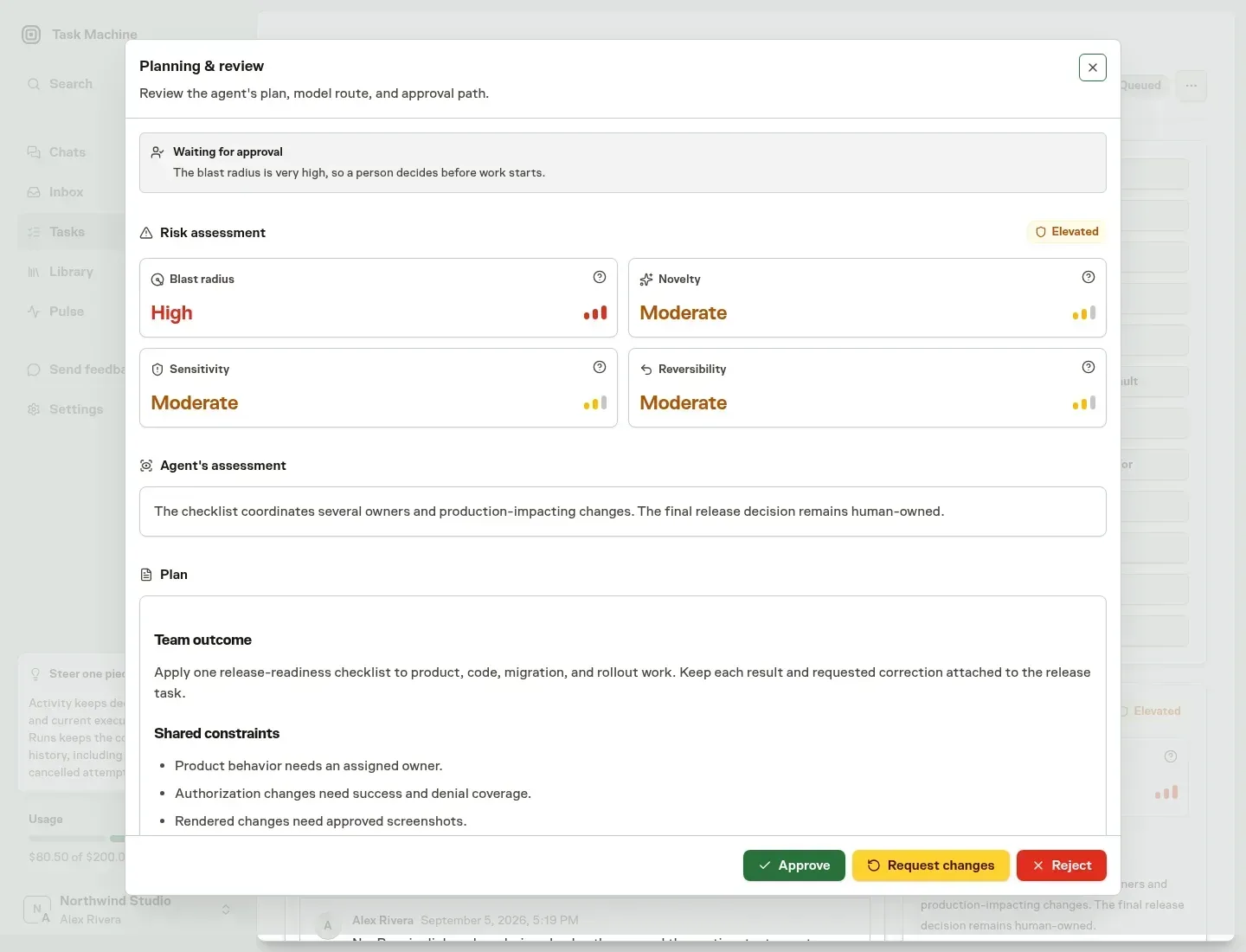
The review surface keeps this task's constraints and risk visible before a person approves its Work Spec.
5. Keep planning, decisions, and execution in separate places
Small teams often start agent work in one chat channel. Product discussion, task assignment, run output, questions, and approvals then become one long transcript.
Use three surfaces for three jobs:
- Chat for direction. Discuss strategy, compare options, and agree on the intended change.
- Inbox for decisions. Resolve questions, approvals, review requests, failed checks, and exceptions with their context attached.
- Tasks for execution. Keep runs, comments, proof, and correction history attached to the outcome.
The separation follows how Task Machine works. It lets a technical lead resolve decisions without reading every run log. A developer can open one task and see the implementation history. A founder can keep unresolved strategy out of an active engineering queue.
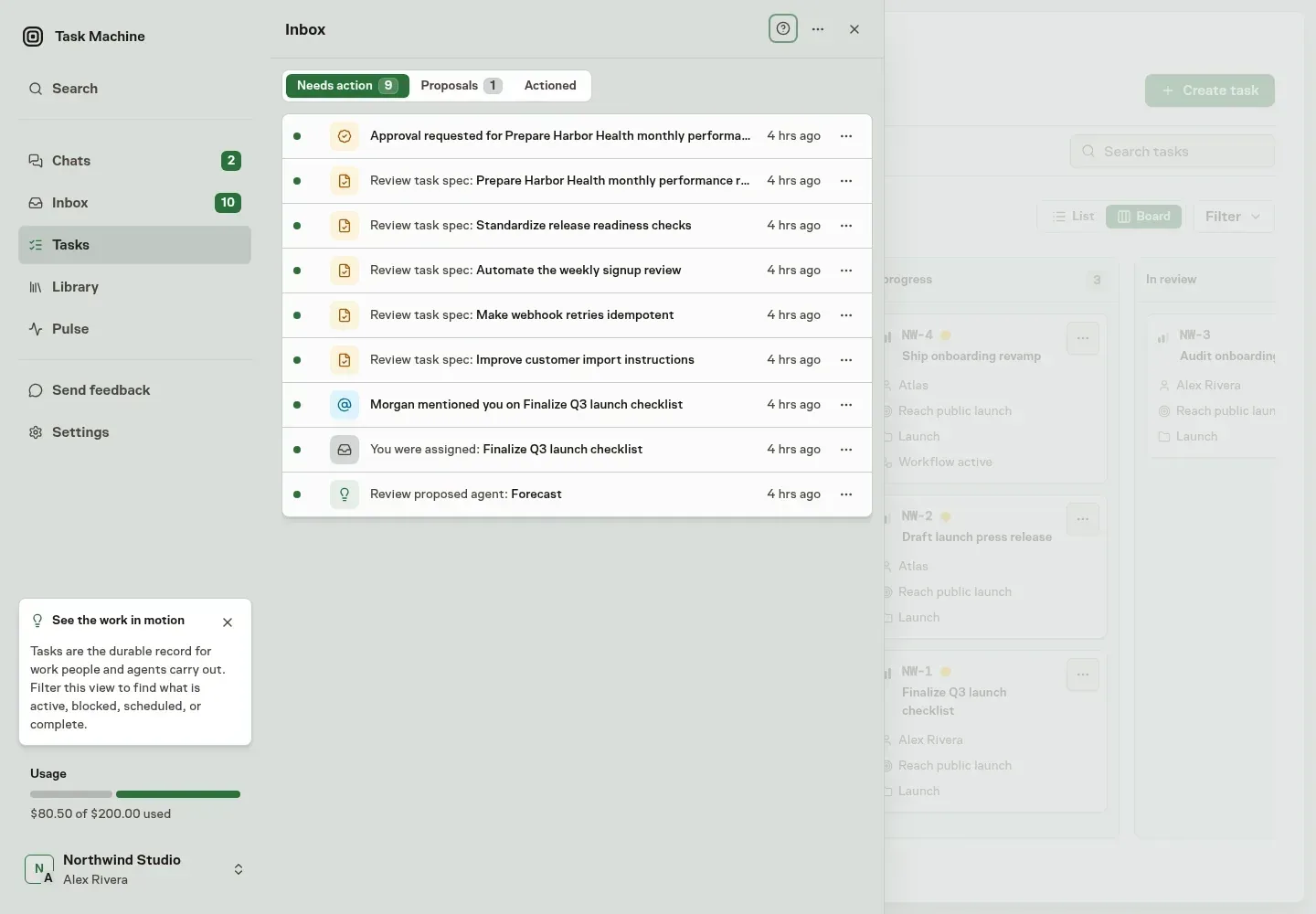
The Inbox keeps decisions separate from execution logs while preserving the task context needed to act.
6. Increase agent freedom after the workflow repeatedly delivers acceptable work
Agent freedom should grow from observed outcomes. Start a new workflow with close review, then relax one boundary at a time after several acceptable results.
A practical progression is:
- The agent works one assigned task and a person reviews the full result.
- Repeated tasks pass the required checks and arrive with clear evidence.
- The agent can retry routine failed checks within a small limit.
- The agent can propose follow-up work for a person to accept or reject.
- Publishing, spending, destructive changes, and external communication continue to wait for explicit human approval.
The customer chooses the boundaries. Agent profiles make those autonomy levels explicit while Task Machine records the work and routes the decisions that still need a person.
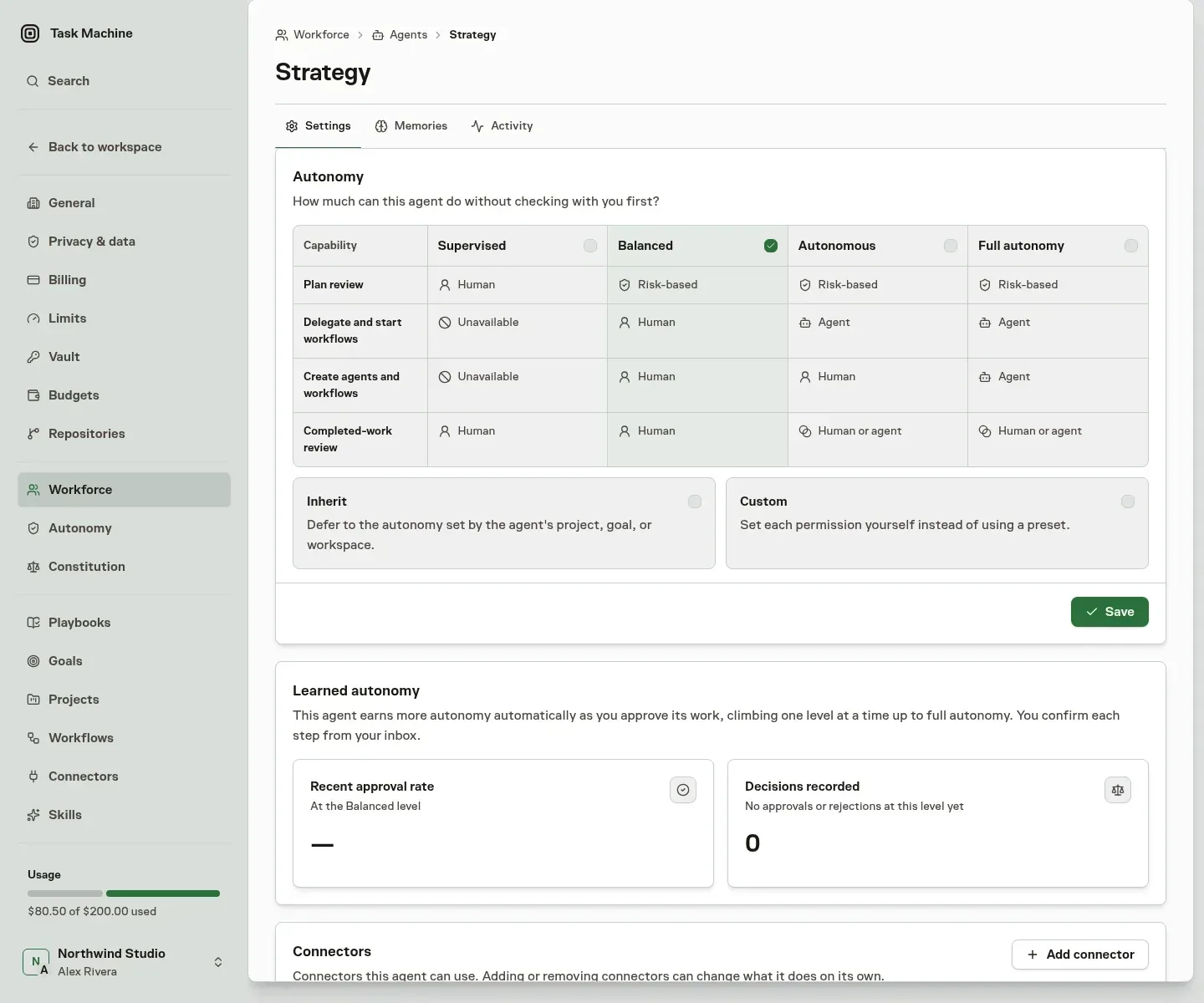
The complete autonomy controls let the team remove one routine approval without removing outcome checks or human-only boundaries.
For the next sprint, choose one recurring workflow and apply all six lessons before adding more agents. Compare its task cost and active time with the current baseline on Task Machine Pulse.