How to Write SEO Content
A practical guide to turning keyword lists into researched briefs, approved drafts, and measured SEO learning loops.

Founder, Task Machine
SEO content writing is the recurring process that turns a keyword list into researched briefs, search-aligned drafts, and approved pages. The useful version does not start with blank-page writing. It starts with keyword research, live SERP analysis, competitor gaps, evidence boundaries, and a brief that a writer can draft from without re-researching.
The work is worth systematizing because content quality usually falls apart at handoff points. Research lives in one doc, the draft ignores the search intent, source-needing claims appear without evidence, and the page ships without a clear reason it should rank or be cited.
Why SEO content becomes thin content
SEO content earns a bad name when teams optimize for volume before evidence. A keyword becomes a title, the title becomes a draft, and the draft becomes another page that repeats what already ranks. That does not help searchers, and it gives AI answer engines little reason to cite the page.
The better process is slower at the front and faster later. Each target gets a brief with the SERP pattern, dominant intent, true difficulty, competitor gap, fan-out questions, internal links, and an evidence ledger. The draft then has a clear job.
What the manual process looks like
Run by hand, SEO content writing has nine steps:
- Scope the site, topic cluster, audience, business goal, geography, language, and domain strength.
- Discover, classify, score, and cluster keywords into pillar and cluster topics.
- Analyze the live SERP for priority keywords: features, ranking patterns, intent, top pages, and difficulty.
- Compare competitor coverage and identify gaps worth closing.
- Write an evidence-graded brief with the target keyword, intent, gap angle, outline, fan-out questions, title, meta description, internal links, and source ledger.
- Draft the content so the answer appears above the fold, the keyword appears naturally, and source-needing claims are cited or flagged.
- Verify the draft against the brief and SEO quality bar, then obtain human approval.
- Before publication, record the page owner, target query, fixed baseline and candidate windows, primary outcome, business signal, guardrails, sources, and readback date.
- Once the fixed result window matures, compare it with the baseline, review confounders, and decide whether to expand the demonstrated pattern, keep observing, revise, or call the result unproven.
The repeatability is in the gates: every claim is labeled, every gap names the competitor, every draft answers the intent before it asks for anything, and every measured conclusion stays tied to the plan recorded before results arrived.
What an agent can automate
A strategist, writer, and independent reviewer map well to the workflow:
- Research before drafting. The SEO strategist scopes the topic, clusters keywords, analyzes the SERP, and runs competitor gap analysis. If competitors are missing and cannot be inferred, the agent asks.
- Score with evidence labels. Metrics are labeled as Measured, User-provided, Estimated, or N/A. The agent should never present an estimate as measured.
- Write draftable briefs. Each brief includes the SERP snapshot, true difficulty, gap angle, H1 and outline, fan-out questions, internal links, title and meta drafts, and the source ledger.
- Draft to the brief. The content writer answers the query above the fold, uses headings and blocks that are easy to extract, covers fan-out questions, and keeps keyword placement natural.
- Verify before approval. The strategist checks the draft against intent and evidence boundaries. The independent quality reviewer checks consequential handoffs against explicit outcome requirements before the human approves the plan.
- Record the measurement contract. Approved drafts enter a change log with an owner, publication details, fixed comparison windows, one primary outcome, a downstream business signal, guardrails, source systems, and readback date. Approval records the plan. It does not publish the page.
- Read back due results. On schedule, the strategist loads the exact windows from Search Console or approved exports, checks indexation, conversion, non-brand coverage, cannibalization, and material confounders, then prepares a bounded decision for approval.
The agents should not publish or change live pages. They produce verified drafts and reproducible performance readbacks for human judgment.
The guardrails that make it safe
SEO work is vulnerable to fabricated facts, stale claims, and pages that satisfy a tool while disappointing the reader. The guardrails are evidence labels, source ledgers, and a verifier step that can send drafts back.
The first approval point sits after the strategist verifies the draft. It decides which plans may enter the change log, but it does not publish anything. A second approval point sits after the measured readback. It decides whether the evidence supports expansion, more observation, revision, or no conclusion. That approval records a decision only. It does not edit, redirect, remove, or replicate a page.
Set it up in Task Machine
The SEO content writing playbook provides a starting point for the method above. You need an active Task Machine workspace with Chat, workspace-management and Playbook-installation access (workspace owners have it). Google Search Console and SEO data access can be authorized after install. Until then, the workflow can use attached exports and web research.
1. Find the playbook
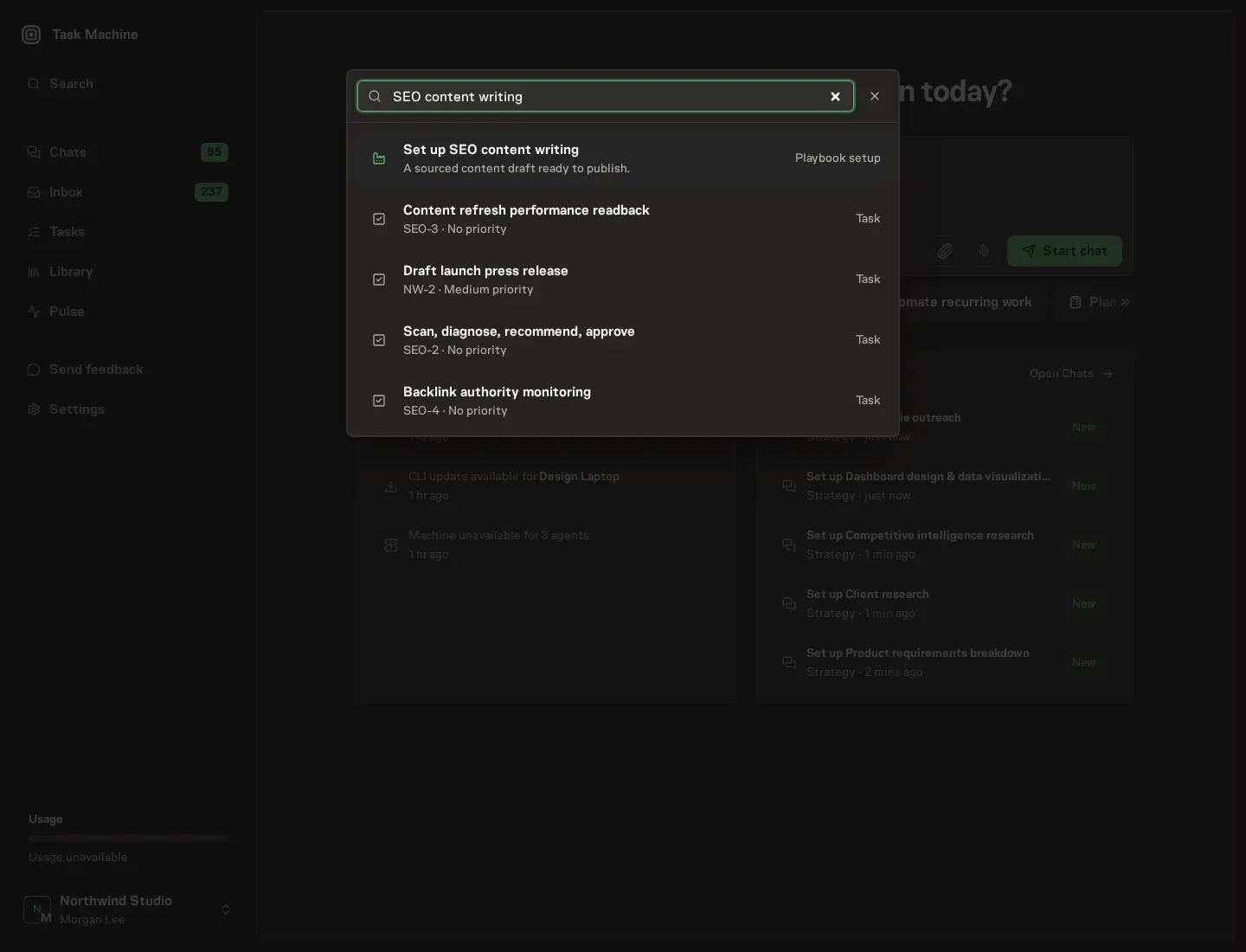
Open Search in your workspace and enter "SEO content writing". The command center lists Set up SEO content writing under Playbook setup.
2. Start the conversation
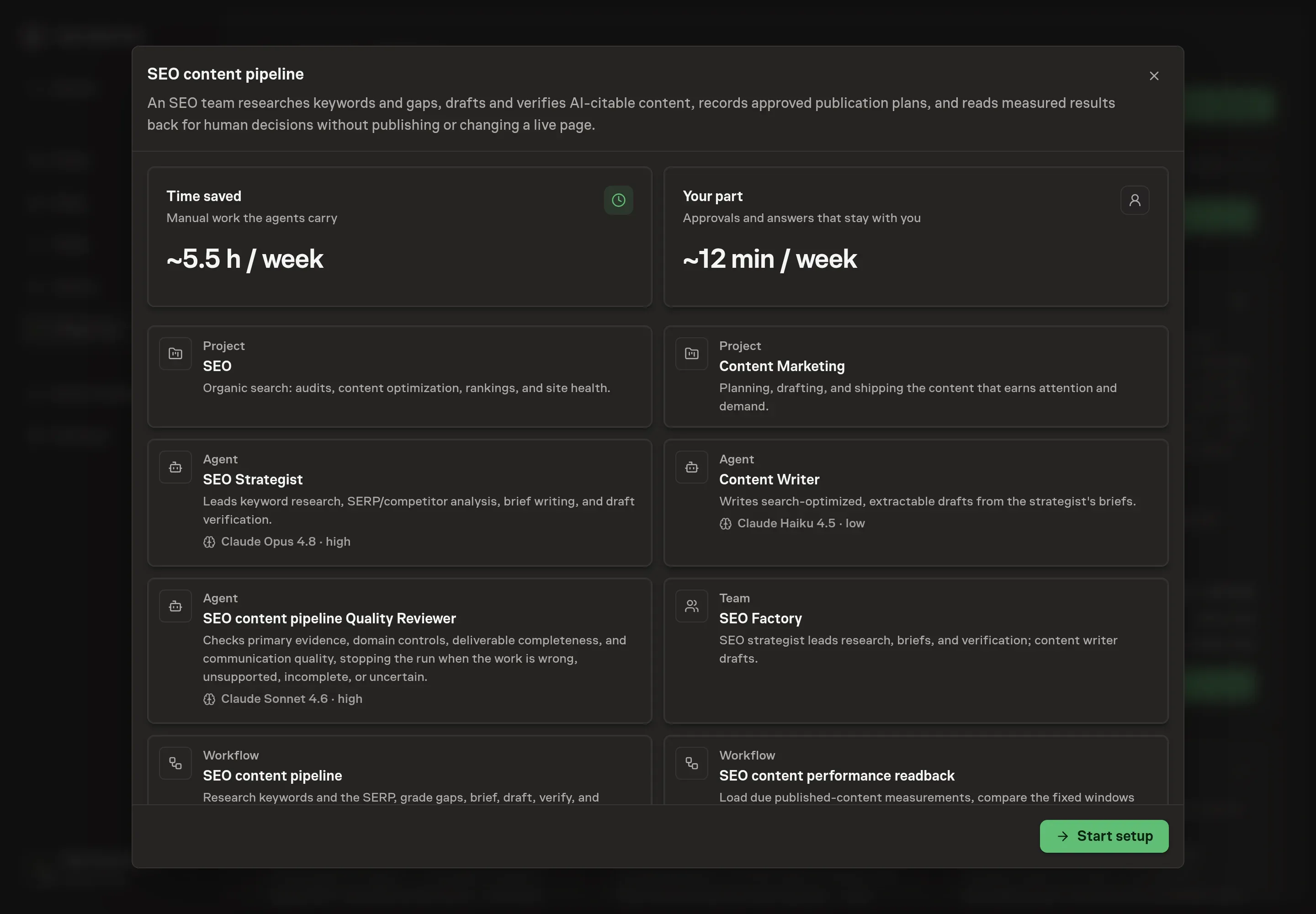
Choose Set up SEO content writing. Task Machine opens a dedicated Chat with the Playbook card and an editable, unsent request. Read the intended job and outcome, add your situation, and send it when ready. Opening the draft does not install anything or start work. This walkthrough uses settings that require approval of the proposed Playbook.
3. Agree the services
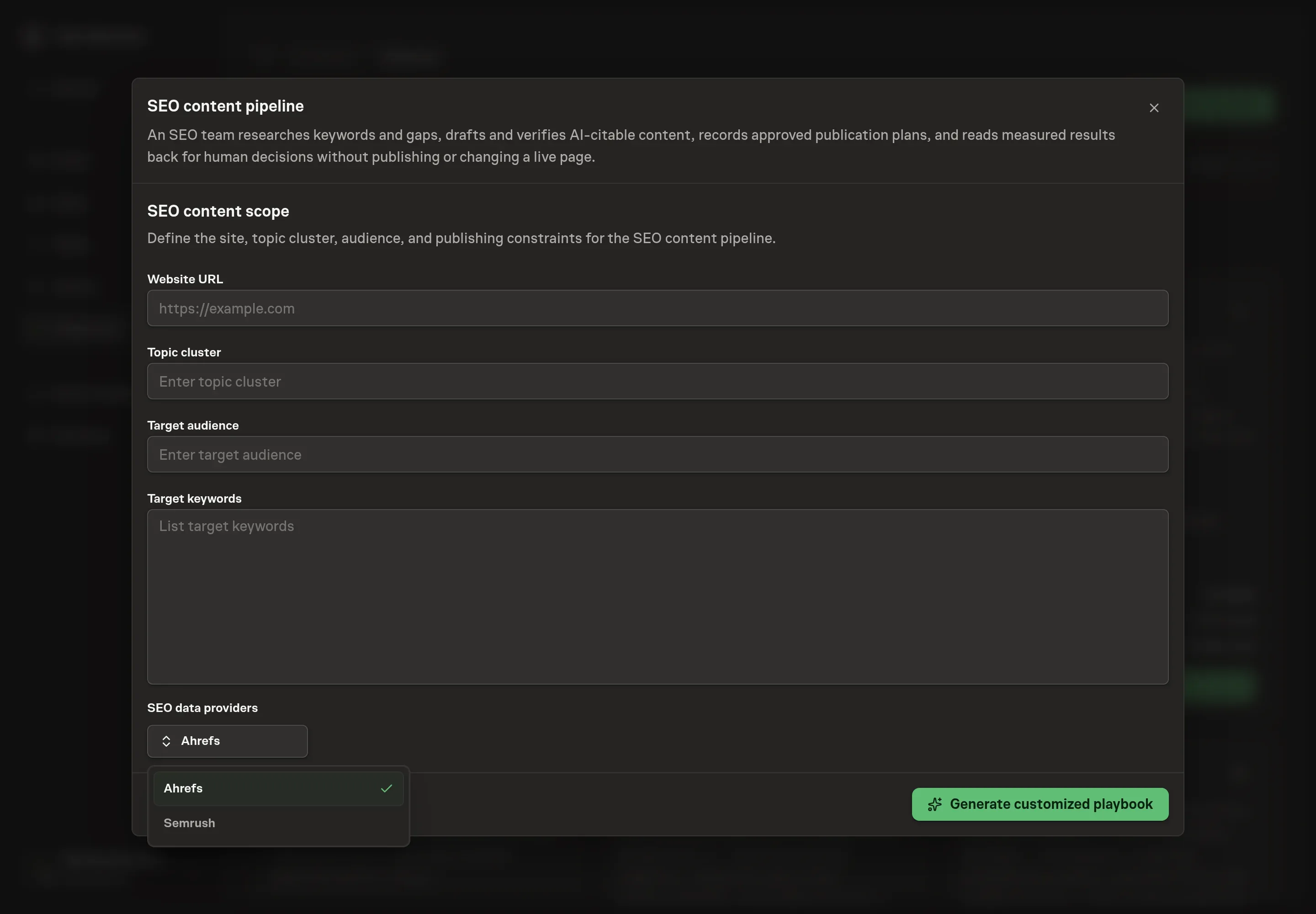
Tell the Agent which services you use. The catalog offers these starting choices:
- SEO data providers: Ahrefs, Semrush. Optional.
Discuss any missing access or export-based alternative before generation. Check the exact proposal includes only the services you agreed. Enter credentials only through secure setup, never in Chat.
4. Agree the working brief
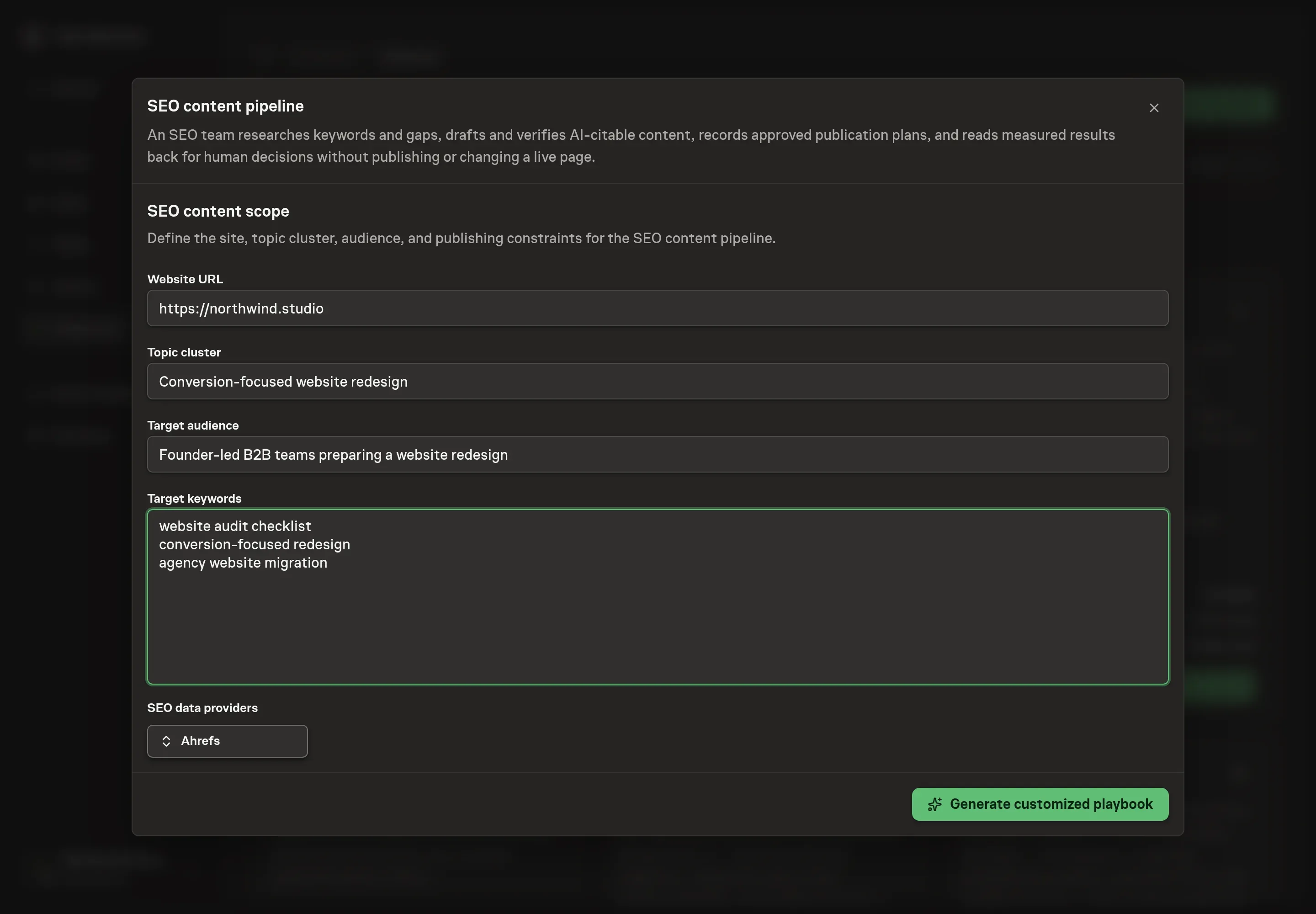
Use Chat to agree the inputs, expected output and limits before asking for a proposal. Discuss the website URL, topic cluster, target audience, target keywords, and chosen SEO data provider. For Northwind Studio, that might be a website redesign topic cluster for founder-led B2B teams, with keywords around website audit checklist, conversion-focused redesign, and agency website migration.
5. Review the proposed Playbook
Ask the Agent to generate the Playbook from the agreed brief. Open its proposal in Chat and check the instructions and resources it will install, which carry more detail than the conversational summary. Review the customized strategist and writer instructions, both workflow prompts, change log, selected services, goal, and schedules. Confirm the content workflow includes research, drafting, verification, approval, and recording. Confirm the readback compares fixed windows, checks guardrails and confounders, and waits for a second approval. Ask for a revised proposal if anything is missing or changes the job.
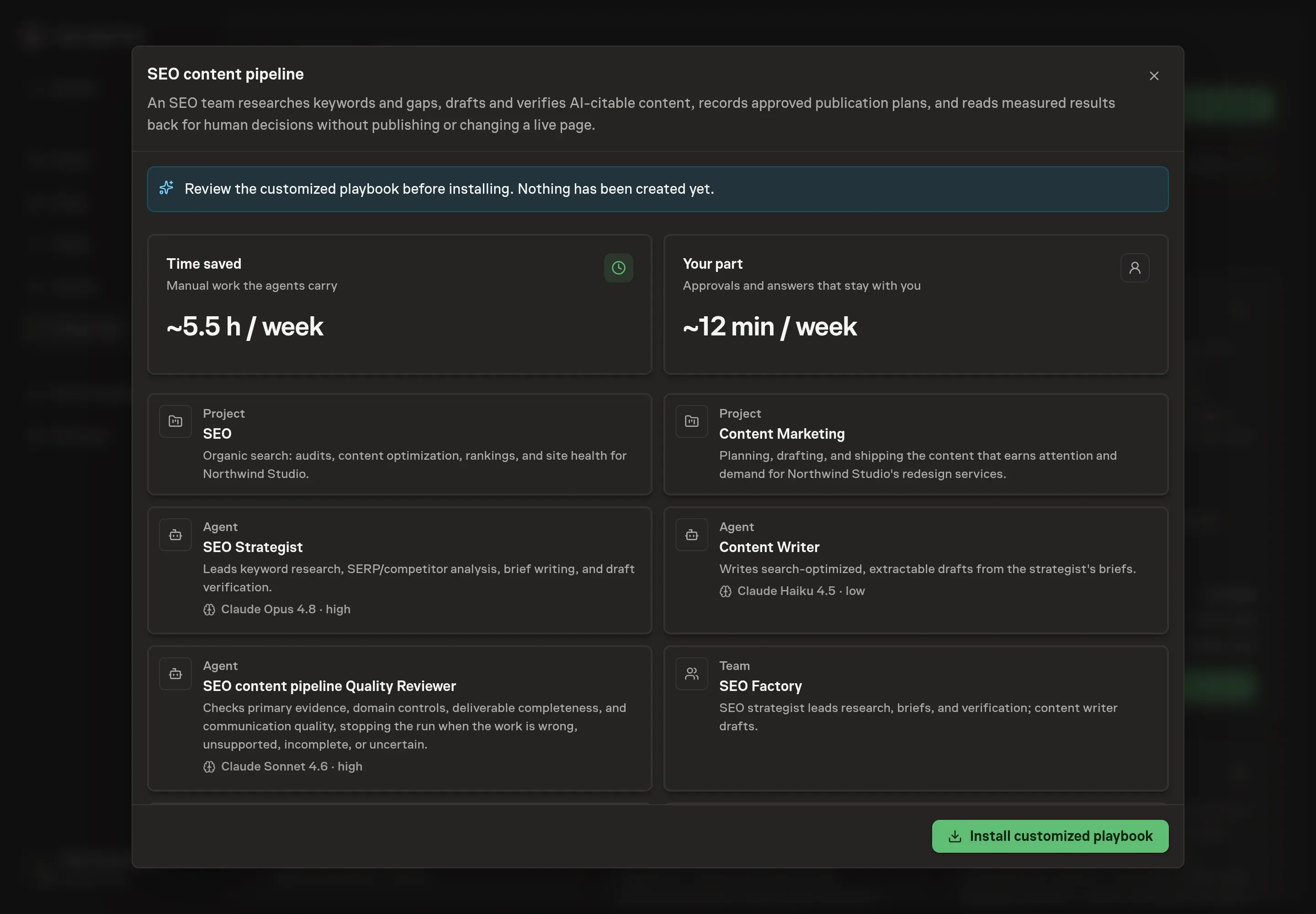
6. Approve and prepare the first work
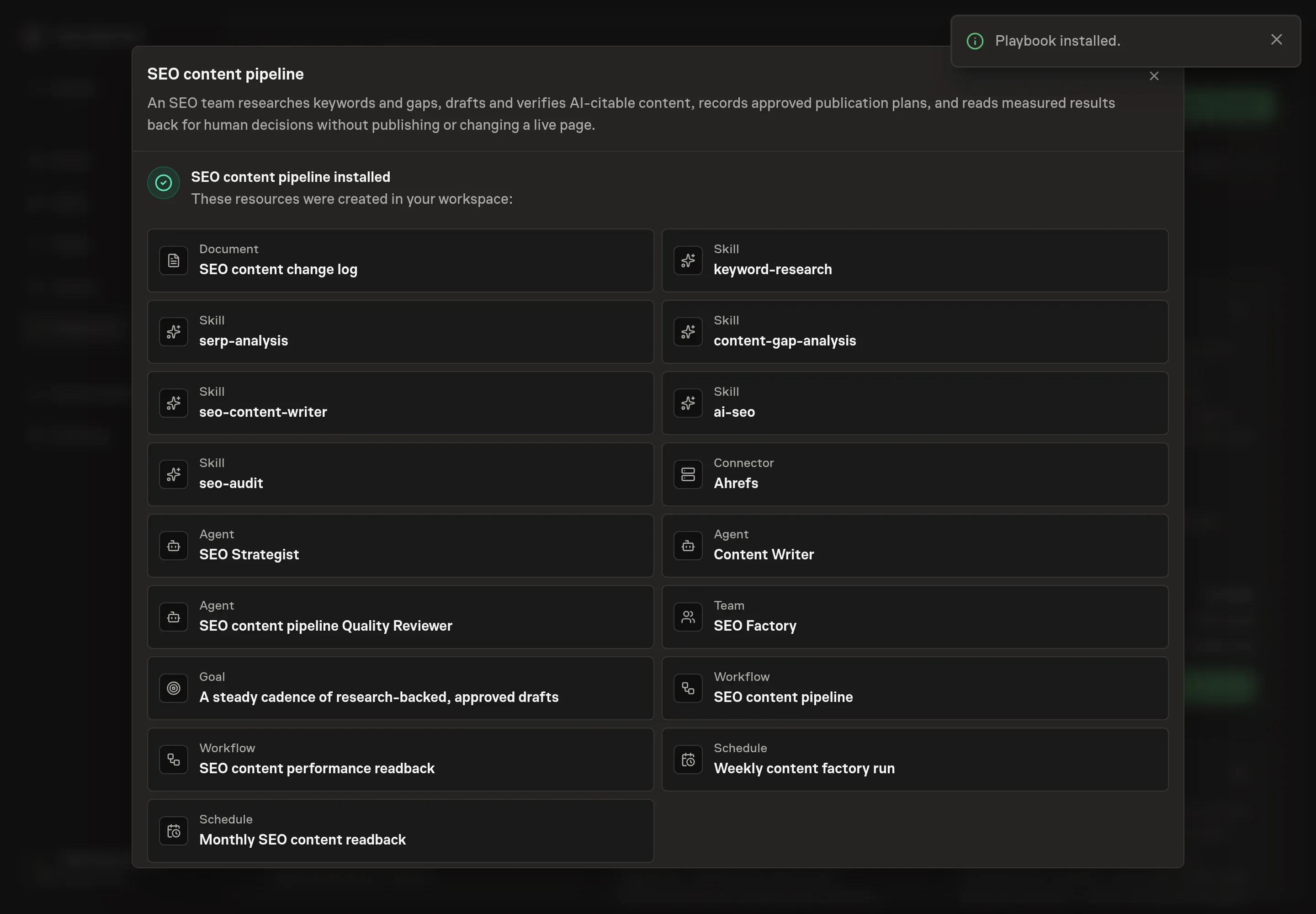
Choose Approve on the proposal in Chat when the configuration matches your brief. Task Machine installs that reviewed configuration. The approved item retains its review details. If your autonomy settings allow direct installation, this approval may not be required. Check the resulting configuration in that case too.
Complete any remaining secure service setup from the installation details in Chat. Inbox keeps those setup items available if you return later. Prepare the source documents and inputs before starting the first Task or Workflow. Installation does not authorize sending, publishing or changing an external service beyond the boundaries you agreed. Confirm each schedule's cadence and timezone, and resolve any pending schedule setup before it starts. A readback must wait for its agreed observation window and source data. Check the reviewed tracker or results document before the first cycle so evidence and human decisions have a durable home.
What good looks like
Judge SEO content writing by research quality and editorial readiness:
- Every brief is draftable. The writer can see intent, SERP pattern, gap angle, fan-out questions, links, and source needs without redoing research.
- Every metric is labeled. Search volume, difficulty, traffic, and competitor estimates are marked as Measured, User-provided, Estimated, or N/A.
- Every draft passes verification. The answer appears above the fold, source-needing claims are cited or flagged, and the structure is useful to humans and answer engines.
- Primary outcome. Organic clicks for the target-query/page pair are compared over a fixed 28-day baseline and candidate window. The window can differ when approved before publication, never after results arrive.
- Business signal and guardrails. Conversions or qualified leads stay separate from the primary SEO outcome. Indexation, non-brand query coverage, conversion rate, and cannibalization must not materially worsen.
How the loop learns
Before publication, the change log records the page owner, target query and intent, approved draft, planned URL, baseline and candidate windows, source systems, one primary outcome, a downstream business signal, guardrails, and readback date. The default compares the 28 complete days before publication with days 8–35 after publication, leaving seven days for discovery and indexing. Search Console supplies page-and-query clicks and indexation evidence. Approved analytics exports or selected SEO data services supply the other named measures.
When the readback becomes due, the strategist uses those exact windows. It checks indexing delay, seasonality, campaigns, branded-query shifts, search-results changes, simultaneous site releases, tracking changes, low volume, and cannibalization before drawing a conclusion. The human then chooses expand, keep observing, revise, or unproven. Expand can authorize a narrowly scoped next plan, but no decision edits or replicates a live page automatically. Negative and inconclusive results stay in the log so weak patterns do not return as fresh advice.
Common questions
Can this replace an editor? No. The workflow prepares and verifies drafts. A person still approves what ships and decides whether the page fits the brand and publishing plan.
Does this write for AI answer engines instead of people? No. The method writes for people and organizes for clarity. Definition blocks, direct answers, tables, FAQs, and sourced claims help readers and make the page easier to cite.
What happens if competitor data is missing? The strategist asks for competitors when none are inferable. A gap analysis needs a comparison set.
Can this run from a keyword export? Yes. SEO data services help with volume and difficulty, but attached exports and web research can carry the workflow until services are authorized.
How soon can I judge a published page? Use the fixed observation rule recorded before publication. The default waits through a seven-day discovery period and then reads 28 complete candidate days against the prior 28 days. If traffic is too low or indexing is delayed, the defensible decision is keep observing or unproven, not a reconstructed winner.