How to Review Marketing Claims
A practical guide to reviewing marketing claims with claim extraction, substantiation checks, safer rewrites, and attorney approval.

Founder, Task Machine
Marketing claims review is the process of reading campaign copy before it ships, extracting every factual or implied claim, checking whether each claim has matching substantiation, and rewriting risky language so the campaign keeps its intent without creating avoidable legal exposure. It works claim by claim through what the marketing says a product, customer, competitor, or outcome can do.
The work matters because risky claims rarely look risky to the team writing them. "Trusted by 10,000 teams", "the only platform for X", "secure alternative", and "faster than legacy tools" can all be reasonable or dangerous depending on the proof, the comparison, the jurisdiction, and the disclosure overlay.
Marketing moves faster than its substantiation files
Marketing teams move faster than substantiation files. Product capabilities change, launch copy drifts from the PRD, customer counts become stale, comparative claims pick up a named competitor, and a harmless-sounding endorsement may need a disclosure because the speaker has a material connection.
The dangerous part is usually specificity. Pure puffery is often low risk, but specific factual, comparative, implied, and absolute claims need evidence that matches the exact wording. A benchmark from last year may not support a current claim. A broad security posture may not support "HIPAA compliant" unless the contract, configuration, and BAA support it.
What the manual process looks like
Done by hand, a legal or product reviewer runs a disciplined sequence:
- Collect the asset, campaign context, product notes, substantiation files, and launch deadline.
- Extract every sentence or phrase that states a fact, makes a comparison, implies an outcome, or promises a specific result.
- Classify each claim as vague or puffery, specific factual, comparative, implied, or absolute.
- Test substantiation against the exact claim: who measured it, when, sample size, method, and whether it is apples-to-apples.
- Research the currently operative advertising standard for the specific claim, such as FTC, NAD, state UDAP, sector rules, or platform policy.
- Write a flagged memo with cut, rewrite, or substantiation-needed calls, then route it to an attorney before publication.
The time goes into keeping every claim, proof file, standard, and safer rewrite tied together so the attorney can approve the decision without rebuilding the review.
What an agent can automate
An agent can do the assembly and first-pass analysis while keeping legal judgment with the qualified reviewer:
- Extract and classify every claim. The agent reads the attached copy and separates pure puffery from specific factual, comparative, implied, and absolute claims.
- Check substantiation precisely. It tests whether the proof matches the exact wording, date, sample, and comparison basis instead of asking whether some proof exists somewhere.
- Research the operative standard. For each non-puffery claim, the agent looks up the standard that maps to that quoted claim and tags citations that need verification.
- Draft safer rewrites. The memo suggests language that keeps the marketing intent while reducing exposure, such as replacing unsupported absolutes with narrower, supportable claims.
- Verify before attorney review. A second verifier checks cited standards and substantiation calls so an untraceable citation does not reach the attorney as if it were settled.
The agent drafts the memo. It does not approve copy for publication, and it does not turn the memo into legal advice.
The guardrails that make it safe
The safe boundary is explicit: every memo waits for attorney approval before any copy ships. The agent can find claims, research standards, draft rewrites, and assemble the substantiation-needed table, but the publish decision remains a human legal act.
The second guardrail is verification. The bundle includes a claims verifier whose job is to reject fabricated, unmapped, or weakly supported standards before the memo reaches the attorney. That matters because a confident but wrong citation can be worse than no review at all.
Set it up in Task Machine
The Marketing & claims legal review playbook provides a starting point for the method above. You need an active Task Machine workspace with Chat, workspace-management and Playbook-installation access (workspace owners have it). Web search and fetch access help the agent research public standards, but the workflow can still label research gaps when tools are unavailable.
1. Find the playbook
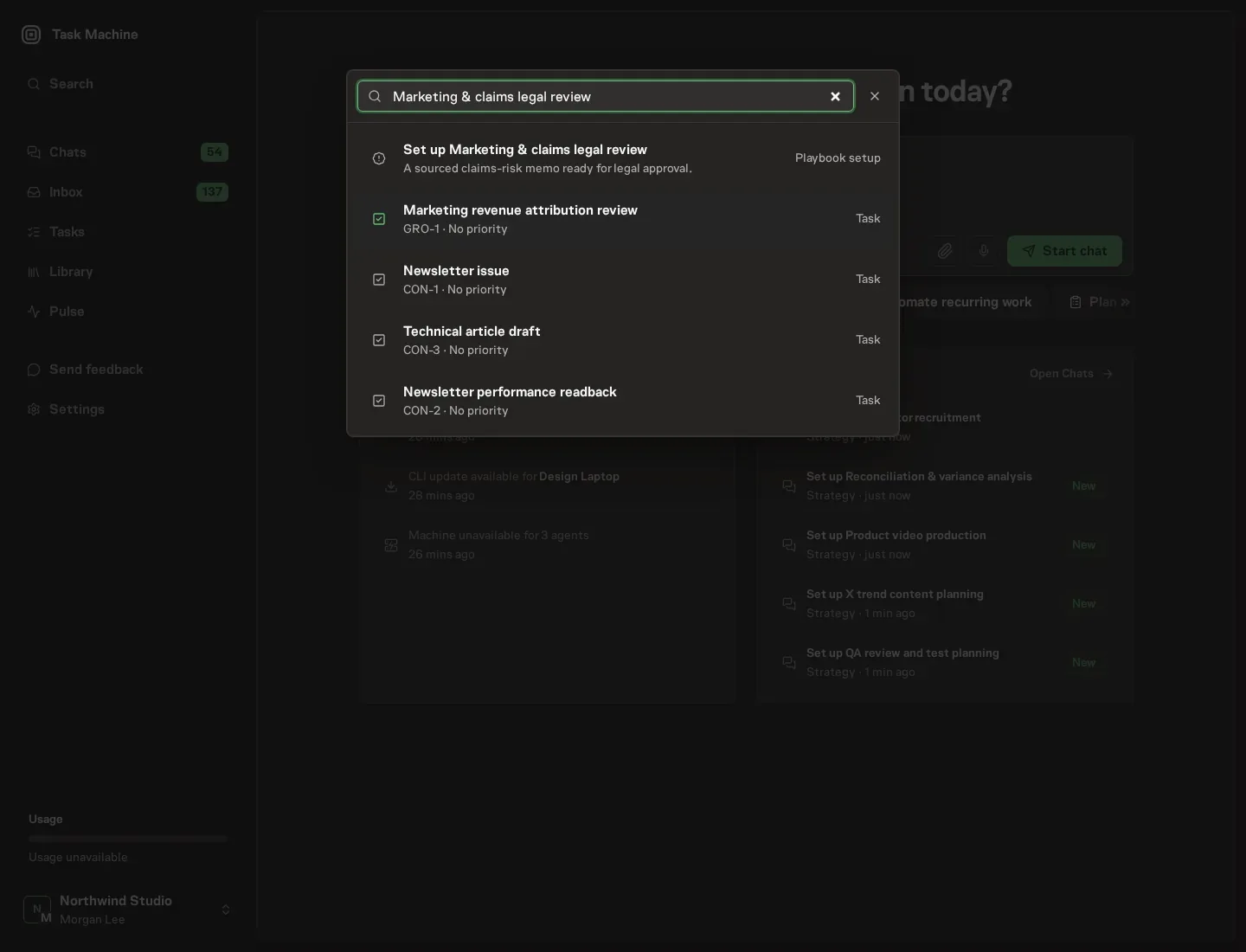
Open Search in your workspace and enter "Marketing & claims legal review". The command center lists Set up Marketing & claims legal review under Playbook setup.
2. Start the conversation
Choose Set up Marketing & claims legal review. Task Machine opens a dedicated Chat with the Playbook card and an editable, unsent request. Read the intended job and outcome. Add your situation and send it when ready. Opening the draft does not install anything or start work. This walkthrough uses settings that require approval of the proposed Playbook.
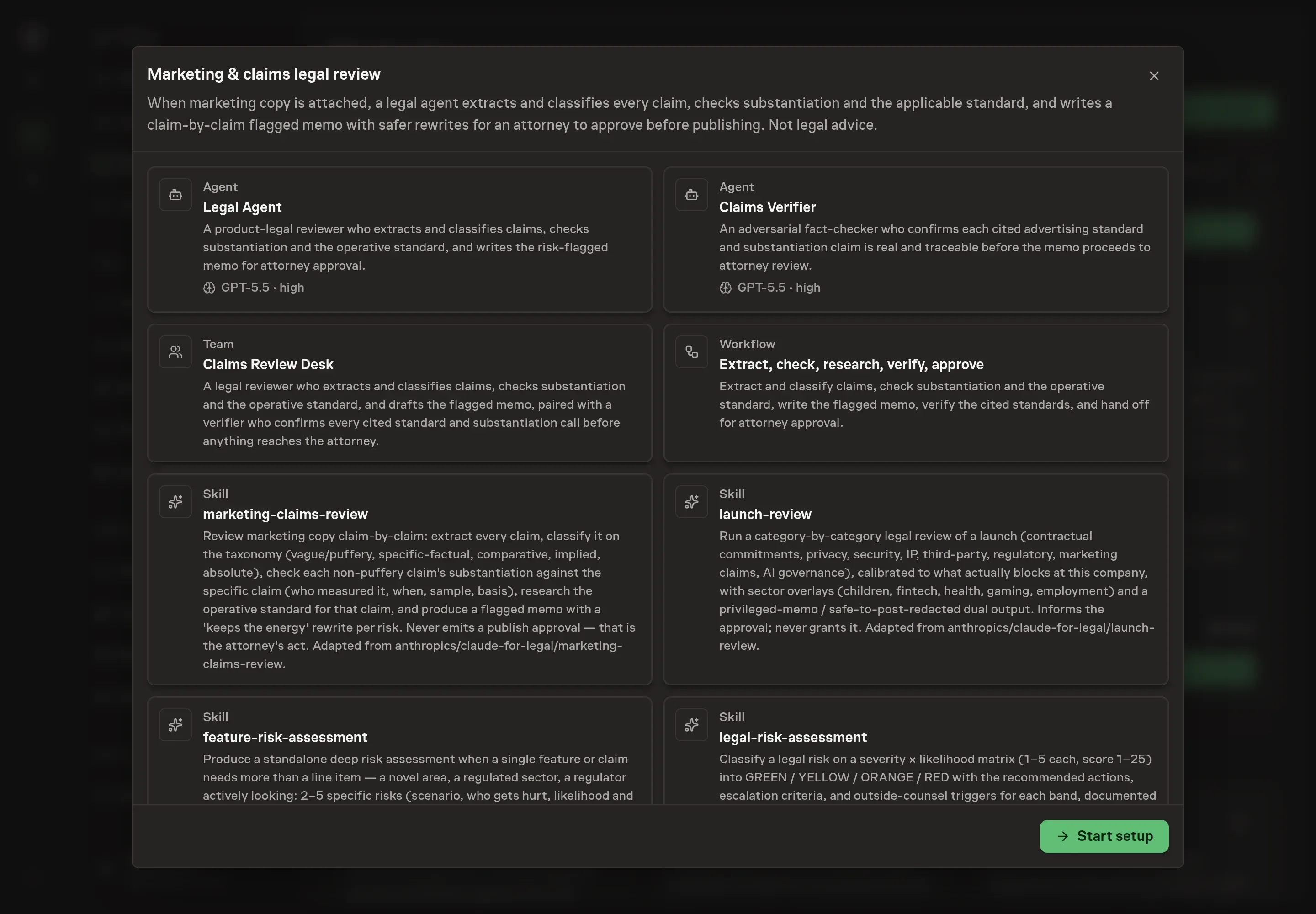
3. Agree the working brief
Use Chat to agree the inputs, expected output and limits before asking for a proposal. Discuss the campaign or asset name, the claim types you expect, substantiation sources, and the review standard or jurisdiction. Strong inputs name the exact asset and proof sources as well as the campaign theme.
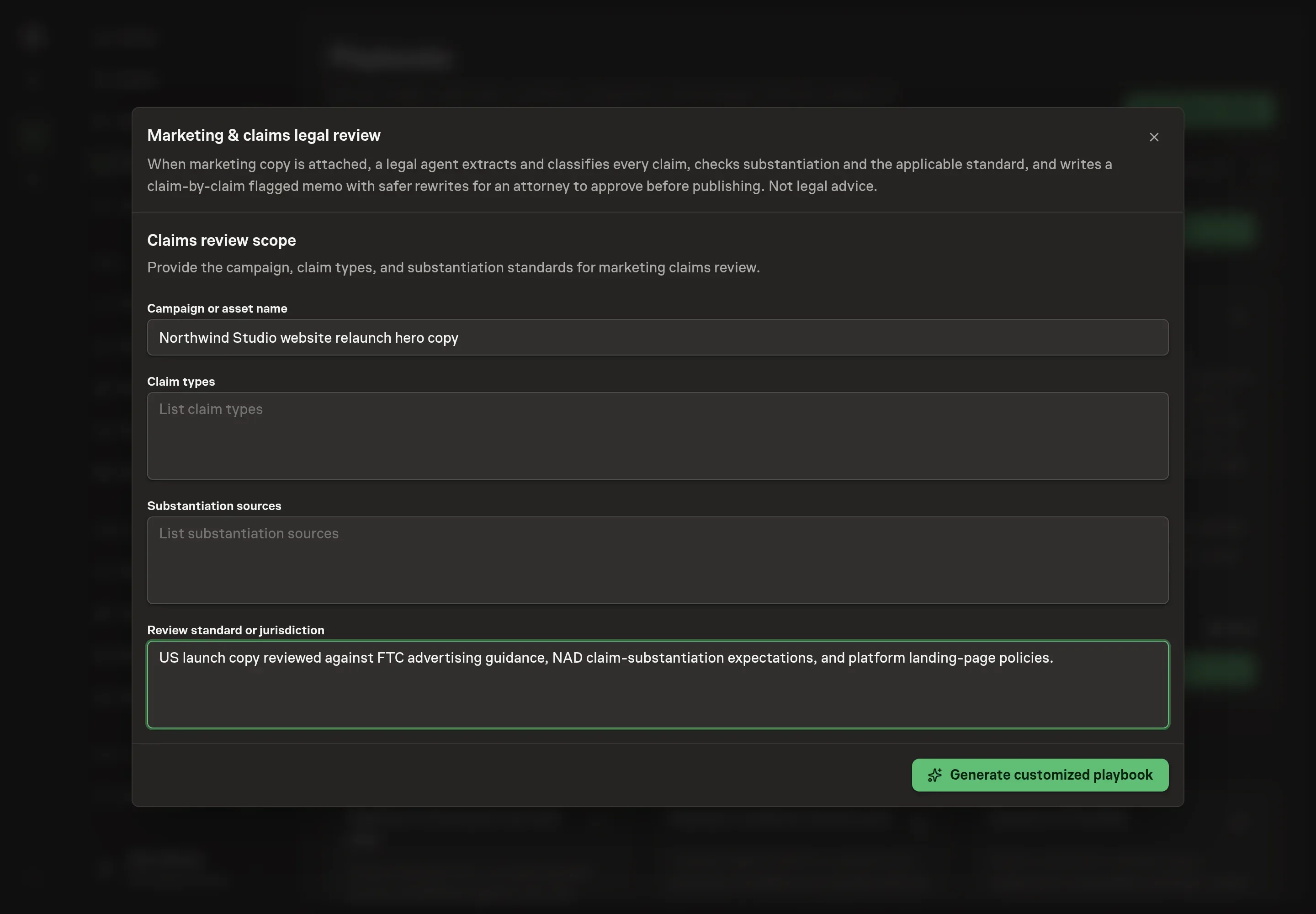
4. Review the proposed Playbook
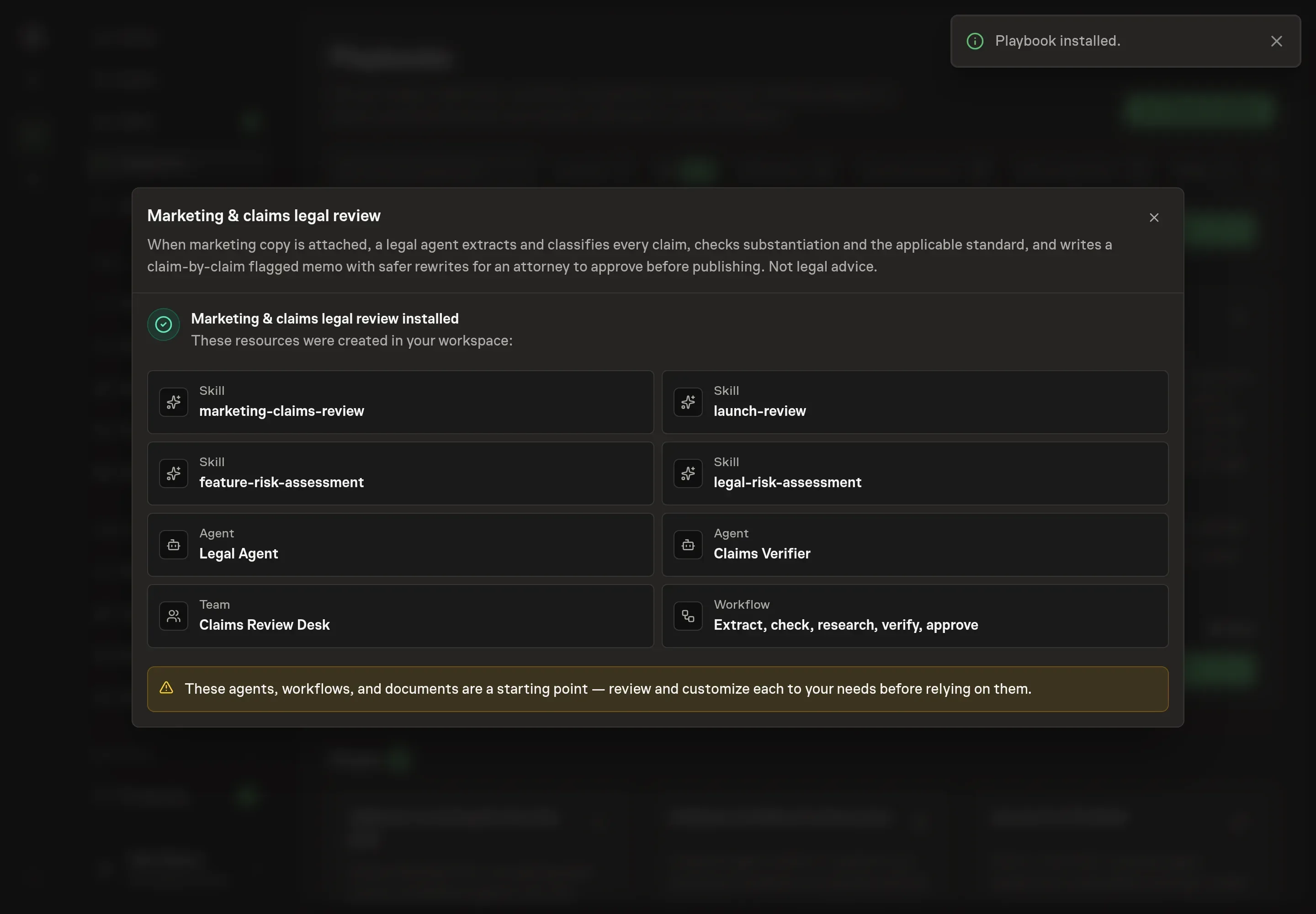
Ask the Agent to generate the Playbook from the agreed brief. Open its proposal in Chat and check the instructions and resources it will install, which carry more detail than the conversational summary. Confirm that the workflow extracts claims, checks substantiation, researches standards, writes the memo, verifies citations, and waits for attorney approval. Ask for a revised proposal if anything is missing or changes the job.
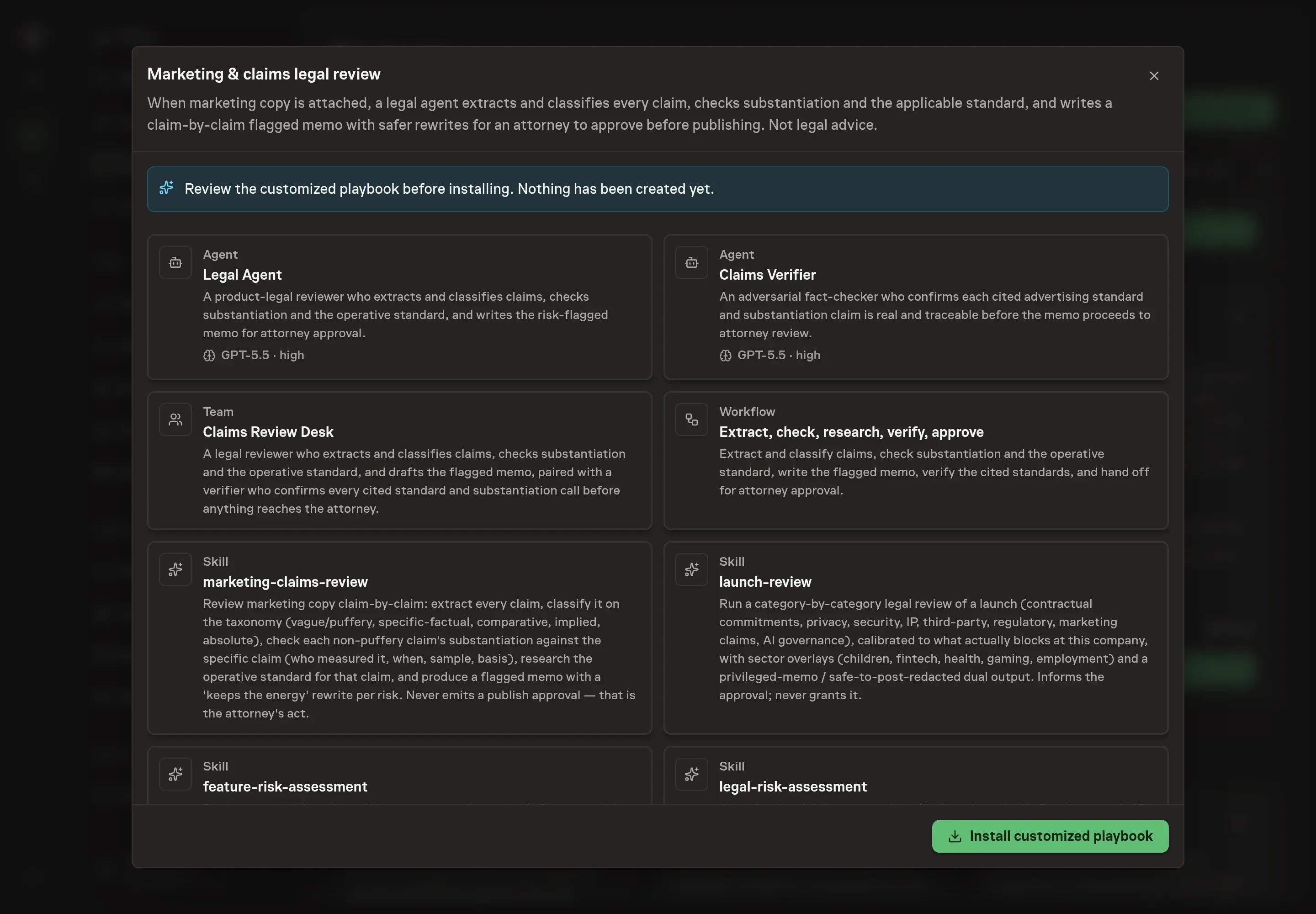
5. Approve and prepare the first work
Choose Approve on the proposal in Chat when the configuration matches your brief. Task Machine installs that reviewed configuration. The approved item retains its review details. If your autonomy settings allow direct installation, this approval may not be required. Check the resulting configuration in that case too.
Complete any remaining secure service setup from the installation details in Chat. Inbox keeps those setup items available if you return later. Prepare the source documents and inputs before starting the first Task or Workflow. Installation does not authorize sending, publishing or changing an external service beyond the boundaries you agreed.
What good looks like
A useful claims review makes the attorney's decision easier:
- Every claim is accounted for. The memo shows what was reviewed and why pure puffery was left off the flagged list.
- Substantiation matches the wording. The proof supports the actual claim, including date, sample, method, and comparison basis.
- Every cited standard is traceable. The citation maps to a quoted claim and survives verifier review.
- The rewrite is usable. The safer wording preserves the campaign intent while removing unsupported absolutes, comparisons, or implied outcomes.
Common questions
Does this replace an attorney review? No. The playbook drafts and verifies the memo so an attorney can review it faster. Publication approval remains with the attorney.
Can it review images or product UI claims? The bundle is built for words. It can flag an image that implies a claim, but visual review is a human call.
What if the standard cannot be confirmed? The agent should label the gap and stop rather than inventing a rule. The reviewer can broaden research, add source material, or escalate the claim.
Should every launch use this workflow? Use it when copy contains factual, comparative, implied, absolute, testimonial, influencer, atypical-results, auto-renewal, or regulated-sector claims. Pure brand lines with no factual claim may not need the full workflow.