The Real Economics of AI Agents for Indie Hackers
A 30-day dataset turns agent cost, founder attention, review cycles, and completed tasks into a practical solo-company budget.

Founder, Task Machine
A solo founder can buy more model usage in minutes. Buying more judgment is harder. Every new agent task creates a future claim on the same person's time: a brief to clarify, a question to answer, a result to review, or a correction to request.
This makes agent economics different from a software subscription. Token spend is visible on an invoice, while fragmented founder attention appears as interrupted mornings and half-finished decisions. A realistic budget has to account for both.
We analyzed an anonymized, platform-wide Task Machine window from August 6 through September 4, 2026. Across 534 tasks with active time, agents averaged 1 hour 43 minutes of execution. Across 533 tasks with recorded cost, the average was $21.43. Sixty-eight tasks reached done.
Average recorded cost
$21.43
Average active agent time
1h 43m
Tasks completed
68
The interface screenshots use fictional examples. The published figures come from the anonymized 30-day dataset.
The dataset suggests six lessons for founders who need agent work to fit a real monthly budget.
1. Keep separate budgets for money and attention
An indie hacker needs a model budget and a founder-attention budget.
| Budget | Unit | What consumes it |
|---|---|---|
| Agent execution | Recorded USD cost | Model calls, retries, failed attempts, review runs, and rechecks |
| Founder attention | Focused minutes | Briefing, answering questions, approving actions, and judging results |
The 30-day dataset recorded $11,423.21 in task-attributed cost across many workspaces. A solo founder needs a budget based on personal task volume, task types, and model choices. The platform-wide $21.43 average provides a first reference point.
| Planned tasks per month | Cost at $21.43 average | Attention at 5 minutes each | Attention at 10 minutes each |
|---|---|---|---|
| 10 | $214.30 | 50 minutes | 1 hour 40 minutes |
| 25 | $535.75 | 2 hours 5 minutes | 4 hours 10 minutes |
| 50 | $1,071.50 | 4 hours 10 minutes | 8 hours 20 minutes |
The 5 to 10 minute range applies to roughly one hour of routine, well-scoped execution. Longer tasks usually need more. Coding, design, and strategy work with manual review often exceeds the range. Founder attention was not timed in the dataset, so this assumption should be tested against personal work.
Task Machine budgets keep model spend visible at workspace, project, agent, team, or task scope. A founder can set the money boundary without pretending it also measures personal attention.
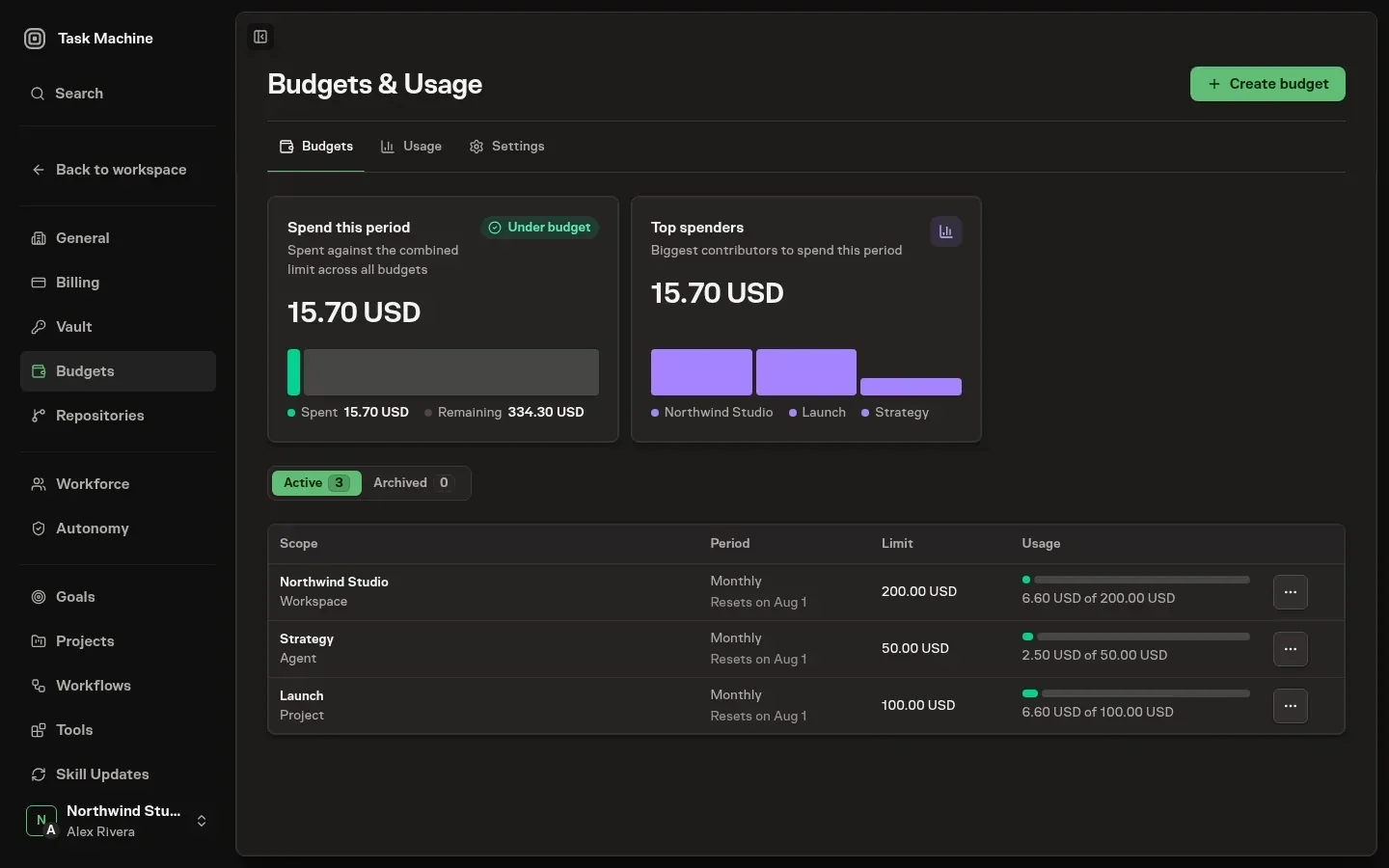
Scoped budgets make the money limit explicit while founder review time remains a separate planning input.
2. Use the average and reserve for expensive outliers
The median cost was $0.20, the average $21.43, the 90th percentile $81.42, and the highest task $468.04. Different task sizes, models, and review cycles produced a wide cost range.
Average recorded task cost
Across 533 tasks with recorded cost
$21.43
Using the median to budget 50 tasks would reserve only $10. One substantial implementation could exceed that budget several times over. Using the maximum for every task would lock up money that most tasks never need.
Start with the average multiplied by expected task volume. Keep a separate allowance for several tasks above the 90th percentile, and require a decision before a task consumes that reserve. Task-level usage and duration show how one piece of work is consuming that reserve and which stages account for the spend.
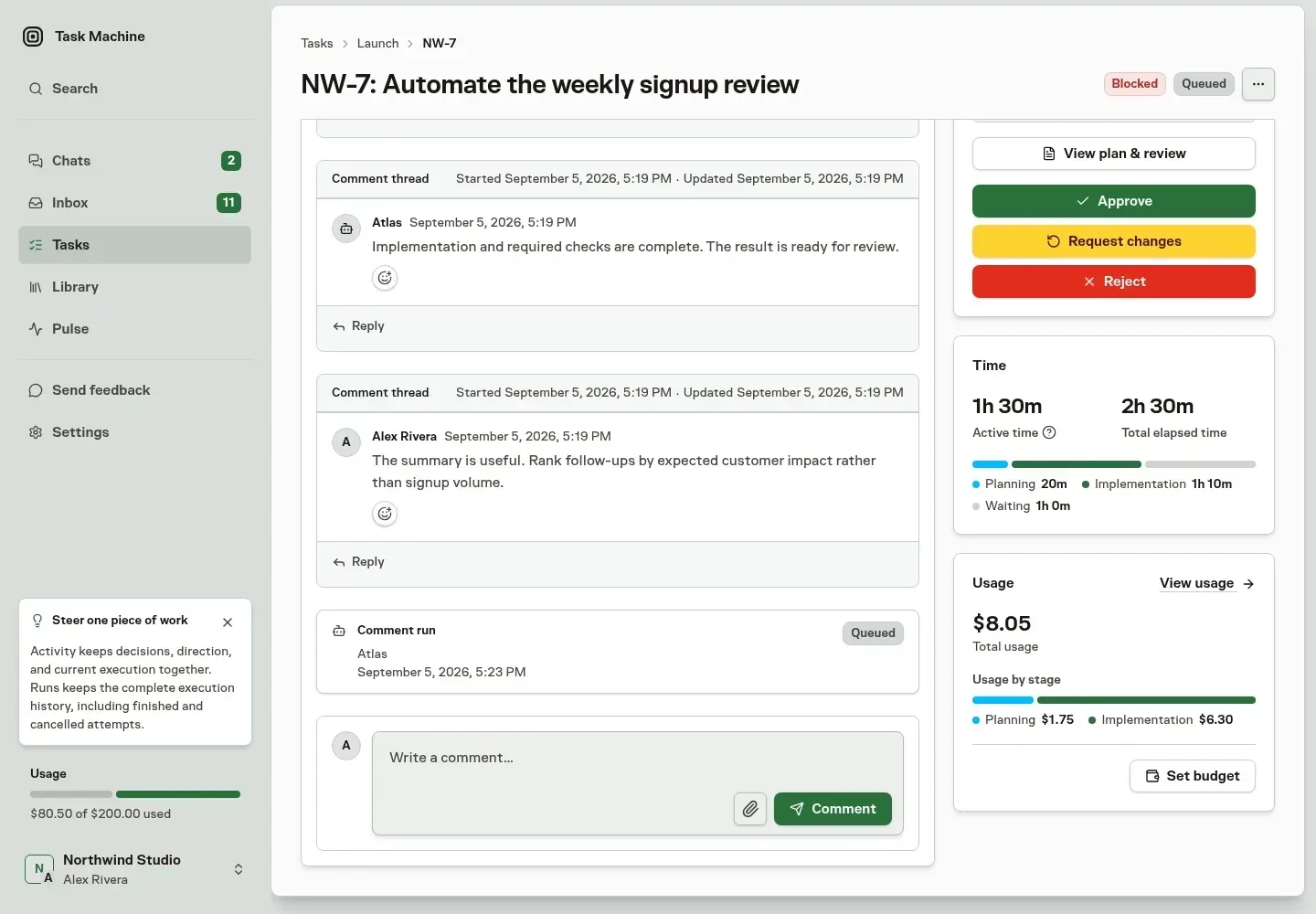
The task detail shows the outlier's time and stage spend before the founder decides whether to fund more work.
3. Budget one correction cycle before delegation
Implementation accounted for 43.0% of recorded cost. Rework accounted for 40.5%. Rework means the agent continued after review requested a change, including necessary fixes from human review and avoidable corrections caused by missing context.
Recorded cost by execution stage
Share of recorded task cost
100%
Before execution, a task should answer four questions:
- What outcome should exist? Name the artifact, behavior, or decision.
- What must remain unchanged? Protect product behavior, data boundaries, tone, or existing workflows.
- What proves the result is acceptable? Name the checks, screenshots, source links, or review criteria.
- Which decisions require human approval? Identify unresolved choices, external actions, spend, or access changes.
This short brief moves avoidable discovery out of the expensive implementation loop while preserving corrections that improve the result. Task Machine records the brief as a Work Spec during the agent loop, so clarifications and required checks remain with the current task.
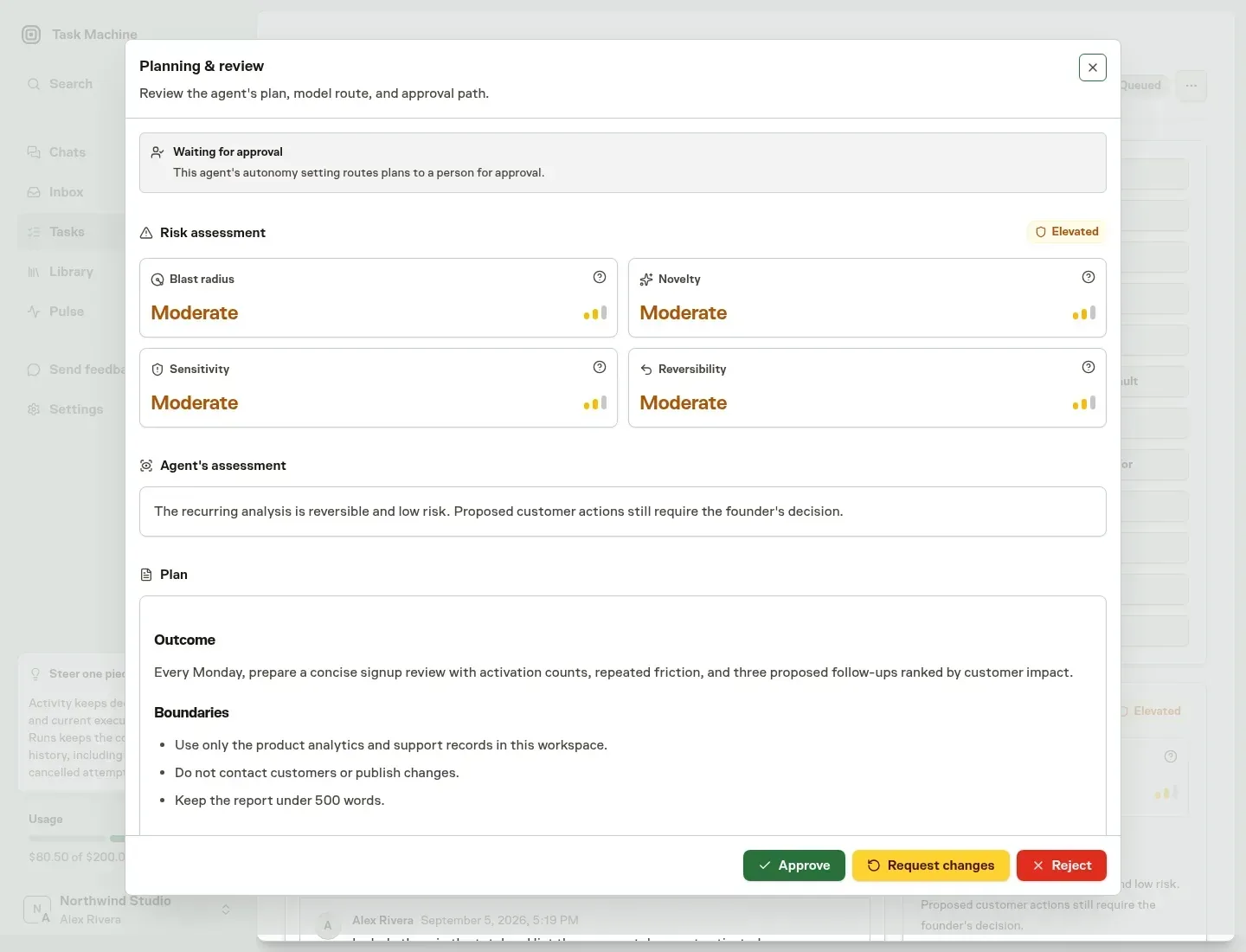
The review surface shows the task's risk and decision boundary before the founder approves the Work Spec.
4. Process agent decisions at fixed times
The platform recorded 237 agent questions and 395 approval decisions during the 30-day window. More parallel work can create more decision traffic than one founder can process.
Agent questions
237
Approval decisions
395
A founder can protect focused work with a simple routine:
- Check the decision queue once before the main work block and once near the end of the day.
- Answer questions that block customer delivery or revenue first.
- Batch low-risk approvals that already include the required context and proof.
- Return vague requests for clarification without reconstructing the task yourself.
- Send repeated failed checks or unanswered questions to the task owner before retrying.
Urgent customer work may justify an immediate interruption. Routine agent progress does not. The Inbox collects questions and approvals with their decision context, which lets a founder process them on a deliberate schedule.
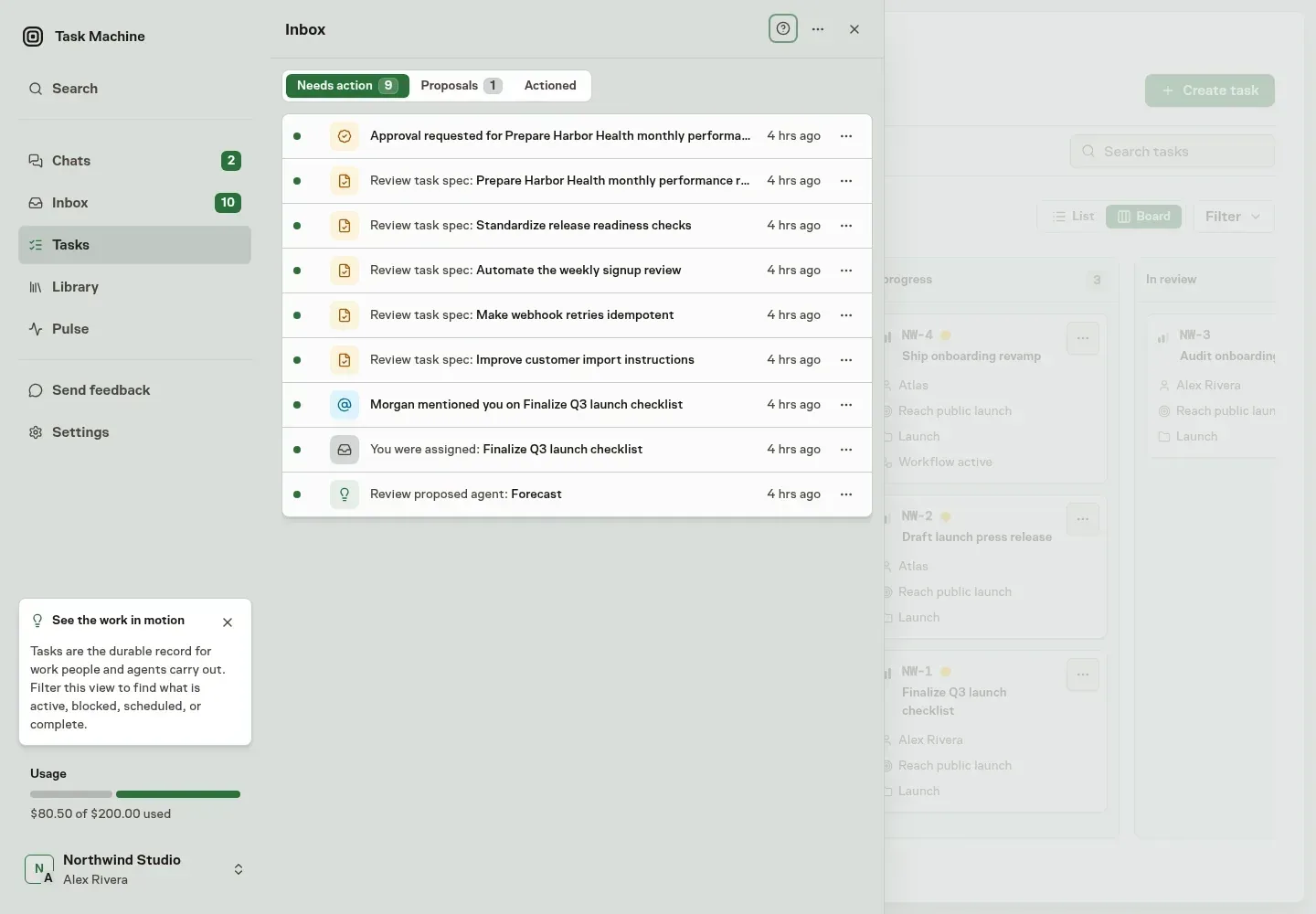
The Inbox turns scattered agent interruptions into one queue of decisions that can be processed at fixed times.
5. Choose tasks by repeat value
A high first-run cost can make sense when the task creates reusable instructions, checks, documents, or operating rules. The same spend is harder to justify for a one-off artifact with unclear acceptance criteria.
Rank candidate work by repeat value:
- High repeat value: release preparation, weekly analytics review, content refresh checks, dependency maintenance, and customer-feedback triage.
- Medium repeat value: a product feature with reusable tests, a launch package, or research that updates an existing decision.
- Low repeat value: an isolated artifact with unclear acceptance criteria and no future workflow.
Chat works well while the founder is still deciding what should happen. A script works well when every transformation is deterministic. An agent task fits work with a defined outcome, judgment during execution, and history that improves the next run.
A playbook packages the agents, workflow, instructions, and schedule behind recurring work so each run starts from the improved operating method.
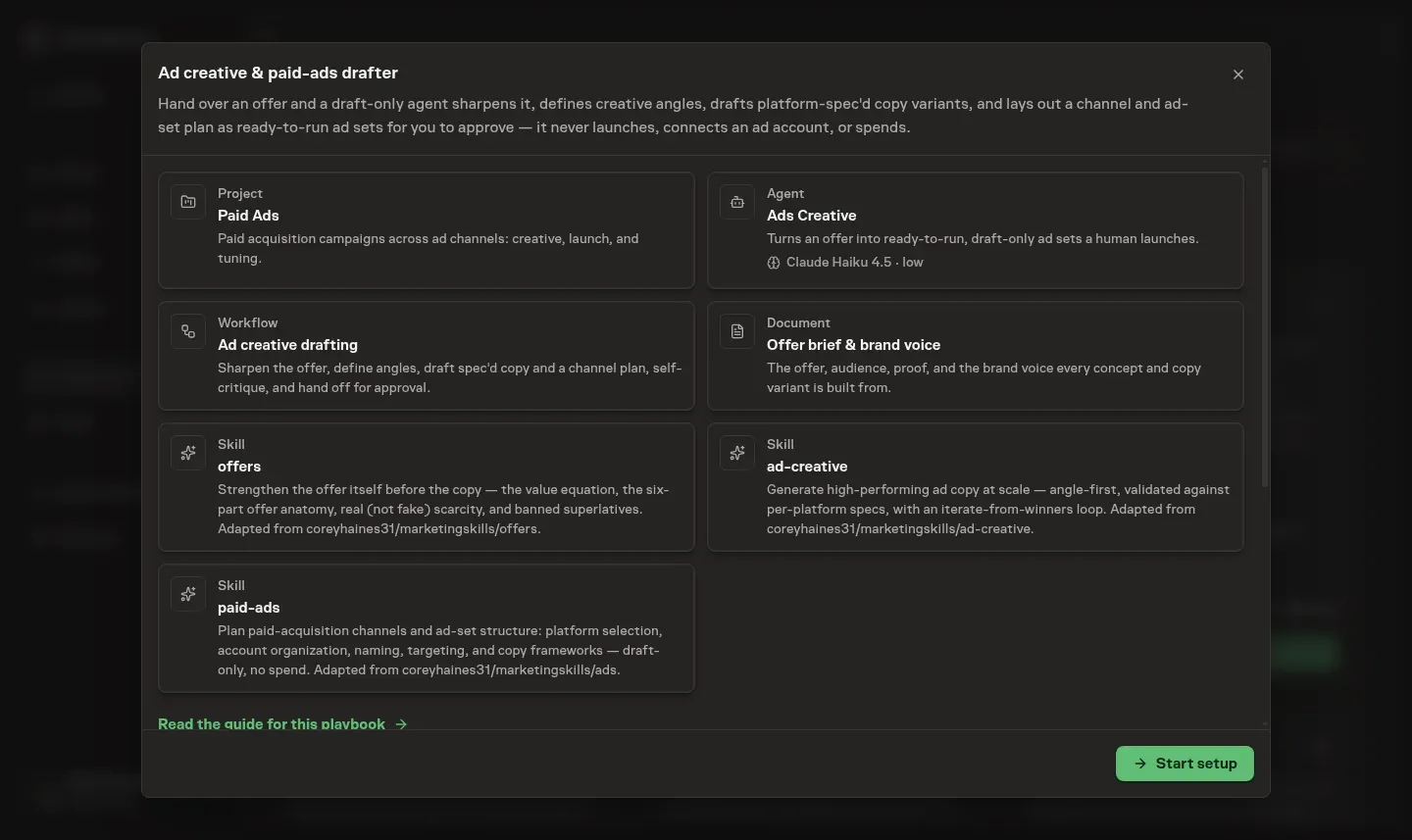
The playbook preview exposes the complete recurring method before it is installed in a workspace.
6. Track spend and completed outcomes separately
The dataset contained 533 cost-bearing tasks and 68 completions. Subtracting those numbers would create a false failure count. Some tasks remained active or open across the reporting boundary, and some accumulated work before reaching their final state.
A solo dashboard should track:
- tasks that received execution,
- tasks that reached done,
- total and average recorded cost,
- costly tasks still open,
- unanswered questions,
- pending approvals.
Each measure prompts a different action. High cost with low completion can point to broad work or long-running tasks near completion. Pending approvals can explain stalled work without indicating an agent failure.
The Work Timeline places completed runs on one time axis, making delivered outcomes and still-open work easier to review separately.
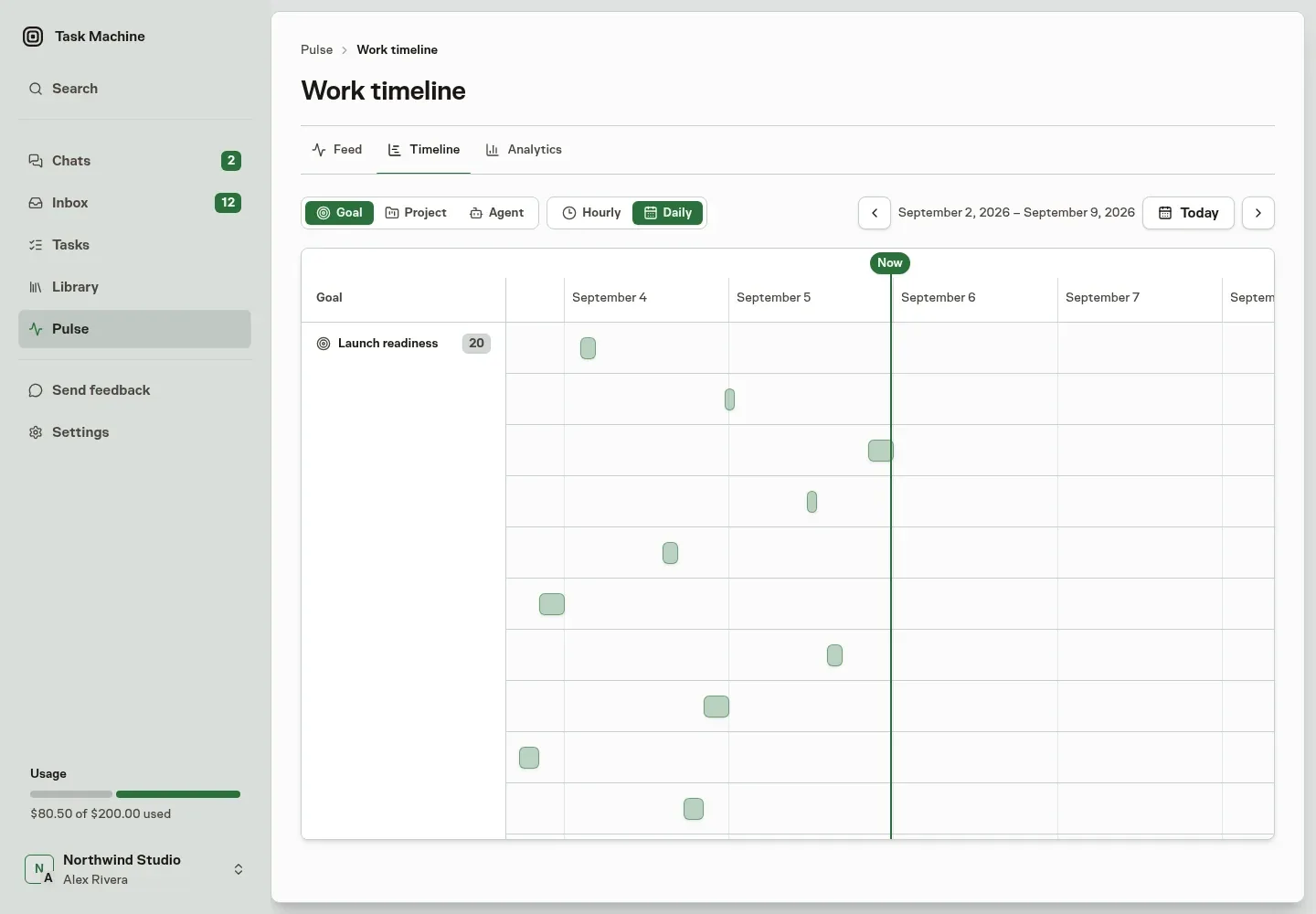
Twenty launch-readiness tasks make the pattern of completed execution visible before the founder decides what to fund next.
For the next month, choose one recurring workflow, set its model and budget, reserve founder attention, and review its first three outcomes. Use Task Machine Pulse as a public baseline while your own history develops.