Observability
Budgets
On this page
Repeated work is where cost and effort accumulate. Budgets track recorded usage and can prevent new agent work from starting once an applicable limit is exhausted. They do not interrupt work already running or guarantee that its final usage stays below the limit.
Standard retries bound repeated attempts, while Workflow approvals and verifier checks keep the process under review.
A budget tracks usage within a scope
A budget attaches limits to a part of your work. Its scope identifies the usage measured against those limits. Task-based checks cover workspace, project, goal, task, agent, and workflow budgets. Team budgets track team usage but do not currently block new runs.
- Workspace tracks the whole operating context.
- Project tracks one project's work.
- Goal tracks work pursuing one goal.
- Task tracks a single piece of work.
- Agent tracks one agent's work.
- Workflow tracks a repeating process.
- Team tracks work by the team's members.
A budget carries a monetary limit and currency, and a status. Budgets limit spending only. Token usage is reported in usage analytics but never limited. Its period can be daily, weekly, monthly, quarterly, yearly, or one-time.
Scopes overlap by design: a tight per-agent limit can sit inside a looser project budget, so you can control one part without restating the whole. Budgets are separate from billing. Setting a budget does not purchase usage or change your subscription.
Each budget lives on what it covers. Set a goal's, project's, workflow's, Team's, or Agent's budget on its Budget tab, which shows this period's spend against the limit and the top spenders by stage, Agent, Project, and more. Set a Task's budget from its actions menu. To see every budget at once, open Settings, then Billing & usage, and choose the Budgets tab. It separates Active and Archived budgets, showing each budget's scope, period, limit, and recorded spend, and each scope links to the page where its budget is set. Workspace managers also choose the Default currency new budgets start with there.
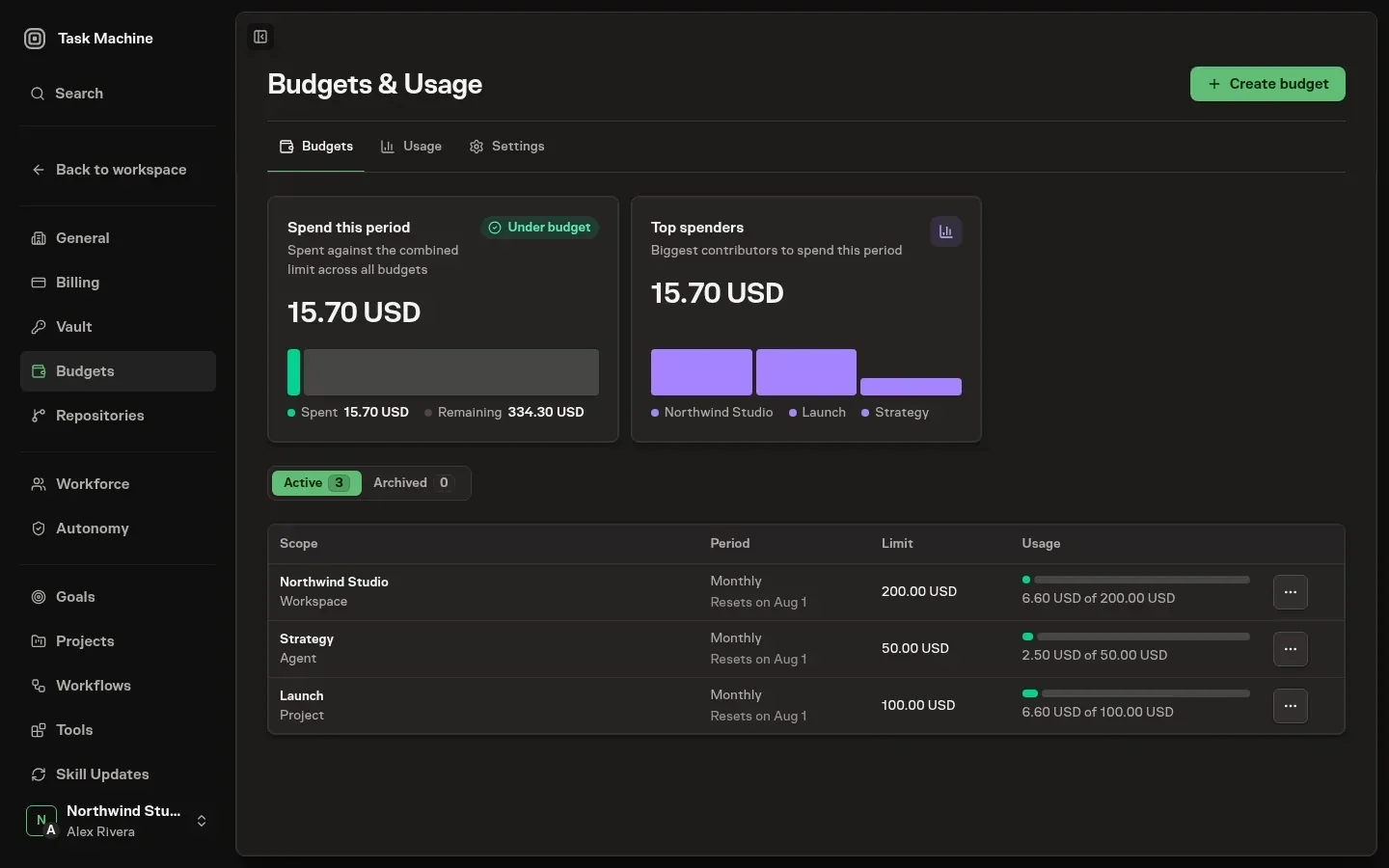
From the overview you create the workspace budget, edit any budget's limits and period, and archive a budget you no longer want tracked or restore one you do, all live across sessions. Creating, editing, and archiving require the budget-manage permission.
The page stays viewable to anyone with read access and hides the controls from members who only watch.
Exhausted budgets prevent new starts
Task Machine compares recorded usage with each budget's limits for the current period. Spend is normalized to a single base currency and then converted into the budget's own currency, so a budget set in euros and work paid for in dollars can be compared.
The Budgets tab shows that spend next to each limit and marks budgets near or over their limits.
As usage approaches or reaches a limit, a notice lands in the inbox for members who can manage budgets, with one warning per threshold in each period rather than a stream. Before starting task-based agent work, Task Machine checks the active budgets covering its task, project, goal, agent, workflow, and workspace.
If recorded spending has reached an applicable limit, new work is refused. Work already running can continue and may take usage beyond that limit.
Agents can propose operating limits
An agent can read its applicable budgets before attempting expensive work.
From its worker an agent sees the budgets that govern its work, each with how much of the limit is already spent and whether it is near or over, so a careful agent checks its remaining room before starting expensive work rather than discovering the ceiling by being stopped at it.
An Agent can propose a new operational budget, changes to an existing budget's spending cap, currency, period, or subscription-usage setting, and restoration of an archived budget. Creation, update, and restoration each follow their own configured and learned autonomy rule, including sampled reviews. Pending proposals leave accepted budgets unchanged.
When review is required, the complete scope, accepted-to-proposed values, rationale, and resolution actions are available in Inbox for budget managers. Automatic application uses the same validation and stale-state safeguards. If the budget changed after the Agent inspected it, the update cannot overwrite that newer state.
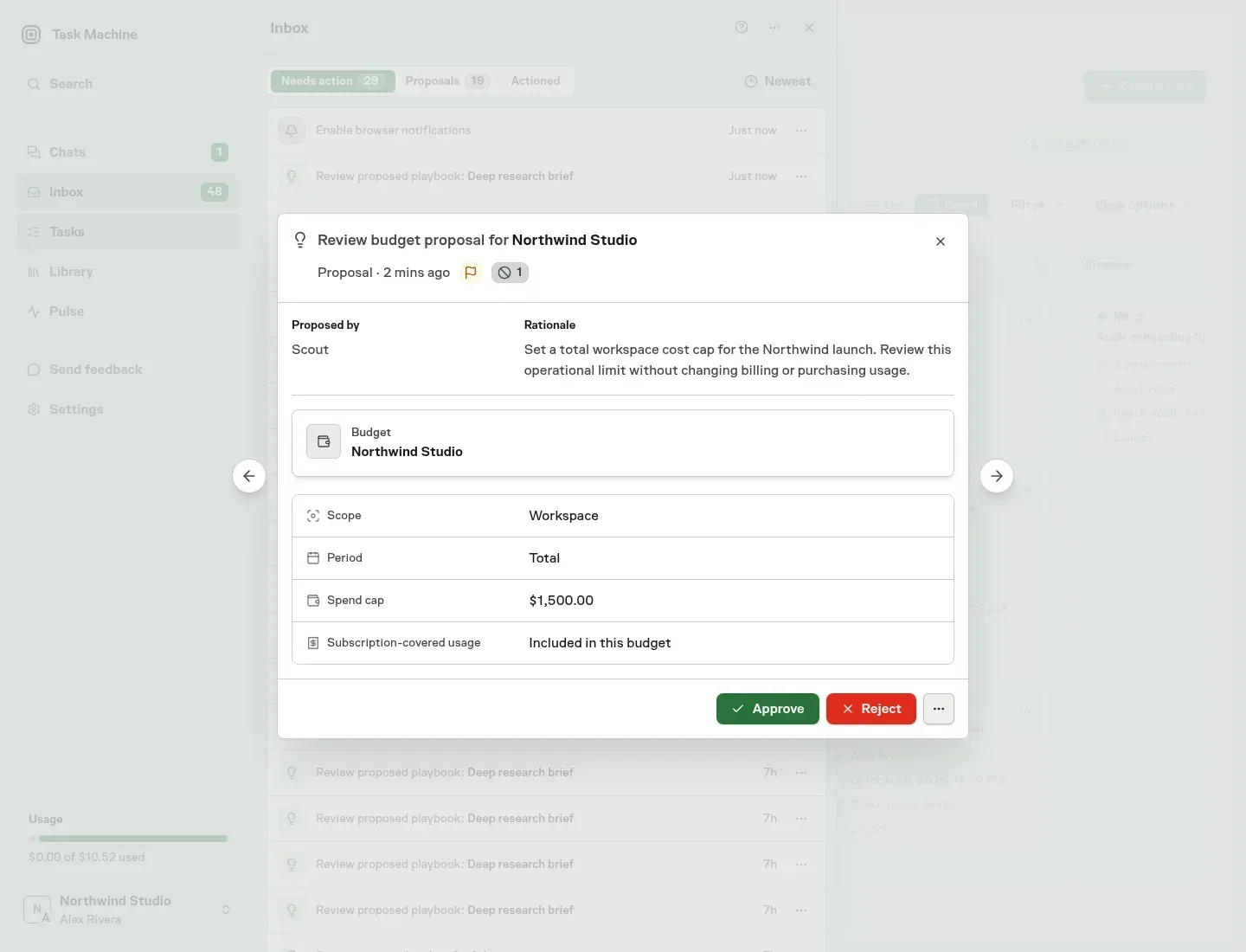
When an Agent needs more room, it can request a budget increase, naming the budget, a higher limit, and its reason. The same budget-update autonomy rule decides whether it applies or waits for review. A pending increase leaves the limit unchanged.
The budget's scope determines which Agent may request an increase:
- Goal or Team: the request must come from its lead.
- Workspace, Project, Task, Agent, or Workflow: an Agent working in that scope may ask.
Connected MCP tools may submit operational budget proposals and increase requests, but always wait for a Human budget manager's decision. They cannot approve their own changes or purchase usage. Budget proposals never change a subscription or bypass the limits on new work.
See where spend is going
Open Analytics in Pulse to see where recorded Task cost and effort went. It shows spend, a daily or weekly cost trend, token totals when recorded, and active time, and every view follows the filters you set.
You can break down spend by agent, project, goal, task, worker, execution stage, or model. The stages separate planning, implementation, review, code review, verification, rework, discussion, recheck and follow-up while preserving historical attribution. Every attributed model stays separate so you can tell exactly what is driving the bill.
A period control narrows the window from this month down to a single day, or widens it out to all time.

Task, goal, project, and workflow detail pages show their own usage as one monetary total across local and Cloud agent runs. Task usage keeps its execution-stage breakdown, while Chat shows one Chat category. Neither card exposes providers, models, tokens, execution sources, or internal correction details.
When a budget covers the scope, the card also shows its status and next reset. To set or edit that budget, open the resource's Budget tab.
Standard retries cap repeated attempts
Standard retries bound repeated Workflow attempts. The recovery depends on what happened:
- Worker failure or timeout: up to three retries, with increasing delays beginning at five seconds.
- Missing required document: one rework attempt with feedback before the Run fails.
- Verifier
FAIL: two rework attempts by default, followed by a pause for Human review if they are exhausted. - Verifier
UNCERTAIN: an immediate pause for Human review. - Verifier
PASS: the Run continues. - Constitution violation or malformed verifier response: the Run fails rather than following the ordinary
FAILretry path.
The builder does not expose general per-step attempt and delay controls.
Read the retry record before restarting
A workflow run records retries, verifier decisions, and the reason work failed or paused. Use that history to decide whether to correct the instructions, resolve a blocker, or retry.
Budgets and retries cover different boundaries. Applicable exhausted budgets prevent new starts based on recorded usage, while retry counts limit repeated attempts. Neither replaces the approvals and checks you choose for consequential work.
Money versus operating limits
A budget controls work against recorded cost or token usage. It does not fund the Workspace. Billing and usage explains the available allowance and charges. A Run that fails can still have consumed paid resources.
Team budgets support usage reporting and increase requests. The ordinary Task execution check applies Workspace, Project, Goal, Task, Agent, and Workflow budgets. Do not rely on a Team budget as an equivalent hard execution gate. Use an applicable enforced scope when new Agent work must pause at its recorded limit.
Choose a review boundary and leave room for reasonable recovery. Budget checks do not guarantee that every in-flight or externally billed operation stops at an exact monetary amount.