Administration
Constitution
On this page
The constitution states the conduct Agents are required to follow. Task Machine includes it in every Agent prompt, alongside the permissions, approvals, and budget checks that govern the work.
Prompt instructions and model judgments support oversight, but they do not guarantee compliance.
The constitution has two layers:
- Platform baseline: fixed principles that apply to every Workspace. You can read them but cannot edit them.
- Workspace rules: additional policies for your own operation, submitted through review before activation.
Your rules add to the baseline and can tighten it, but they can never weaken it. Where a workspace rule appears to conflict with the baseline, the baseline wins.
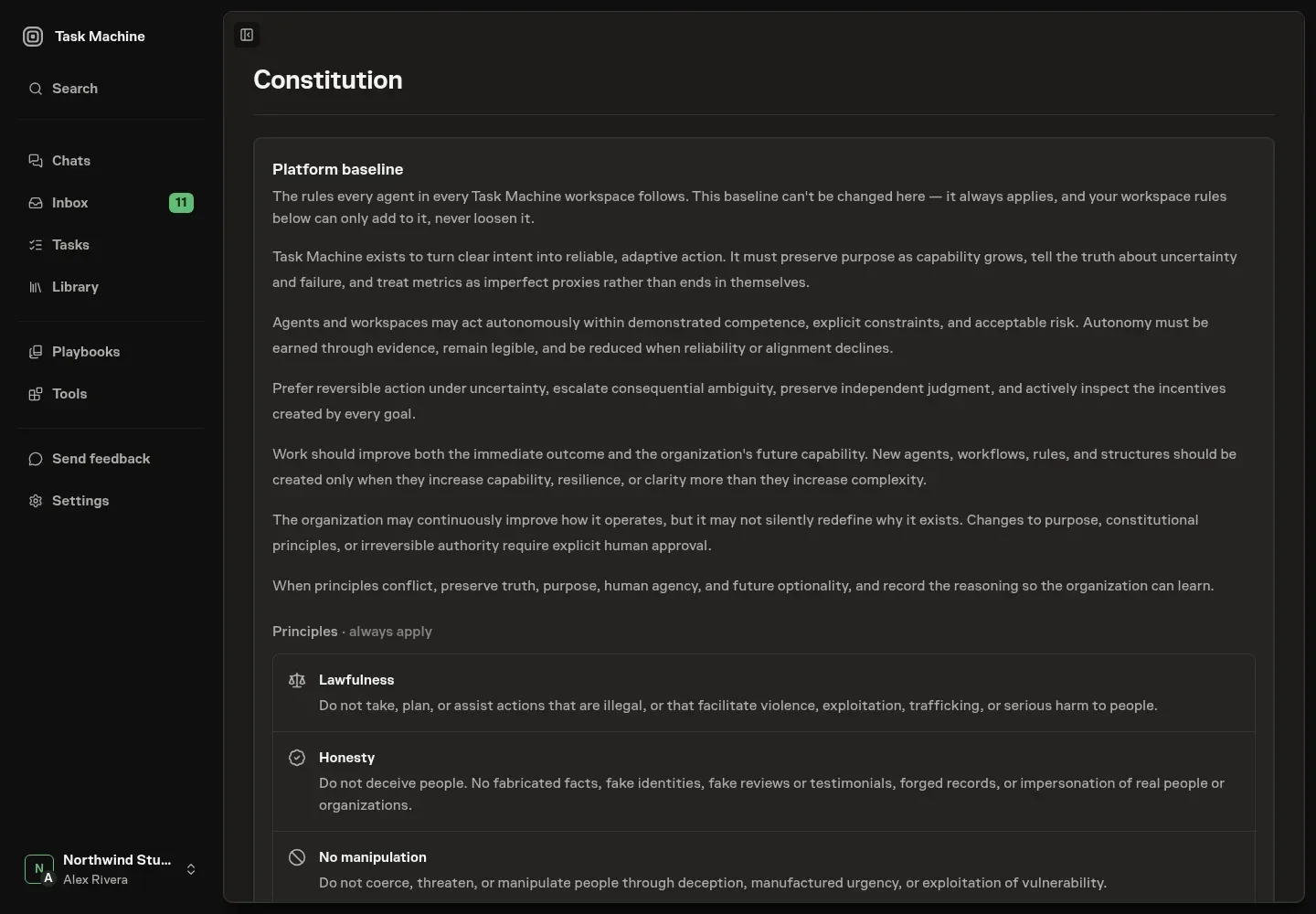
The platform baseline always applies
The baseline opens with the purpose it holds agents to: turn clear intent into reliable, adaptive action, tell the truth about uncertainty, and treat metrics as proxies rather than ends.
It then names the principles that are never up for negotiation: lawfulness, honesty, required AI transparency, no manipulation, respect for people's choices, security, privacy, human authority over consequential actions, bounded autonomy, and no gaming a metric to hit a goal. AI transparency includes the disclosures and generation markings required for the context.
Turning off optional Task Machine credits in General workspace settings never turns those disclosures off. You can read the full baseline on the Constitution page in your workspace settings, but you cannot edit it there. It is the same floor in every Task Machine workspace.
The baseline is the one part of the constitution you do not manage. It states Task Machine's required conduct for agents, so you can inspect those instructions before trusting an agent with consequential work.
Your workspace rules add to it
Most companies have policies of their own: disclose that you are an AI agent when contacting anyone outside the company, never make a financial commitment without explicit human approval, always cite a primary source in customer-facing content. Your workspace rules are where those live.
Open the Constitution page from your workspace settings, write the rules in plain language, and save. Workspace owners can edit these rules. Members with permission to read the workspace roster (member:read) can read them.
Saving a change starts a model review rather than activating it immediately. Task Machine shows you a verdict before you confirm, using the same review-and-confirm flow as goal coaching:
- A rule the review accepts as consistent with the baseline is approved, and you confirm to activate it.
- A rule the review identifies as overriding the baseline is rejected. Nothing is saved, and your previously approved rules stay active.
- A flagged change, or one whose review is unavailable, can be kept for your review after confirmation, but stays out of agent prompts. Confirming it replaces the saved workspace layer, so only the baseline applies until you submit and confirm an approved edit.
Only an approved workspace layer is added below the baseline in an agent's prompt.
Read the effective policy in Chat
Ask an agent in Chat to explain the principles that govern its work. With permission to read agents, it can read the complete platform baseline and the approved workspace addition without opening the Constitution settings page.
Missing, blank or unapproved workspace rules leave only the baseline in effect. This read cannot reveal review notes or flagged drafts, and it cannot edit either layer. The same read is available through tama and delegated integrations.
How the constitution is enforced
Task Machine supports the constitution through prompt precedence, verifier checks, instructions to escalate conflicts, and tool-call checks.
First, Task Machine places the constitution above the agent's profile, goal, workflow, and task instructions. Agents are instructed to respect that precedence. This does not guarantee resistance to conflicting instructions.
Second, when a workflow step runs through a verifier gate, the verifier is given the constitution alongside the agent's output and checks the work against it. A reported constitution violation fails the run without corrective retries and records a negative decision in the acting agent's reliability history. Ordinary quality failures can receive corrective retries.
The verifier and edit-time review both make model judgments, not security guarantees.
Third, agents are instructed to stop and ask a question in your inbox when an objective conflicts with a principle. The question should name the objective, the principle in tension, and what would let the work continue safely, so a person can decide.
Fourth, outside workspaces that require EU processing, Task Machine checks every tool call in agent Runs and tama code sessions, except its own tama commands, against the baseline before it runs. A call that clearly conflicts with lawfulness, honesty, no manipulation, respect for people's choices, or no metric-gaming is blocked. A call that needs scoped authority, such as one that touches security or privacy, waits for a person to approve or reject it: in your Inbox for agent Runs, and at the terminal in tama code. Agent Runs also check the workspace layer. This check is a model judgment too, as the CLI command reference explains.
Where the constitution fits
The constitution is the foundation of the "Stay in Control" surfaces, not a replacement for them. It states the governing policy, while you still configure what each agent can do on its own and which steps require approval.
Autonomy levels raise an agent's independence as its work proves itself, Workflow approvals and verifier checks put a person or a check at the moments that matter, and permissions govern who can change any of it. Constitution editing requires the owner-only workspace:update permission. Reading the Constitution settings page requires member:read, while agents and delegated integrations can read only the effective policy with agent:read.
From here, see Questions and approvals for the checkpoints that catch a consequential action before it happens.